World’s climate scientists to issue stark warning over global heating threat

Fiona Harvey

IPCC’s landmark report will be most comprehensive assessment yet as governments prepare for pivotal UN talks in November
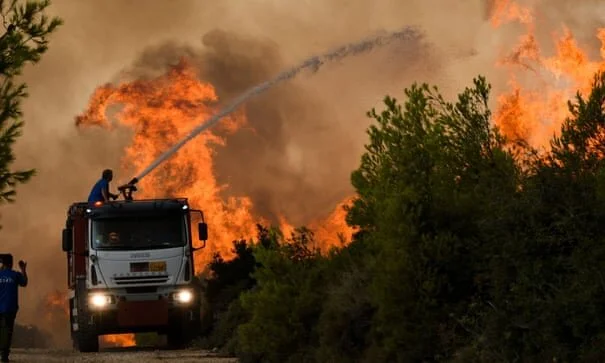
Emergency services try to extinguish a wildfire last week in northern Athens, Greece. Photograph: Eurokinissi/Rex/Shutterstock

Emergency services try to extinguish a wildfire last week in northern Athens, Greece. Photograph: Eurokinissi/Rex/Shutterstock

The fires, floods and extreme weather seen around the world in recent months are just a foretaste of what can be expected if global heating takes hold, scientists say, as the world’s leading authority on climate change prepares to warn of an imminent and dire risk to the global climate system.

The Intergovernmental Panel on Climate Change (IPCC) will on Monday publish a landmark report, the most comprehensive assessment yet, less than three months before vital UN talks that will determine the future course of life on Earth.

Policymakers have already previewed the findings, finalised on Saturday night, which have been the subject of an intense two weeks of online discussion by experts around the world, and represent eight years of work by leading scientists.

Doug Parr, policy director at Greenpeace UK, said governments must take heed of the warnings. “Practical, funded and deliverable plans [by governments] to keep us below the supposedly safe limits [of heating] are almost non-existent. Urgent climate action was needed decades ago – now we’re almost out of time. The UK government has a huge responsibility as host of the UN climate talks to ensure world leaders sign up to policies that not just put the brakes on the climate crisis, but slam it into reverse.”
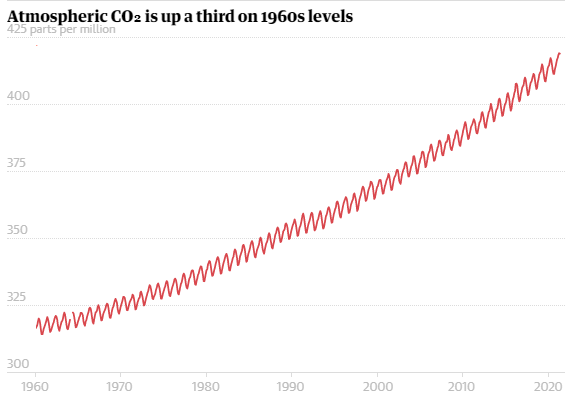
Guardian graphic | Source: Scripps Institution of Oceanography, NOAA

Guardian graphic | Source: Scripps Institution of Oceanography, NOAA

The IPCC, made up of hundreds of the world’s foremost climate scientists, publishes comprehensive assessments about every seven years, with this report the sixth since 1988. This one will be different, however: previous work has shown that the 2020s are a crucial decade, in which greenhouse gas emissions must be halved in order to limit heating to 1.5C above pre-industrial levels, established by previous IPCC reports as the threshold of safety, and the lower of two goals in the 2015 Paris agreement.

Michael Mann, distinguished professor of atmospheric science at Pennsylvania State University, said this would be the last IPCC assessment that can make a real difference in policy terms, before we exceed 1.5C and the ambitions of the Paris agreement.

“Climate change is now causing amplified weather extremes of the sort we’ve been witnessing this summer – droughts, heatwaves, wildfires, floods, superstorms,” he said. “The impacts of climate change are no longer subtle. We see them playing out in real time in the form of these unprecedented extreme weather disasters.”

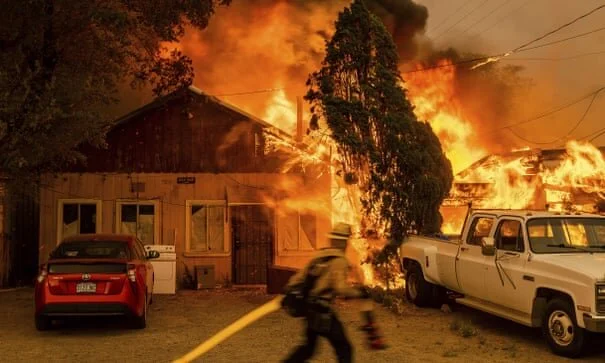
In recent months there have been fires in the US, heatwaves in northern latitudes, and devastating floods in China and Europe. Scientists warn that this may become the norm unless climate breakdown can be stopped.
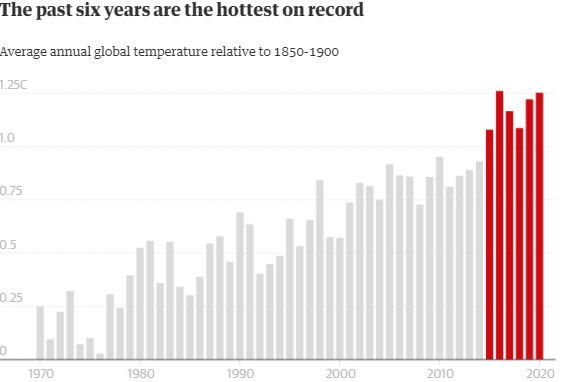
Guardian graphic. Source: ERA5 / Copernicus Climate Change Service

Guardian graphic. Source: ERA5 / Copernicus Climate Change Service

Simon Lewis, professor of global change science at University College London, said: “The observations this summer show that some impacts [predicted in previous IPCC assessments of the climate] seem to be underestimated, but we can’t know if the devastation of summer 2021 is the new normal without a few more years’ data. But what we do know is if emissions continue to rise, then increasingly severe climate impacts will occur.”

He warned that the consequences would be severe. “What we need to keep in mind is that we all live in places that have built up over decades and centuries to cope well with a given climate. The really, really scary thing about the climate crisis is that every single achievement of every human society on Earth occurred under a climate that no longer exists,” he said. “The pressure is on for world leaders to agree both detailed and achievable plans to cut emissions now, and plans to adapt to climate impacts, when they meet in Glasgow in November.”

This year’s weather observations are not included in the IPCC report, which draws on science published in peer-review journals before this year, and since its last comprehensive report in 2013. Mann said: “This is also a limitation. The IPCC reports always seem to be playing catch-up with what we’re witnessing on the ground. Our own work suggests that the models upon which [most IPCC projections] are made still aren’t quite capturing some of the mechanisms that are important here.”

Extreme weather this year has also shown how vital it is that countries and communities around the world take steps to cope with the impacts, said Richard Betts, professor of climate impacts at Exeter University, and head of climate impacts research at the Met Office. “We now need to live with the consequences of what we have already done to the climate. We are hopelessly unprepared to deal with increasingly severe extreme weather events, even though these have been predicted by science for decades.”

Alongside this effort, we should be cutting emissions much faster, he added. “We need to take urgent action on reducing emissions if we want to stop this getting much worse,” said Betts. “The longer it takes to bring this increase [in the buildup of CO2 in the atmosphere], the greater the severity of climate change we will be stuck with.”
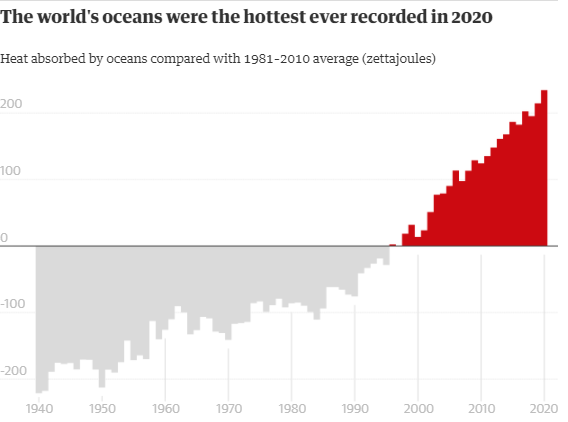
Guardian graphic. Source: Cheng et al, Advances in Atmospheric Sciences 2020

Guardian graphic. Source: Cheng et al, Advances in Atmospheric Sciences 2020

Alok Sharma, the UK minister who will preside over the UN’s Cop26 climate talks, to be held in Glasgow this November, said on Saturday: “This is going to be the starkest warning yet that human behaviour is alarmingly accelerating global warming and this is why Cop26 has to be the moment we get this right. We can’t afford to wait two years, five years, 10 years – this is the moment. [The consequences of failure would be] catastrophic – I don’t think there’s any other word for it.”

Rachel Kennerley, international climate campaigner at Friends of the Earth, said: “The world’s climate scientists are set to issue a stark warning that cannot be ignored. The international community must rapidly deliver the speed and scale of the action required to avoid catastrophic climate change. It’s time to end our reliance on dirty gas, coal and oil, and invest in green jobs and building the zero-carbon future we so urgently need.”

THE GREEN ROOM (Episode 14): Jo-Anne McArthur on Bringing Visibility to Hidden Animals Worldwide

GREEN ROOM: LIVE WEBINAR


Summary of the Discussion

Jo-Anne McArthur a Photojournalist that focuses on animal rights emphasizes the need for the human race to notice the existence of animals and the cruelty that the animal face. She mentioned that animals are sentient beings and should be treated with respect. She shared some of her work which exposes some conditions that animals have to face which is against their rights.


LISTEN TO PODCAST

Audio Block
Double-click here to upload or link to a .mp3. Learn more

ABOUT THE SPEAKER

Jo-Anne McArthur is an award-winning photographer, author, and sought-after speaker.

Jo-Anne McArthur is an award-winning photographer, author, and sought-after speaker.

Read full bio

ABOUT THE MODERATOR

Dr. Jason J. McSparren is an educator, researcher, and administrator with a PhD. in Global Governance and Human Security from Massachusetts Boston.

Dr. Jason J. McSparren is an educator, researcher, and administrator with a PhD. in Global Governance and Human Security from Massachusetts Boston.

read full bio

Q&A

Jason McSparren: Our friends in the audience please welcome Jo-Anne McArthur to the Green Room today. Hello Joanne


Jo-Anne McArthur: Hello thanks so much for inviting me.


Jason McSparren: Glad to have you Joanne. Can you see the screen? Okay.  Do you see the photos?


Jo-Anne McArthur: I can see your Power point. Yes


Jason McSparren: Okay very well, so like we could take a quick look at some of your photos just to give our audience an idea of some of the images that you might seein this latest book hidden animals in the anthropocene and it's an interesting cover.


Jo-Anne McArthur: I will say that all of the work you'll see in this Power point is mine, except for those which are captioned otherwise, this book hidden is my first foray into editing for a large photographic book so this isactually the work of 40 photojournalists globally. I knew I wanted to really be all encompassing with the subject matter and that I couldn't cover that alone with the work that I had done, so we see here images from Celine Magnolia, Aitor Garmendia This image is not mine, what we're seeing here are cultural events like this one here unusual and odd and horrific an incredible capture by Aitor Garmendia who's one of the leading animal photojournalists in the world right now. He's quite relentless in his work and you can skip back to the image of the pig in the garbage also a really highly unusual situation for us to see pigs end up in dumps all the time but this is out of sight and out of mind and what I mean by the ‘hidden animals’ which is the topic of the book, is that animals especially those who are farmed for food are raised by the billions and yet we only ever interact with them on our plate or the fur bearing animals we interact with them when we wear them and yet they are kept by the billions every single day and so we wanted to illuminate their lives so that we can make better decisions think a little bit more critically have important discussions because a lot of us care about animals but we care about the animals who are more familiar to us. Wildlife, companion animals and yet there are others who are as equally sentient and yet we fail to see and we mistreat horribly. An example is here, you've landed on this image of a turtle being filleted which is a word you used. I had not thought of that word for this image but that's exactly what's happening.The turtle is alive and these things just you need to be seen by us


Jason McSparren: Can I ask you a question please?


Jo-Anne McArthur: Please


Jason McSparren: Could you expound a little bit on the idea of animals being sentient beings. Just to kind of give us a little bit of context for some people in our audience who may not actually understand what you're talking about or might need a little bit more background on that idea


Jo-Anne McArthur: Yeah all animals are feeling animals, they are complex and we aren't taught that they are complex, we are taught that they have complex emotional lives or that they make complex decisions and because they have these qualities, it means that they can experience complex emotions like joy and fear and sorrow and anxiety and jealousy. Some of these emotions I suppose are not complex but they do get complex and any of us who live with a cat or a dog or an animal know that they experience the world in us, all sorts of ways just as we do but so do the animals we eat now the pigs and the chickens and the turkeys and the cows and so because they can experience life as we do in many ways they can experience joy and suffering and fear. I think that needs to be known and it was really exciting is that ethology, the study of animal behavior is really growing and so you don't just have to take my word or the word of a dog owner that animals have feeling. We know this because they've been studied and we see incredible behaviors in fish, in insects, in chickens, and it's pretty exciting and so the more we know about how animals feel and think the more it becomes difficult for us to just or at least in theory should be more difficult for us to just put them away in cages that they can't turn around. In horrific fur farms where they're crammed into cages for our benefit especially when we don't need to do this, we don't need to keep animals in these conditions for our survival.


Jason McSparren: Great and that actually prompts another question, again just why is it important to make these animals visible, you mentioned these hidden animals with whom humans have such a close relationship and yet humans fail to see these animals.You mention the animals that we eat, the animals that we wear, we use for research, sometimes we put these animals to work,we view them as entertainment as we can see on the screen right now and also the animals that we sacrifice in the name of tradition and religion and you started to talk about that already, but I'd like if you can just elaborate on that a little bit more why is it important for the general public to see these animals.


Jo-Anne McArthur: Well as the old saying goes, I guess seeing is believing and sometimes we have to see something to become aware of it. It's really that simple and that is the job of photojournalists, photographers and not just animal photojournalists like myself but conflict photographers for example, they are going out into the field to document wars, the things that we do to one another,we need to take what's going on in the world and bring that home and literally bring that into our homes where we're sitting right now, so that we can learn something new and as we know that should and often does lead to conversations and caring and change. Photographers create proof and that's what we're doing here with hidden, this is proof of what is, what needs to be seen and in most of these cases probably all of these cases what should not be. These images don't sugarcoat how we treat animals, it's a five-pound tome of a book and it is modeled after other books of war photography, about how we treat others and long ago I was inspired by war photographers to do something similar for animals. I felt that other animals, non-human animals deserved the visibility that we attempt to give to other suffering people, other suffering animals I guess.


Jason McSparren: Sure, no I totally agree. It's really one of those things as you say you know they're unseen. right, but we interact with animals constantly. In the real life the whole idea of the unseen, we talk about industrial farming etc, even we're seeing in some of these images it's not necessarily even industrial farming. It's small community farming, it's just subsistence living in some cases but the way that we interact with these animals, the way that we may take their lives prior to eating them, etc, it seems to be a pretty brutal life for these animals and the more that people know it could change people's attitudes toward their diets, it could also possibly even improve the lives of the food animals, etc and also the animals that we see in entertainment and things along those lines. So at this point, I just like to mention that folks you can take a look at the Green Institute website for a lot of features and activities. It's https://greeninstitute.ng/. And one of the things that you might be able to find there is this really interesting book, the Principles of Green and Sustainable Science written by the Director of the Green Institute and Founder Adenike Akinsemolu. This book focuses on the Principles of Green and Sustainable Science using various case studies that it contributes to the literature in science, in the environmental fields by providing information on scientific aspects of sustainability. So the Principles of Green and Sustainability Science can be found at the greeninstitute.ng. And as we move on, Jo-Anne I'd like to ask you, many of our audience members are maybe aspiring photographers or maybe just college age people thinking about how they can contribute to the world or how they might be able to build a career. So I ask you what motivated you to pursue this subject matter for your artistic expression and professional focus


Jo-Anne McArthur: Well there certainly wasn't to be lying there. I'm just someone who was really interested in the world and also very interested in suffering and the causes of suffering and when I saw that there were these billions of animals that we just weren't thinking about I became really gripped by this, very curious and started turning my lens away from the other things I was photographing, street photography and humanitarian causes towards animals and sometimes I could just go down the street and photograph the animals coming to the slaughterhouse. Sometimes I traveled farther fields, sometimes I went to a local circus rodeo or zoo and something interesting about using this word hidden. Sometimes it's not just the animals that are literally hidden but their uses and their experiences are hidden to us so what I mean by that is, for example, in circuses and zoos the animals are in plain view they're not hidden at all but we aren't really seeing them. We're there for our enjoyment, our education, sometimes it's just you know a day out for something to do and yet while the animal is right in front of us we aren't really thinking about them, wearen't thinking about their experience, how they might feel about having to perform, how they might have felt about being broken in order to perform and so their lives even though right there in front of us remain hidden as well and that was actually the subject of my second book called captive which is a look atanimals in zoos and aquaria worldwide.


Jason McSparren: Yes I hope to have time to focus on that as well


Jo-Anne McArthur: Yes

DOWNLOAD FULL TRANSCRIPT

Favourite Quote

Well as the old saying goes, I guess seeing is believing and sometimes we have to see something to become aware of it.
— Jo-Anne McArthur

Top Comments

Thank you for showing us. It is an eye opener to cruety faced by the animals that we refused to be aware of- Anonymous


REGISTER FOR THE NEXT GREEN ROOM

Sink or swim: Can island states survive the climate crisis?

UN NEWS

Small island nations across the world are bearing the brunt of the climate crisis, and their problems have been accentuated by the COVID-19 pandemic, which has severely affected their economies, and their capacity to protect themselves from possible extinction. We take a look at some of the many challenges they face, and how they could be overcome.

Low emissions, but high exposure

UNDP/Michael Atwood I The aftermath of Hurricane Irma in Barbuda.

UNDP/Michael Atwood I The aftermath of Hurricane Irma in Barbuda.

The 38 member states and 22 associate members that the UN has designated as Small Island Developing States or SIDS are caught in a cruel paradox: they are collectively responsible for less than one per cent of global carbon emissions, but they are suffering severely from the effects of climate change, to the extent that they could become uninhabitable.

Although they have a small landmass, many of these countries are large ocean states, with marine resources and biodiversity that are highly exposed to the warming of the oceans. They are often vulnerable to increasingly extreme weather events, such as the devastating cyclones that have hit the Caribbean in recent years, and because of their limited resources, they find it hard to allocate funds to sustainable development programmes that could help them to cope better, for example, constructing more robust buildings that could withstand heavy storms.

The COVID-19 pandemic has worsened the economic situation of many island states, which are heavily dependent on tourism. The worldwide crisis has severely curtailed international travel, making it much harder for them to repay debts. “Their revenues have virtually evaporated with the end of tourism, due to lockdowns, trade impediments, the fall in commodity prices, and supply chain disruptions”, warned Munir Akram, the president of the UN Economic and Social Council in April. He added that their debts are “creating impossible financial problems for their ability to recover from the crisis.”

Most research indicates that low-lying atoll islands, predominantly in the Pacific Ocean such as the Marshall Islands and Kiribati, risk being submerged by the end of the century, but there are indications that some islands will become uninhabitable long before that happens: low-lying islands are likely to struggle with coastal erosion, reduced freshwater quality and availability due to saltwater inundation of freshwater aquifers. This means that small islands nations could find themselves in an almost unimaginable situation, in which they run out of fresh water long before they run out of land.

Furthermore, many islands are still protected by reefs, which play a key role in the fisheries industry and balanced diets. These reefs are projected to die off almost entirely unless we limit warming below 1.5 degrees celsius

DESA

DESA

SDG13: Urgent Action to Combat Climate Change

  • Sustainable Development Goal 13 calls for urgent action to combat climate change and its impacts.

  • Climate change continues to exacerbate the frequency and severity of natural disasters, including wildfires, droughts, hurricanes and floods.

Despite the huge drop in global economic activity during the COVID-19 pandemic, the amount of harmful greenhouse gases released into the atmosphere increased in 2002, and the past six years, 2015–2020, are likely to be the six warmest on record.

UNDP Maldives I Water shortages exacerbated by climate change are affecting the Maldives' low-lying islands.

UNDP Maldives I Water shortages exacerbated by climate change are affecting the Maldives' low-lying islands.

Climate finance (climate-specific financial support) continues to increase, reaching an annual average of $48.7 billion in 2017-2018. This represents an increase of 10% over the previous 2015–2016 period. While over half of all climate-specific financial support in the period 2017-2018 was targeted to mitigation actions, the share of adaptation support is growing, and is being prioritized by many countries. 

This is a cost-effective approach, because if not enough is invested in adaptation and mitigation measures, more resources will need to be spent on action and support to address loss and damage.

Switching to renewables

SIDS are dependent on imported petroleum to meet their energy demands. As well as creating pollution, shipping the fossil fuel to islands comes at a considerable cost. Recognizing these problems, some of these countries have been successful in efforts to shift to renewable energy sources.

UNDP/Pierre Michel Jean I Sustainable fishing is improving livelihoods in Haiti.

UNDP/Pierre Michel Jean I Sustainable fishing is improving livelihoods in Haiti.

For example, Tokelau, in the South Pacific, is meeting close to 100 percent of its energy needs through renewables, while Barbados, in the Caribbean, is committed to powering the country with 100 percent renewable energy sources and reaching zero carbon emissions by 2030.

Several SIDS have also set ambitious renewable energy targets: Samoa, the Cook Islands, Cabo Verde, Fiji, Saint Vincent and the Grenadines and Vanuatu are aiming to increase the share of renewables in their energy mixes, from 60 to 100 percent, whilst in 2018, Seychelles launched the world’s first sovereign blue bond, a pioneering financial instrument to support sustainable marine and fisheries projects.


The power of traditional knowledge

The age-old practices of indigenous communities, combined with the latest scientific innovations, are being increasingly seen as important ways to adapt to the changes brought about by the climate crisis, and mitigate its impact. 

UNDP/Stephane Belleros I Solar panels are maintained at a farm in Mauritius.

UNDP/Stephane Belleros I Solar panels are maintained at a farm in Mauritius.

In Papua New Guinea, local residents use locally-produced coconut oil as a cheaper, more sustainable alternative to diesel; seafaring vessels throughout the islands of Micronesia and Melanesia in the Pacific are using solar panels and batteries instead of internal combustion; mangrove forests are being restored on islands like Tonga and Vanuatu to address extreme weather as they protect communities against storm surges and sequester carbon; and in the Pacific, a foundation is building traditional Polynesian canoes, or vakas, serving as sustainable passenger and cargo transport for health services, education, disaster relief and research.

Strategies for survival

While SIDS have brought much needed attention to the plight of vulnerable nations, much remains to be done to support them in becoming more resilient, and adapting to a world of rising sea levels and extreme weather events.

On average, SIDS are more severely indebted than other developing countries, and the availability of “climate financing” (the money which needs to be spent on a whole range of activities which will contribute to slowing down climate change) is of key importance. 

UNDP/Yuichi Ishida I A woman harvests salt in a mangrove in Timor-Leste.

UNDP/Yuichi Ishida I A woman harvests salt in a mangrove in Timor-Leste.

More than a decade ago, developed countries committed to jointly mobilize $100 billion per year by 2020 in support of climate action in developing countries; the amount these nations are receiving is rising, but there is still a significant financing gap. A recently published UN News feature story explains how climate finance works, and the UN’s role.

Beyond adaptation and resilience to climate change, SIDS also need support to help them thrive in an ever-more uncertain world. The UN, through its Development Programme (UNDP), is helping these vulnerable countries in a host of ways, so that they can successfully diversify their economies; improve energy independence by building up renewable sources and reducing dependence on fuel imports; create and develop sustainable tourism industries, and transition to a “blue economy”, which protects and restores marine environments.

A Carbon Calculation: How Many Deaths Do Emissions Cause?

John Schwartz

A new study looks at “the mortality cost of carbon”: lives lost or gained as emissions change over time.

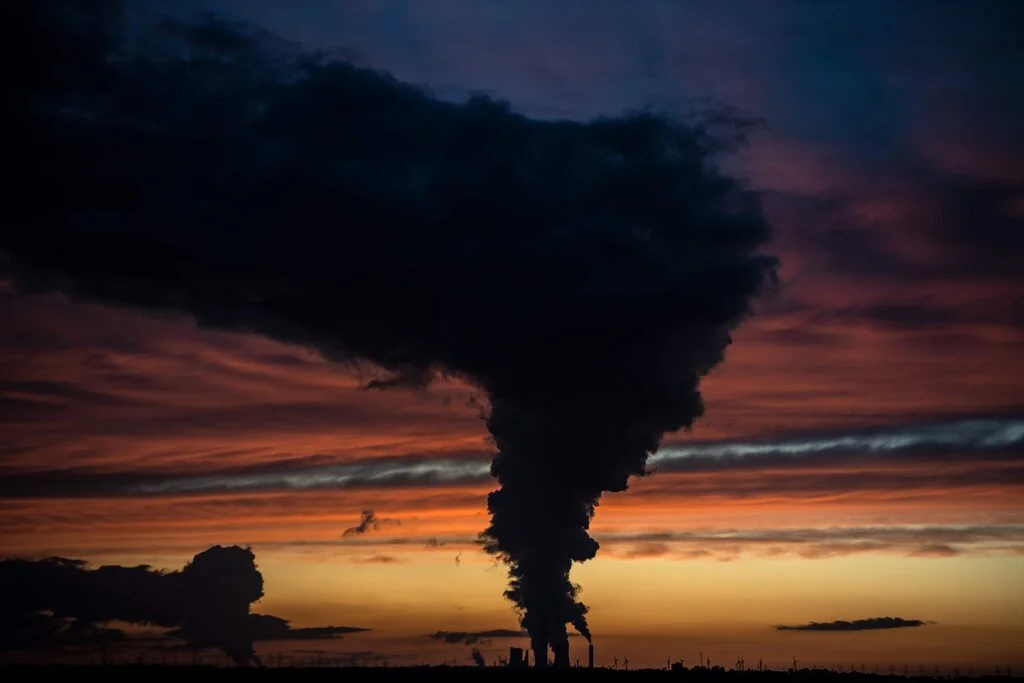
Steam rising from a coal-fired power plant in Roggendorf in western Germany.Credit...Federico Gambarini/DPA, via AFP — Getty Images

Steam rising from a coal-fired power plant in Roggendorf in western Germany.Credit...Federico Gambarini/DPA, via AFP — Getty Images

What is the cost of our carbon footprint — not just in dollars, but in lives?

According to a paper published on Thursday, it is soberingly high, and perhaps high enough to help shift attitudes about how much we should spend on fighting climate change

The new paper, published in the journal Nature Communications, draws on multiple areas of research to find out how many future lives will be lost as a result of rising temperatures if humanity keeps producing greenhouse gas emissions at high rates — and how many lives could be saved by cutting those emissions.

Most of the deaths will occur in regions that tend to be hotter and poorer than the United States. These areas are typically less responsible for global emissions but more heavily affected by the resulting climate disasters.

R. Daniel Bressler, a Ph.D. candidate at Columbia University, calculated that adding about a quarter of the output of a coal-fired power plant, or roughly a million metric tons of carbon dioxide, to the atmosphere on top of 2020 levels for just one year will cause 226 deaths globally.

By comparison, the lifetime emissions beyond 2020 levels of a handful of Americans (3.5, to be precise) will result in one additional heat-related death in this century.

Mr. Bressler also contrasted the effects of people in nations with big carbon footprints with those in smaller ones. While the carbon emissions generated by fewer than four Americans would kill one person, it would require the combined carbon dioxide emissions of 146.2 Nigerians for the same result. The worldwide average to cause that single death is 12.8 people.

The new paper builds on the work of William Nordhaus, a Nobel laureate who first determined what is known as the “social cost of carbon” — an economic tool for measuring the climate-related damage to the planet caused by each extra ton of carbon emissions. The concept has been a crucial part of policy debates over the expense of fighting climate change, because it is used to calculate the cost-benefit analysis required when agencies propose environmental rules. The higher the social cost of carbon, the easier it is to justify the costs of action.

The current version of the Nordhaus model — the “Dynamic Integrated Climate-Economy,” or DICE — puts the social cost of carbon at about $37 per metric ton. The Obama administration’s estimates put the figure at $50 a ton, but the Trump administration cut the estimate to as little as $1. The Biden administration is working on its own social cost of carbon, expected early next year; a preliminary figure released in February roughly matched the Obama administration’s.

In his paper, Mr. Bressler incorporated recent public health research that estimates the number of excess deaths attributable to rising temperatures into the latest version of the DICE model. The resulting extended model produced a startlingly high figure for the social cost of carbon: $258 per metric ton.

He coined a term for the relationship between the increased emissions and excess heat deaths: the “mortality cost of carbon.”

Heat waves, which have been made more frequent and more potent by climate change, have been linked to illness and death, with profound effects in less affluent countries. The recent off-the-charts temperatures in the Pacific Northwest and Canada have already been linked to hundreds of deaths.

Others have tried to put numbers on the mortality associated with climate change and the added costs that it entails, most notably the Climate Impact Lab at the University of Chicago. Maureen Cropper, senior fellow at Resources for the Future, a nonpartisan environmental research organization in Washington, suggested that Mr. Bressler’s $258 estimate appeared to be too high, in part because of the way that the paper looks at how people around the world view the value of their own lives. She added that “although one may disagree with some of the author’s assumptions, it is important for researchers to continue the effort.”

Mr. Bressler acknowledged that there were areas of uncertainty in the paper, including those built into some public health research investigating excess deaths caused by heat. He also relied solely on heat-related deaths without adding other climate-related causes of death, including floods, crop failures and civil unrest. The result is that the actual number of deaths could be smaller, or greater. “Based on the current literature,” he said, “this is the best estimate.”

Richard Revesz, a professor at New York University School of Law, praised the new work, which extends research that he and others have done to view the social cost of carbon as the beginning of an understanding of the costs of climate change, not the full cost.

“It could well have a significant impact on climate change policies,” he said.

The new research also shows the stark difference between personal carbon footprints and the kind of change that can be achieved through actions at the scale of government and business. Having calculated that 4,434 metric tons of carbon dioxide added to the atmosphere would result in one death during this century, Mr. Bressler said that simply taking one coal-fired power plant offline and replacing it with a zero-emissions alternative for just one year, would result in a “mortality benefit of saving 904 lives” over the century. “That would be a lot more impact than a personal decision,” he said.

But he added that he was not promoting one form of action over another.

“I’m just quantifying things,” he said, adding that ultimately, “you just have to reduce carbon.”

Wildfires ravaging forestlands in many parts of globe

Ahmet Gencturk

From North America to Australia, the world is grappling with massive forest fires

ANKARA 

Wildfires have spread to many parts of the world, according to US space agency NASA’s Fire Information for Resource Management System (FIRMS).

unsplash-image-tEIHSmfwznM.jpg

Accordingly, most of North America and South America, the African plateau, the northern Arabian Peninsula and the Mediterranean coast of Europe as well as Northern and Eastern Europe have been affected by fires.

In Asia, fires have been detected on the coasts of India and in Russia's Siberia region as well as in China, Malaysia and Indonesia.

European countries such as Italy, Spain and Greece, which have a coast on the Mediterranean, are also struggling with forest fires.

According to an emergency map of the European Commission showing forest fires, large and small fires on the entire continent reach almost as far as the north of Russia. On the satellite map, it is seen that fires of various sizes have been burning for at least a week in EU countries.

Italy

Southern parts of the country are especially experiencing many forest fires, both large and small.

According to a statement by Italy’s National Fire Corps, more than 800 fires have broken out in the country in the last 24 hours. Firefighters have responded to 250 fires in Sicily and 130 in Puglia, while 20,000 hectares of forest burned in a fire on July 24 in the countryside of Sardinia island’s Oristano province, where 1,500 people were evacuated. Italy requested firefighting aircraft from EU countries to supplement its own aircraft.

Spain

On July 26, the largest forest fire in the last two years broke out in the northern Catalonia region, while 1,657 hectares of land were burned in a fire in Santa Coloma de Queralt municipality in the Tarragona region and 168 people in residential areas were evacuated.

Greece

Greek authorities reported 58 forest fires in the last 24 hours.

The fires intensified around the western port city of Patras and in the town of Soufli, which is close to the Turkish-Greek border.

Russia

Efforts are still underway to extinguish forest fires that started this month in Russia’s northeastern Yakutia region.

Authorities declared a state of emergency for the region, where over 1.3 million hectares of forestland have gone up in flames.

Russia’s Ministry of Emergency Situations reported last Thursday that teams are working to extinguish fires that are continuing in 144 locations.

US and Canada

In the US, according to data Monday from the National Interagency Fire Center, around 450,000 acres of forest have burned in 91 blazes in 13 states. Also, new blazes were reported in the states of Idaho, Alaska and Minnesota.

In the US’s northern neighbor Canada, 4,576 forest fires have been reported so far this year. This amounts to 1,000 times more the average rate of the last decade.

Tourists evacuated from Pescara as Italy records more than 800 wildfires

Lorenzo Tondo and agencies

Wildfires burn across Italy, Spain, Greece and Turkey in heatwaves bringing temperatures above 40C

At least five people have been wounded and holidaymakers evacuated after wildfires devastated a pinewood near a beach in Pescara, Italy, as one of the worst heatwaves in decades swept across south-east Europe.

A five-year-old girl was taken to hospital but her condition is not believed to be life-threatening, according to reports.

About 800 people were evacuated from their homes, including a convent of nuns, after a fire broke out in the 53-hectare (131-acre) Pineta Dannunziana nature reserve, as the fires continue to be active on different fronts.

“We had to evacuate several homes and beach resorts due to the smoke,” said Carlo Masci, the mayor of Pescara. “The biggest problem is the hot wind. We are doing the best we can to limit the damage.”

More than 800 flare-ups were recorded this weekend, mainly in the south, Italy’s national fire service said.

“In the last 24 hours, firefighters have carried out more than 800 interventions: 250 in Sicily, 130 in Puglia and Calabria, 90 in Lazio and 70 in Campania,” the service tweeted.

Wildfires have also broken out across much of south-eastern Europe, including Spain, Greece and Turkey, who are dealing with one of the most severe heatwaves in decades, with temperatures rising above 40C (104F), forcing hundreds to evacuate.

According to EU data, this year’s fire season has been significantly more destructive than average.

More than 200 people were taken to safety from the seaside around Catania in Sicily, while dozens of villages were evacuated in tourist hotspots in southern Turkey, where wildfires that have killed eight people raged for a fifth day.

Fanned by soaring temperatures and strong winds – with experts saying that global heating increases the frequency and intensity of such blazes – Turkey is suffering its worst fires in at least 10 years, with nearly 95,000 hectares burnt so far this year, compared with an average of 13,516 at the same point in the years between 2008 and 2020.

A neighbourhood in the tourist city of Bodrum has been evacuated, CNN Türk reported, as strong winds fanned flames from the nearby Milas district.

Unable to leave by road, 540 residents were taken to hotels by boats, the channel said.

People were also evacuated from the resort city of Antalya, and two bodies were found in that region on Sunday, taking the number of people killed to eight.

Turkey’s defence ministry released satellite images showing the extent of the damage, with forest areas turned black and smoke still visible.

President Recep Tayyip Erdoğan has been criticised after it emerged that Turkey has no firefighting planes, even though one-third of its territory is forested and fires are becoming increasingly frequent.

Meanwhile, a major blaze broke out early on Saturday near Patras in western Greece.

Five villages have been evacuated and eight people were hospitalised with burns and respiratory problems in the region, which remains on alert.

The mayor of the nearby village of Aigialeias, Dimitris Kalogeropoulos, called it “an immense catastrophe”.

“We slept outside overnight, terrified that we would not have a house when we woke up,” a resident of Lambiri told Greek TV station Skai.

In Spain, dozens of firefighters backed by water-dropping aircraft were battling a wildfire that broke out on Saturday afternoon near the San Juan reservoir, about 40 miles east of Madrid

Our biggest enemy is no longer climate denial but climate delay

Ed Miliband

Nothing is more dangerous than the illusion of action – which is all that the British government is offering

‘Climate breakdown can no longer be plausibly denied as a threat etched only in the future.’ Flooding in north London this week Photograph: REX/Shutterstock

‘Climate breakdown can no longer be plausibly denied as a threat etched only in the future.’ Flooding in north London this week Photograph: REX/Shutterstock

Future generations will look back on the climate events of 2021 and say: “That was the year they ran out of excuses.”

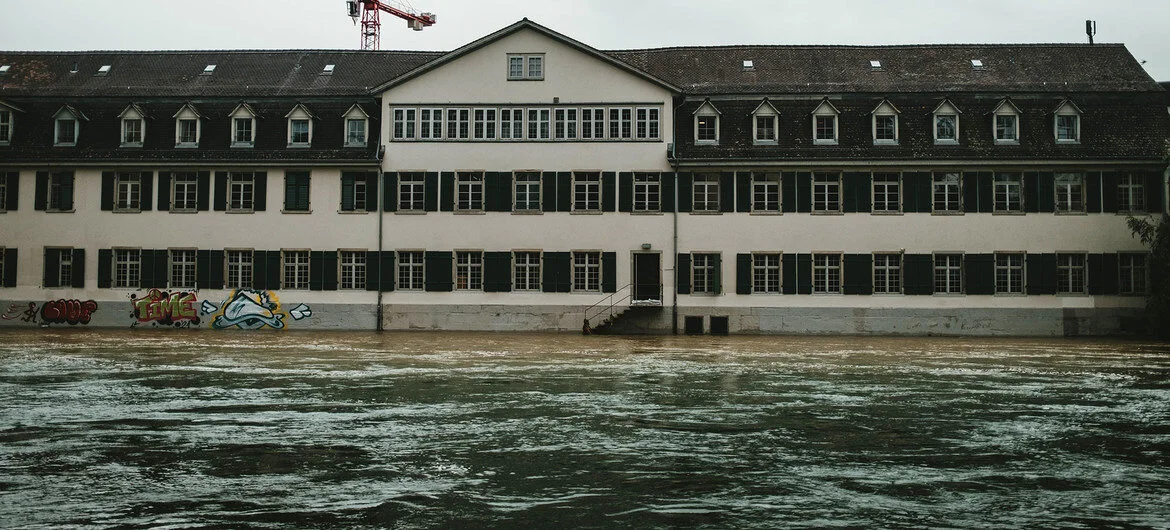
Heatwaves and flooding here in the UK, temperatures topping 50C in Pakistan, hundreds killed by a heatwave in British Columbia, deadly floods in Germany and China. All within a single month. Add to that the recent dire warning from the Met Office that the age of extreme weather has just begun.

The wake-up call that this offers is not just the obvious one: that climate breakdown is already here. It also illustrates that we, in this generation, are in a unique position in the history of this crisis. Climate breakdown can no longer be plausibly denied as a threat etched only in the future. And all too soon, avoiding it may be a luxury lost to the past. The window to avoid catastrophe is closing with every passing day. We’re in the decisive decade in this fight, and we must treat the climate crisis as an issue that stands alone in the combination of its urgency and the shadow it casts over future generations.

The actions we take defy the normal rhythm of political cycles. What we do in the next few years will have effects for hundreds of years to come. Unless the world cuts emissions in half in this decade, we will probably lose the chance to avoid warming of significantly more than the 1.5C set out in the 2015 Paris accord. We have seen the catastrophic effects of a world warmed by just 1.2C. What happens if we get to 2.5 or 3C? By then, we’ll look back at recent summers as not the hottest we’ve ever had but, in all likelihood, the coolest we will ever have again.

The accompanying truth is that our biggest enemy is no longer climate denial but climate delay. The most dangerous opponents of change are no longer the shrinking minority who deny the need for action, but the supposed supporters of change who refuse to act at the pace the science demands. As Bill McKibben, environmentalist and climate scholar, says on climate: “Winning slowly is the same as losing.”

The UK government is a case in point. There is a chasm between the boosterish rhetoric of the Johnson government and the reality. We are way off meeting our climate targets, which are themselves insufficiently ambitious, graded “somewhere below” four out of 10 for delivery by the Climate Change Committee. Nothing is more dangerous than the mirage of action shrouding the truth of inaction, because it breeds either false confidence that we will be OK or cynicism and despair about meaningless political promises.

But why are they failing? Above all, because of a dogged refusal to put government investment at scale behind a green recovery. The more government refuses to provide that proper plan and finance, the harder the decisions on boilers, cars and industrial transition become. A government that absents its responsibility for making these transitions is a government that will fail to make them happen.

This is not simply failing to protect us from the biggest long-term threat we face; it’s economically illiterate too.

The case for investing now is not just clear as a question of intergenerational equity, it’s also the only conclusion to draw from a hard-headed fiscal analysis of the costs and benefits. The Office for Budget Responsibility tells us that the costs of acting early are surprisingly small relative to our national income – in the central scenario, an average annual investment in net terms of just 0.4% of GDP between now and 2050.

Meanwhile, we know that inaction is entirely unaffordable, leaving massive costs of climate damage racked up and left for future generations. The OBR also tells us that delay will significantly raise the cost of action, in part because we are baking high carbon into our infrastructure. We will have to make the transition at some point; failing to act now will betray our children and grandchildren and will just end up costing more.

We should act now not just because we must avoid future generations living in a disaster movie but because rewriting the script can produce a better world. Rapid decarbonisation is the imperative, but we can do so in a way that fixes the inequalities that exist in our current economic system. This is the promise of the Green New Deal – that this transformative programme of investment can also generate good jobs, help existing industries transition and create new ones, ensure warmer homes, cleaner air, and a lasting shift in wealth and power across our country. This is the vision we must fight for.

Particularly, in this year of all years, what we do here at home has real impacts around the world. If other governments believe that a country that has led the way on climate is full of hot air, it simply undermines trust and lets the big polluters off the hook. In the less than 100 days left to COP26, the prime minister must finally wake up to the fact that this is not a glorified international photo opportunity but a complex and fragile negotiation where he must deliver at home and engage in the hard yards of diplomacy.

Just over 50 years ago, Martin Luther King said of the fight for racial and economic justice: “We are now faced with the fact that tomorrow is today. We are confronted with the fierce urgency of now. In the unfolding conundrum of life and history, there is such a thing as being too late.” As the generation that stands astride the causes and consequences of this climate emergency, we must take heed of those words.

From electric dreams to supercharged reality: the road race to a clean energy future

UN NEWS

The global Formula E electric race series, a partner with the UN Environment Programme (UNEP), has grown in popularity since it launched some seven years ago, attracting the attention of major car manufacturers, changing people’s perceptions of electric vehicles, and bringing the world one step closer to a sustainable transport future.

UN/Joon Park I Formula E car at the 2021 New York race in Red Hook, Brookyln.

UN/Joon Park I Formula E car at the 2021 New York race in Red Hook, Brookyln.

Transport is believed to be responsible for around a quarter of all greenhouse gas emissions, and combustion engines are a major cause of poor air quality in urban areas, which is a factor in asthma and other respiratory diseases.

Despite being around for many years, electric vehicles remain a small part of the overall car market. However, with growing concern about climate change, and some eye-catching commitments from governments and car manufacturers, which include plans to ban or end the production of combustion engines within the next few decades, that could be about to change. 

Formula E is so far the only sport to be certified net zero carbon since its inception, and those associated with the championship are committed to combatting the climate crisis by accelerating the adoption to electric vehicles. 

In July, Conor Lennon from UN News spoke to Julia Pallé, Formula E’s Sustainability Director, and Lucas di Grassi, who won the championship’s first ever race back in 2014, and is a clean air advocate for the UN. They discussed the growth of electric car racing, and why it can help convince the general public to give up combustion engines.

Julia Pallé: Formula E was built with sustainability in its DNA, and it is part of the reason that teams, drivers, and partners join us. Everyone is involved in pushing electric vehicles to the mass market.
We are using the championship as a platform to advance the electrification of transport by showcasing a range of products and services that are contributing to the creation of a low carbon economy.

Lucas di Grassi: I joined Formula E back in 2012, and I was the third employee. I had already driven an electric car, and I was very interested in the technology. 

I think that the public understands that sustainability is not a choice. There are too many people consuming too much, and we need to improve everyone’s quality of life sustainably, without damaging the planet for future generations. 

Electric vehicles are a part of that, and Formula E is at the core of the transition, in terms of research and development, and also changing people’s perception of electric vehicles, which has changed massively over the last five years.

Overcoming a resistance to change

Conor Lennon: Did you encounter any scepticism in the early days of the competition?

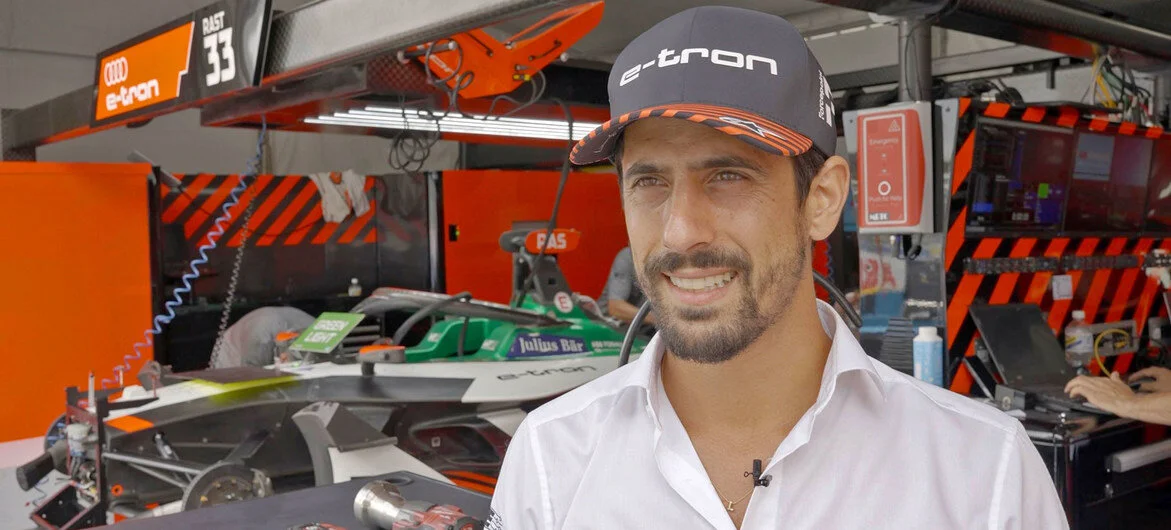
UN/Joon Park I Lucas di Grassi, Formula E driver for the Audi team, at the 2021 New York race in Red Hook, Brookyln.

UN/Joon Park I Lucas di Grassi, Formula E driver for the Audi team, at the 2021 New York race in Red Hook, Brookyln.

Lucas di Grassi: Yes, especially in the motor sport world, where people are very nostalgic. First of all, people laughed about the project, they thought it was a joke. Then they criticised the cars for being slow, for not making any noise, and because we would have to change cars during the races. Then they started to take it seriously, and a few years later they all wanted to join the series!

The famous American physicist Richard Feynman once said that you measure intelligence by people’s ability to adapt or to understand change without getting offended. Formula E is a good example: I grew up loving combustion engine cars, but it is clear that we have to go electric. The motor sports world didn’t agree, but a large proportion of people now understand that electric vehicles can be exciting and fun.

Julia Pallé: There was a lot of scepticism and a reluctance to change. We have seen many victories along the way. From finishing the first season, to more and more partners joining us, and now we are the world championship with the biggest line-up of car manufacturers!
We have also seen many new electric racing series following our example, and this is the biggest testimony that we opened up the way, and showed that electric vehicle races are highly attractive. 

Concentrating on the low-hanging fruit

Lucas di Grassi: we have to remember that electric mobility is not just about passenger cars. It ranges from e-bikes, scooters, mopeds, and motorbikes, to cars, vans, trucks, and buses.

However, smaller vehicles are much easier to electrify than trucks travelling long distances, or planes. Large freight ships can’t just go electric, and even if we were to switch to a technology such as hydrogen or nuclear power, the cost of transporting the goods would be much higher.

So we need to concentrate on the low-hanging fruit first, such as e-bikes and cars. That’s why I created the world’s first electric scooter championship. These are not regular scooters, they are very fast, and can reach up to 120 kilometres per hour. Another important development in the growth of sustainable transport is autonomous driving, which is much more efficient, and in 2015 I joined Roborace, the first global championship for autonomously driven, electrically powered vehicles

An electric race against time

UNFCCC Secretariat I A team of cyclists on electric bikes ends a 600 km ride at the COP24 Climate Change conference (file)

UNFCCC Secretariat I A team of cyclists on electric bikes ends a 600 km ride at the COP24 Climate Change conference (file)

Conor Lennon: it seems that you’re taking a twin-track approach with Formula E, testing, and developing a fast-evolving technology, and raising awareness. But there’s a race against time, because the number of people who want to use cars is fast rising, and we have to show that is possible to massively scale up electric transportation to meet that demand.

Julia Pallé: It is clear to all of us, from professionals, to those working with the UN, and the general public, that we have nine years to cut emissions by some 50 per cent in order to reach our climate action goals. To do this we have to change the way we live and, at an individual level, the biggest impact we can have is in the way that we travel.

What we are trying to do is to offer concrete solutions: we are backed by many car manufacturers who are developing technology in Formula E that is used to improve the cars, which ultimately benefits consumers.

We are also a showcase, giving a taste of what a future sustainable lifestyle can look like: offering plant-based food options, banning single-use plastics. So, it’s not about compromising, or giving up things we like, but doing things in a different, enhanced way.

This discussion is adapted from an SDG Media Zone video, part of a series produced for the 2021 High Level Political Forum, the largest annual gathering on progress on the Sustainable Development Goals (SDGs).

The UN and Sustainable Transport

  • The United Nations is playing a part in this coming transition towards clean energy, bringing together major players in the industry at the Sustainable Transport Conference, which takes place in Beijing this October.

  • This year’s conference will focus on how to plan and develop transport systems that boost economic growth, reduce inequalities, and improve the environment for everyone.

  • The programme will reflect the diversity and complexity of the transport sector and will provide an opportunity for policy dialogue as well as forging partnerships and initiatives to advance sustainable transport.

Together, we must tackle growing hunger, urges Guterres

UN NEWS

Inefficient global food production is at the root of a huge rise in hunger as well as one-third of all emissions and 80 per cent of biodiversity loss, UN Secretary-General António Guterres has warned, in a call to all countries to transform food systems to speed up sustainable development.

Two and a half million people in the Central African Republic (CAR) are facing hunger.

Two and a half million people in the Central African Republic (CAR) are facing hunger.

Up to 811 million people faced hunger in 2020 – as many as 161 million more than in 2019 - Mr. Guterres said, at the Pre-Summit of the UN Food Systems Summit in Rome beginning Monday. 

Pointing to the disruption caused by the COVID-19 pandemic, the UN chief added that three billion people cannot afford to eat healthily, either. 

Grazie mille, Prime Minister Draghi, for your support and leadership in hosting the @FoodSystems Pre-Summit.

Italy has demonstrated that it values smallholder farmers, especially women, in defining the future of sustainable #FoodSystems. pic.twitter.com/7q0Xb7dfCv
— Amina J Mohammed (@AminaJMohammed) July 26, 2021

We are seriously off track to achieve the Sustainable Development Goals (SDGs) by 2030”, said Mr. Guterres, who highlighted how “poverty, income inequality and the high cost of food” were responsible for these ills, and how climate change and conflict are were “consequences and drivers of this catastrophe”. 

Mohammed pledge 

Echoing those concerns and urging action at this week’s Pre-Summit, UN Deputy-Secretary-General Amina Mohammed insisted that tackling growing hunger and poor nutrition were challenges that the international community should rise to, “as we have the means to do it”.  

Ms. Mohammed welcomed the fact that 145 countries had already embarked on national dialogues to decide on how sustainable food systems should look by 2030, in reference to regular online meetings, public forums and surveys with youth, farmers, indigenous peoples, civil society, researchers, private sector, policy leaders and ministers of agriculture, environment, health, nutrition and finance.  

The outcome of these exchanges will contribute to suggested actions organized around the Summit’s five action tracks to transform food production and leverage the far-reaching significance of food systems to help achieve the 17 Sustainable Development Goals (SDGs), the Deputy UN chief explained: 

“There is no one size that fits all. We must work country by country, region by region, community by community, to ensure the diversity of needs are addressed to support each reality. The same applies for our food systems and the changes that are required so that we feed the world, without starving the planet of its future.” 

The Pre-Summit, which is being held in a hybrid format, brings delegates together from more than 100 countries to launch a set of new commitments through coalitions of action and mobilize new financing and partnerships. 

Fragile sustainability  

Ms. Mohammed highlighted how the pandemic had reversed efforts towards sustainable development, with latest UN data indicating that around 100 million people have been pushed into poverty since the start of the global health crisis. 

UN Photo/Giulio Napolitano I Amina Mohammed, UN Deputy Secretary-General, addresses the Pre-Summit of the United Nations Food System Summit 2021 in Rome, Italy.

UN Photo/Giulio Napolitano I Amina Mohammed, UN Deputy Secretary-General, addresses the Pre-Summit of the United Nations Food System Summit 2021 in Rome, Italy.

But she insisted that this week’s meeting in Rome hosted by the UN Food and Agriculture Organization (FAO) had the opportunity to “drive progress” on the delivering the 2030 Agenda, by agreeing positions on sustainable solutions, ahead of the Leaders’ UN Food Systems Summit in New York in September. 

“Through the 2030 Agenda, we agree to transform our world. We can only do that by working together,” Ms. Mohammed said. 

“That means we must listen to one another, appreciate diverse perspectives and understand the dynamic and interconnected challenges that we face. It means we must commit to making the choices that are needed to ensure we leave no one or country behind.”

‘Record-shattering’ heat becoming much more likely, says climate study

Damian Carrington

More heatwaves even worse than those seen recently in north-west of America forecast in research

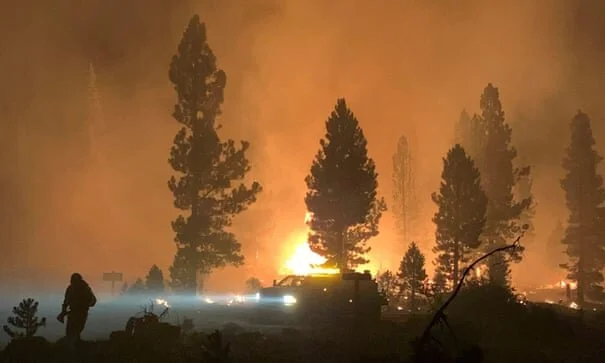
Firefighters tackle the Bootleg fire, near Klamath Falls, Oregon on 17 July. Scientists say the world has yet to see the worst impacts possible from global heating. Photograph: US Forest Service/AFP/Getty Images

Firefighters tackle the Bootleg fire, near Klamath Falls, Oregon on 17 July. Scientists say the world has yet to see the worst impacts possible from global heating. Photograph: US Forest Service/AFP/Getty Images

“Record-shattering” heatwaves, even worse than the one that recently hit north-west America, are set to become much more likely in future, according to research. The study is a stark new warning on the rapidly escalating risks the climate emergency poses to lives.

The shocking temperature extremes suffered in the Pacific north-west and in Australia 2019-2020 were “exactly what we are talking about”, said the scientists. But they said the world had yet to see anything close to the worst impacts possible, even under the global heating that had already happened.

The research found that highly populated regions in North America, Europe and China were where the record-shattering extremes are most likely to occur. One illustrative heatwave produced by the computer models used in the study showed some locations in mid-northern America having temperatures 18C higher than average.

Preparing for such unprecedented extremes was vital, said the scientists, because they could cause thousands of premature deaths, and measures taken to adapt to date had often been based only on previous heat records.

Scientists already know that heatwaves of the kind mostly seen today will become more common as the climate crisis unfolds. But heatwaves are usually analysed by comparing them with the past, which means the vast majority are only marginally hotter than before. This can give a false sense of a gradual rise in record temperatures.

The new computing modelling study instead looked for the first time at the highest margins by which week-long heatwave records could be broken in future.

It found that heatwaves that smash previous records by roughly 5C would become two to seven times more likely in the next three decades and three to 21 times more likely from 2051–2080, unless carbon emissions are immediately slashed. Such extreme heatwaves are all but impossible without global heating.

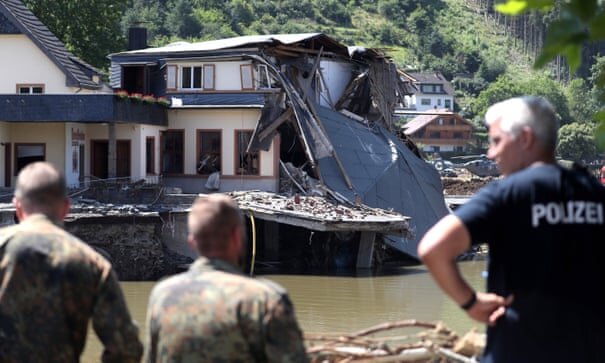
Soldiers inspect damage after the flooding of the River Ahr, in Rech in the district of Ahrweiler, Germany, on 21 July. Photograph: Friedemann Vogel/EPA

Soldiers inspect damage after the flooding of the River Ahr, in Rech in the district of Ahrweiler, Germany, on 21 July. Photograph: Friedemann Vogel/EPA

The vulnerability of North America, Europe and China was striking, said Erich Fischer, at ETH Zurich in Switzerland, who led the research. “Here we see the largest jumps in record-shattering events. This is really quite worrying,” he added.

“Many places have by far not seen anything close to what’s possible, even in present-day conditions, because only looking at the past record is really dangerous.”

The study also showed that record-shattering events could come in sharp bursts, rather than gradually becoming more frequent. “That is really concerning,” Fischer said: “Planning for heatwaves that get 0.1C more intense every two or three years would still be very worrying, but it would be much easier to prepare for.”

The cost of cooling: how air conditioning is heating up the world

Aliya Uteuova

As temperatures rise, a new book delves into the environmental toll of America’s favorite way to cool off

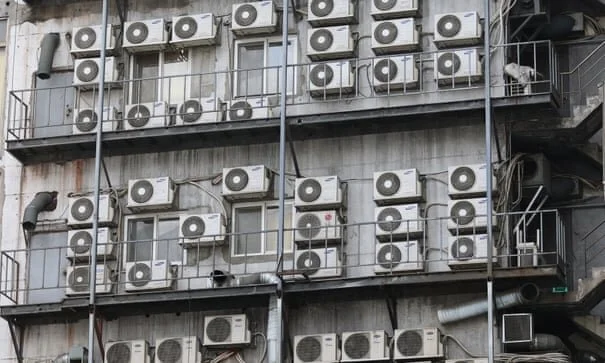
Air conditioners outside a building in Seoul. The harmful chemicals that make our lives comfortable contribute to the climate crisis. Photograph: Yonhap/EPA

Air conditioners outside a building in Seoul. The harmful chemicals that make our lives comfortable contribute to the climate crisis. Photograph: Yonhap/EPA

The widespread reliance on air conditioning in the US is explored in Eric Dean Wilson’s book After Cooling: on Freon, Global Warming, and the Terrible Cost of Comfort. The book explores how air conditioning has become one of the most effective ways to cool off – and explains how harmful chemicals that make our lives comfortable also contribute to the climate crisis.

The modern refrigerant – gas in fridges, freezers and air conditioners – was first introduced in 1930s in the form of a chemical called chlorofluorocarbons (CFCs), better known as Freon. This chemical escaped into the air over time, ripping a hole in the ozone layer. In 1987, a global agreement was reached to ban the production of CFCs – although every year an ozone hole reappears over Antarctica in October.

HFCs, the chemicals that replaced the banned refrigerant, while not ozone-depleting, their global warming potential can be hundreds to thousands of times that of carbon dioxide. Today, the most commonly used refrigerant in air conditioners and cars is HCFC, which has much smaller ozone-depleting potential.

Wilson’s book is not a call to ditch air conditioners. He acknowledges that in a heatwave, refrigerants are life-saving. Prolonged hot temperatures can diminish people’s mental and physical capacity, and air conditioning is an effective heat management tool in classrooms. But before the widespread use of commercial air conditioning, our world was cooler – and in seeking comfort we have warmed our planet.

In an interview, Wilson reflects on the cost of American comfort.

So when I’m sitting 3ft away from a window AC unit, am I blasting harmful chemicals into my house or the atmosphere?

Air conditioners don’t consume or emit refrigerants directly. But what the chemical industry that produced air conditioners claimed was that they didn’t send Freon into the atmosphere. According to the industry, it was totally safe because it would never leak. Well, that’s not what happens. What happens, especially with car air conditioners, is that when a refrigerant is charged into a system, into an air conditioner, it slowly, over the course of like 15 years, leaks.

And even if it doesn’t, when getting rid of an air conditioner, the vast majority of people just pass it on the street, or put it in the dump, or something like that, which is technically illegal. But there’s no way to actually regulate that. Just walking down the street today, I saw two air window units just smashed on the street. It’s expensive to have somebody come and take care of them properly. And these units most likely have HFCs.

What was the alternative to CFCs once they were banned?

There are replacements like HFOs (hydrofluoroolefins) that don’t deplete the ozone layer. All evidence points to them being fine, but with each subsequent generation of refrigerants CFCs we’ve thought they were fine and they weren’t. I’m not a chemist, and I’m not an atmospheric scientist, but I see a pattern here that I’m quite skeptical of.

Can you speak about the reliance on AC during a heatwave?

In a heatwave, you have people who are susceptible to heat-related illnesses. These are people who tend to live in neighborhoods that have less access to natural shade, fewer trees, less access to parks, more asphalt that absorbs heat and can make areas of the city 10F hotter in some places.

Low-income residents are also more vulnerable. Even if they can afford the unit, they might be reluctant to turn it on because they might be behind on their energy bills. Also, what happens in the heatwave is that everyone in the city turns on their air conditioner, and it overloads the grid, and there’s a potential for blackouts.

One of the things that I write about very briefly in the book is pointing to the need for things like community solar, or community-controlled energy, rather than having a monopoly company that controls it. Because when profit is the driving motive, monopolies are not interested in saving lives.

What if we don’t want, or can’t afford, AC?

The most lo-tech solution is planting more trees. Initiatives to make sure that there is lush vegetation on every street in New York, especially in working-class neighborhoods, where there tend to be less trees, I think that’s crucial. Another solution is sustainable design that incorporates passive cooling. There are innovative architects who are looking at nature, things like termite mounds, beehives, things that exist in the wild and regulate temperature.

Understanding how to shade, how to give light, but without direct sunlight that will heat a room. Things like incorporating natural wind into a room, and using better building materials that don’t absorb heat. And these cooling strategies don’t have to be enormously expensive, so I have a lot of faith in good design.

What do you hope people take away from your book?

The vast majority of cooling in the United States is not for emergency situations. And it’s not even for situations that, I would argue, make our lives better. So what I’m asking is for us to really consider how our level of comfort and what we’ve defined as comfort has been constructed. And whether our level of comfort has actually led to a planet that’s uninhabitable. I’m not calling for all of us to suffer at all, I’m actually calling for us to again, to redefine what it means to be comfortable.

Water-related hazards dominate list of 10 most destructive disasters

UN NEWS

Against the backdrop of a rapidly changing global climate, water-related hazards top the list of natural disasters with the highest human losses in the past 50 years, according to a new report by the World Meteorological Organization (WMO).

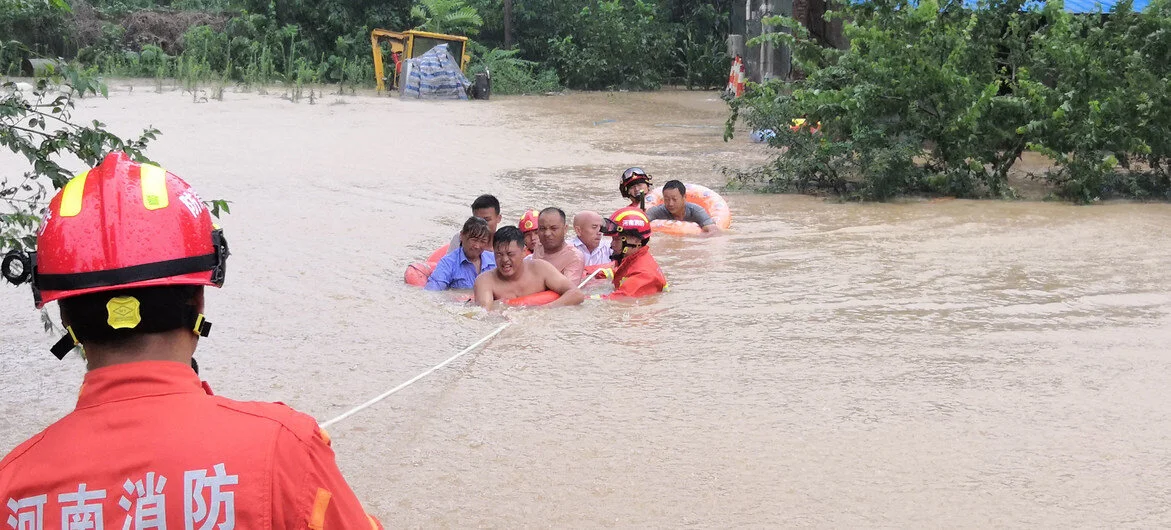
China Fire and Rescue I Rescuers pull villagers from flood waters in Xingyang city in China's Henan Province.

China Fire and Rescue I Rescuers pull villagers from flood waters in Xingyang city in China's Henan Province.

The Atlas of Mortality and Economic Losses from Weather, Climate and Water Extremes (1970-2019) – which will be published in September – finds that of the 10 disasters causing the most human fatalities in the past five decades, droughts top the list with some 650,000 deaths across the globe. 

Storms caused upwards of 577,000 fatalities, floods led to more than 58,000 deaths, and extreme temperatures caused over 55,000 to die.

Extreme rainfall events

Excerpts from the report were released as temperatures in parts of North America soar, and unprecedented flooding in north-central Europe continues to dominate news headlines.

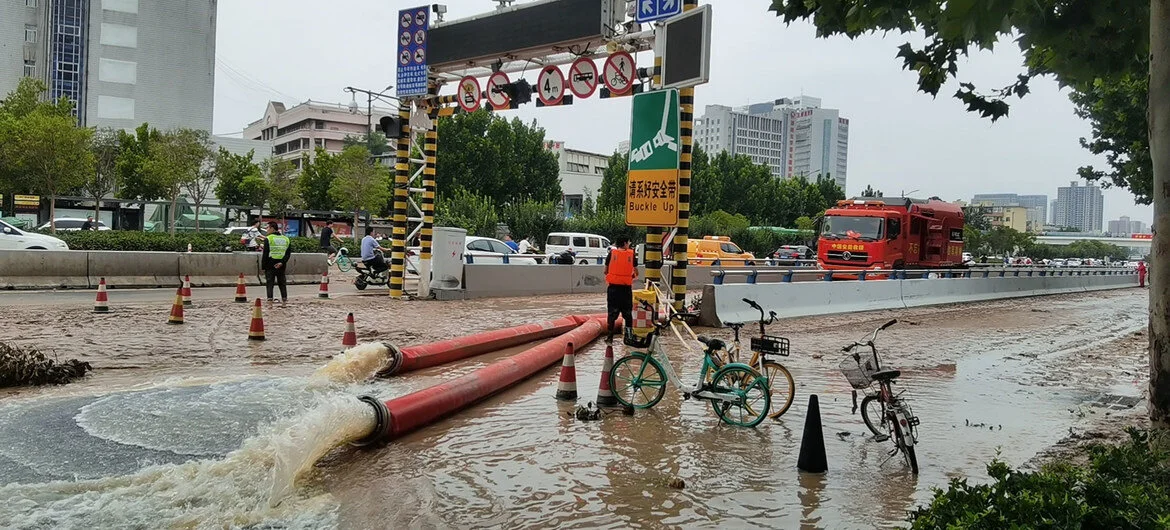
China Fire and Rescue I Frontline workers drain flooded road tunnels in Zhengzhou, the capital city of China's central Henan Province.

China Fire and Rescue I Frontline workers drain flooded road tunnels in Zhengzhou, the capital city of China's central Henan Province.

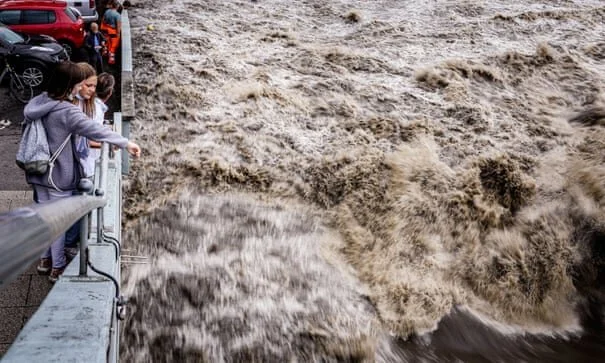
The German national meteorological service said up to two months’ worth of rainfall fell in 2 days, on 14 and 15 July, affecting parts of Germany, Belgium, the Netherlands, Luxembourg, Switzerland and Austria.

According to news reports, more than 120 people have died in Germany alone, and hundreds remain missing.  
Meanwhile, parts of the central Chinese province of Henan received more accumulated rainfall between 17 and 21 July than the typical average for a full calendar year.

Economic losses

The report estimates that, of the top 10 events examined between 1970 and 2019, storms accounted for approximately $ 521 billion in economic losses, while floods accounted for about $115 billion. 
Excerpts from the report show that floods and storms resulted in the largest losses in Europe in the past 50 years, at a cost of $377.5 billion. 

A 2002 flood in Germany caused $16.48 billion in losses, representing the single costliest event in Europe during the period studied.

Across the continent, a total of 1,672 recorded disasters resulted in nearly 160,000 deaths and $476.5 billion in economic damages.

‘Clearly linked’ to climate change

“Weather, climate and water-related hazards are increasing in frequency and intensity as a result of climate change,” said WMO Secretary-General Petteri Taalas.

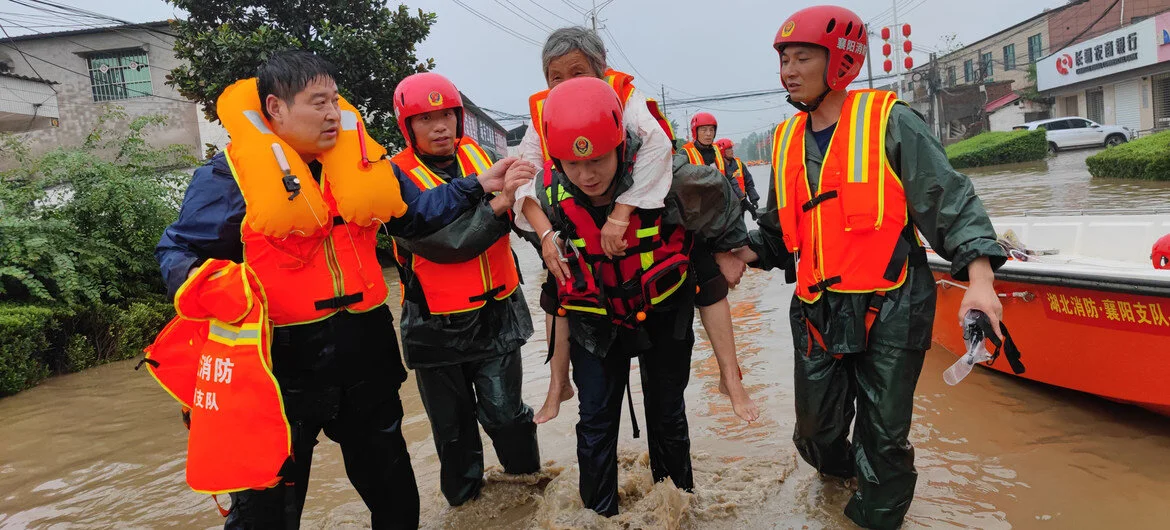
China Fire and Rescue I Emergency workers rescue an elderly person in Xuchang, in China's Henan Province.

China Fire and Rescue I Emergency workers rescue an elderly person in Xuchang, in China's Henan Province.

“The human and economic toll was highlighted with tragic effect by the torrential rainfall and devastating flooding and loss of life in central Europe and China in the past week,” he added.

Also noting that the recent record-breaking heatwaves in North America are “clearly linked” to global warming, Taalas cited a recent rapid attribution analysis that climate change, caused by greenhouse gas emissions, made the heatwave at least 150 times more likely to happen.

Emphasizing that no country is immune from such changes, he said it is imperative to invest more in climate change adaptation, including by strengthening multi-hazard early warning systems.

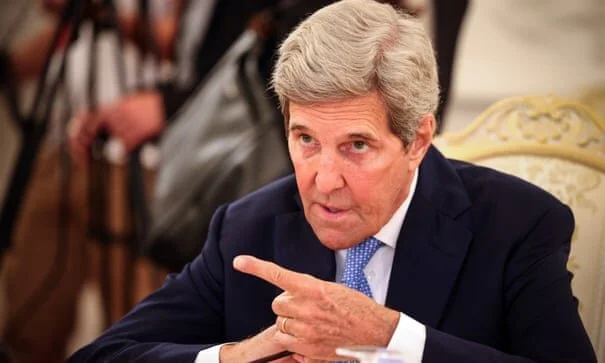
John Kerry: world leaders must step up to avoid worst impacts of climate crisis

Fiona Harvey

US envoy uses landmark speech in London to make impassioned plea for unified global effort

John Kerry also called on governments to invest in clean energy. Photograph: Dimitar Dilkoff/AFP/EPA

John Kerry also called on governments to invest in clean energy. Photograph: Dimitar Dilkoff/AFP/EPA

The world still has a chance of staving off the worst impacts of climate breakdown but only if governments step up in the next few months with stronger commitments on cutting greenhouse gas emissions, the US envoy for climate change has said.

John Kerry, appointed by Joe Biden to spearhead the US’s international efforts to tackle the crisis, urged all large economies to come forward with new plans to cut emissions before the Cop26 UN climate talks in Glasgow this November.

“The climate crisis is the test of our own times and, while it may be unfolding in slow motion to some, this test is as acute and as existential as any previous one. Time is running out,” he said.

He called Cop26 “a pivotal moment” and 2021 “a decisive year”, as the world must get to grips with the climate crisis and rapidly slash emissions in the 2020s to have a chance of a safe future.

Speaking as floods have devastated parts of Europe and heatwaves and wildfires swept North America, Kerry drew a parallel between the ruins of Europe after the second world war and the ravages of the climate crisis.

“The world order that exists today didn’t just emerge on a whim. It was built by leaders and nations determined to makes sure that never – never – again would we come so close to the edge of the abyss,” he said.

Kerry said his earliest memory, aged four, was of the ruined skeleton of a burned-out building in Europe, where he had been taken by his mother, who fled the Nazis. “That journey has always given me the bedrock confidence that we can solve humanity’s biggest threats together.”

Staying within 1.5C of global heating, the aspirational goal of the 2015 Paris climate agreement, was still possible, he insisted.

“There is still time to put a safer 1.5C future back within reach. But only if every major economy commits to meaningful absolute reductions in emissions by 2030. That is the only way to put the world on a credible track to global net zero by mid-century,” he said.

The Paris agreement targets an upper limit of holding global temperature rises to well below 2C above pre-industrial levels, with an aspirational lower limit of 1.5C.

Kerry made it clear that the Cop26 summit must aim for the lower threshold, and warned that current government pledges on emission cuts would lead to 2.5C or 3C rises.

“We’re already seeing dramatic consequences with 1.2C of warming. To contemplate doubling that is to invite catastrophe,” he said.

Kerry used his landmark speech at the Royal Botanic Gardens, Kew, in London, with just over 100 days to go before Cop26, to make an impassioned plea for a unified global effort. “We can’t afford a world so divided in its response to climate change when the evidence for compelling action is so strong.”

His words will be seen as partly aimed at China, the world’s biggest emitter and second largest economy, which has yet to submit to the UN a national plan for emissions cuts before 2030.

China had set a long-term goal of net zero emissions by 2060 and has national targets aimed at reducing the amount of carbon procured per unit of GDP. However, Kerry made it clear that absolute cuts in emissions, rather than cuts relative to economic growth, were essential.

But he is likely to also have other countries in his sights. He said the US was working with “allies, partners, competitors and even adversaries all too aware that some things happening today threaten to erase the very progress so many are struggling to advance”.

UN climate summits proceed by consensus so recalcitrant counties can thwart agreement. For Cop26 to be a success, countries such as Russia, Brazil and Saudi Arabia will need to acquiesce at least – Kerry’s remarks will be seen as warning them not to disrupt the process.

He also called on governments to invest in clean energy, holding out the prospect of a clean energy boom worth $4tn a year by 2030, and said new technologies such as hydrogen and carbon capture and storage would also be needed.

The International Energy Agency warned this week that governments were failing to rebuild stronger from the Covid-19 pandemic, with only 2% of economic bailout money going to clean energy. It warned emissions could reach record levels within two years as a result, with disastrous consequences for the climate.

How data could save Earth from climate change

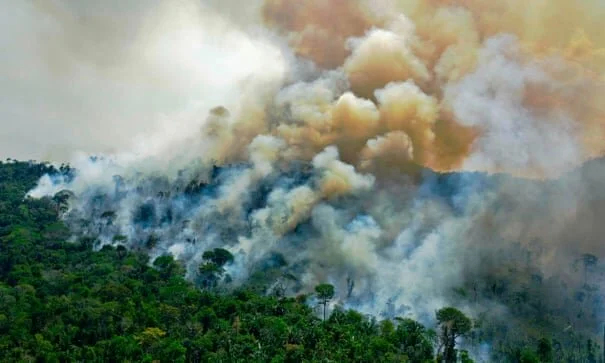
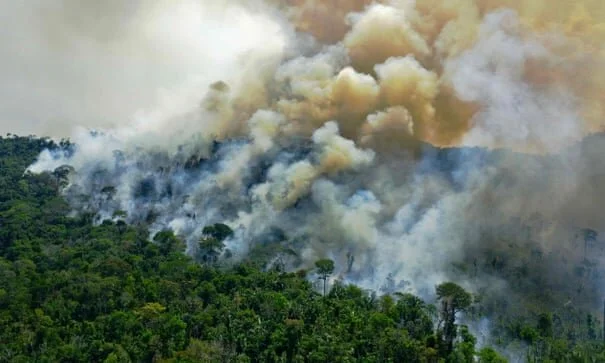
The Amazon rainforest in flames south of Novo Progresso, Brazil. It now emits more CO2 than it absorbs. Photograph: Carl de Souza/AFP/Getty Images

The Amazon rainforest in flames south of Novo Progresso, Brazil. It now emits more CO2 than it absorbs. Photograph: Carl de Souza/AFP/Getty Images

Using a name inspired by Indonesian farmers, Subak will share information and fund hi-tech solutions to fight global heating

As monikers go, Subak may seem an odd choice for a new organisation that aims to accelerate hi-tech efforts to combat the climate crisis. The name is Indonesian, it transpires, and refers to an ancient agricultural system that allows farmers to co-ordinate their efforts when irrigating and growing crops.

“Subak allows farmers to carefully synchronise their use of water and so maximise rice production,” said Bryony Worthington, founder and board member of the new, not-for-profit climate action group. “And that is exactly what we are going to do – with data. By sharing and channelling data, we can maximise our efforts to combat carbon emissions and global warming. Data is going to be the new water, in other words.”

Bryony Worthington and Gi Fernando, who hatched the idea of Subak. Photograph: Supplied

Bryony Worthington and Gi Fernando, who hatched the idea of Subak. Photograph: Supplied

Subak will be officially launched on Monday and will select and fund non-profit groups, working around the world, to combat the climate crisis. Early start-ups already helped by Subak include one group that is assisting UK local authorities to boost electric car use, while another is using accurate weather forecasts to make best use of solar power across Britain and limit fossil fuel burning to generate electricity.

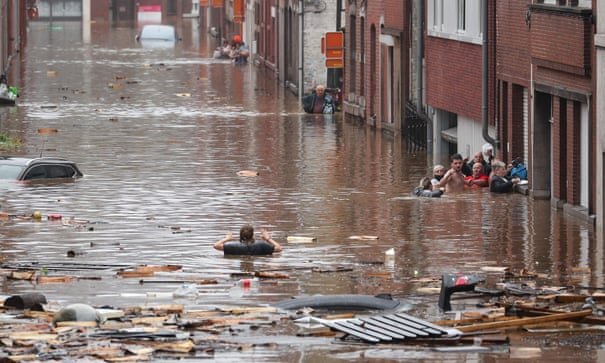
These efforts are being launched after a week of headlines that have highlighted how perilous life on Earth is becoming as global heating grips the planet. Floods in Germany and Belgium left more than 150 dead; scientists revealed that the Brazilian rainforest now emits more carbon dioxide than it absorbs; and fires devastated vast tracts of Californian forests. In each case, scientists warned that rising temperatures – triggered by increasing levels of carbon dioxide in the atmosphere – are likely to have played a key role in bringing about these catastrophes.

Urgent action is clearly needed, says Lady Worthington, a noted climate activist and lead author of the team which drafted the UK’s 2008 Climate Change Act, legislation that required the UK to reduce its carbon emissions by at least 80% of their 1990 levels. At the time, Worthington was working with Friends of the Earth but was seconded to government to help design the legislation. For her efforts, she was made a peer in 2010.

Floods in Liege, Belgium, on Thursday. Photograph: Bruno Fahy/Belga/AFP/Getty Images

Floods in Liege, Belgium, on Thursday. Photograph: Bruno Fahy/Belga/AFP/Getty Images

Since then, Worthington has continued in the battle against the climate crisis, and in 2019 she read Harvard academic Shoshana Zuboff’s book The Age of Surveillance Capitalism ,which focuses – disapprovingly – on hi-tech companies’ growing use of personal data to make money.

“It woke me up to the fact a whole new world of digital tools was being deployed to generate profits,” says Worthington. “I realised it would be better if those tools could be used to save the planet – to protect the global commons – and not merely to boost share value.”

Worthington contacted Gi Fernando, a tech entrepreneur, and the pair hatched the idea of Subak, which has since been given funding by the Quadrature Climate Foundation (QCF) that was recently set up by the London investment management company, Quadrature Capital. Its aim is to provide initial funding to help groups establish themselves but also to give expert guidance over legal, management and other issues.

“When you start up a company or group, you are quite alone,” says Fernando. “So if you have a community around you that can offer help – HR, finance, tools – that is incredibly helpful. And then, once that group gets on their feet, they can then start to help other startup entrepreneurs wanting to open new avenues in order to help fight climate change.”

Fernando’s words are echoed by several of the groups that Subak has already helped to set up, such as Open Climate Fix. This aims to reduce carbon emissions by improving weather forecasts to make the best use of solar power plants – whose effectiveness is reduced when the weather is cloudy.

Doyle, a small town in California, was ravaged last week by wildfire for the second time in less than a year. Photograph: Noah Berger/AP

Doyle, a small town in California, was ravaged last week by wildfire for the second time in less than a year. Photograph: Noah Berger/AP

“If we get very good data about forthcoming cloud cover, we will know exactly how much solar-generated electricity can be provided in the UK on a given day,” said Open Climate Fix’s co-founder, Jack Kelly. “That will mean we will not need to generate unnecessary electricity from other sources – in particular fossil fuel sources such as gas – because we have underestimated the solar power we will get that day. That will help to reduce carbon emissions.”

Subak’s provision of engineers and software experts who have turned weather satellite images into cloud cover forecasts was a critical piece of assistance, added Kelly.

A similar tale is told by Richard Allan of New AutoMotive, which is monitoring how electric cars are being taken up in communities across the UK. Factors include vehicle use, sales patterns and favourite types of cars and trucks. That data can be fed to local authorities to ensure charging stations, battery replacement services and other resources are provided to maximise take-up of electric cars.

“Replacing petrol and diesel vehicles with electric versions as quickly as possible is going to be extremely important in reducing carbon emissions,” says Allan. “And data about take-up rates in communities will be vital in achieving that goal.”

This view is endorsed by Worthington. “Just as a major corporation has lots of different companies under its control, Subak is going to help set up lots of new outfits, each aimed at boosting efforts to control climate change.

“We are going to be the Diageo of climate protection, though we will not be co-ordinating drink production. We will be generating precious data about the climate.”

Climate crisis in numbers

415: The number of parts per million of carbon dioxide that make up the atmosphere. Before the Industrial Revolution in the mid-1700s, the global average amount of carbon dioxide was about 280ppm. Burning fossil fuels has since added a further 135ppm and if global energy demand continues to grow and is met mostly with fossil fuels, that figure could exceed 900ppm by 2100.

3.6mm: The estimated increase each year in sea level, according to measurements of tide gauges and satellite data. This is a result of human-induced warming of the planet. It is projected that the sea level will rise a further 40 to 80cm by 2100, although future ice sheet melt could make these values considerably higher.

43.1 billion: In 2019 that was the number of tons of carbon dioxide from human activities that were emitted into the atmosphere. Carbon dioxide is a greenhouse gas that absorbs heat and release it gradually over time, like bricks in a fireplace after the fire goes out. Current increases in greenhouse gases have tipped the Earth’s energy budget out of balance, trapping additional heat and raising Earth’s average temperature.

28 trillion: The estimated numbers of tons of ice that our planet has lost between 1994 and 2017. Global warming has a particularly severe impact at higher latitudes and this has been most noticeable in the Arctic. Scientists worry that as ice melts, less solar radiation will be reflected back into space and temperatures will rise even faster. Ice loss will become increasingly severe as a result.

Sources: Royal Society; US National Oceanic and Atmospheric Administration; Scientific American


Deadly flooding, heatwaves in Europe, highlight urgency of climate action

UN NEWS

Unsplash/Claudio Schwarz Floods have affected cities across Europe, including Zurich in Switzerland.

Unsplash/Claudio Schwarz
Floods have affected cities across Europe, including Zurich in Switzerland.

The agency said that countries including Belgium, Germany, Luxembourg and the Netherlands had received up to two months’ rain in two days from 14 to 15 July, on ground that was “already near saturation”.

Photos taken at the scene of some of the worst water surges and landslides show huge, gaping holes where earth and buildings had stood until mid-week, after media reports pointed to well over 100 confirmed fatalities in Germany and Belgium on Friday morning, with an unknown number still missing across vast areas.

“We’ve seen images of houses being…swept away, it’s really, really devastating”, said WMO spokesperson Clare Nullis adding that that the disaster had overwhelmed some of the prevention measures put in place by the affected developed countries.

In a statement issued by his Spokesperson, the UN Secretary-General António Guterres, said he was saddened by the loss of life and destruction of property. "He extends his condolences and solidarity to the families of the victims and to the Governments and people of the affected countries."

The UN chief said the UN stood ready to contribute to ongoing rescue and assistance efforts, if necessary.

🌊Floods, 🔥fire 🌡️heat
WMO roundup of the summer of extremes at https://t.co/aQ6iEf4fN7#ClimateChange #ClimateActionNow
Photo of #flooding in #Liege, #Belgium, by @BrunoFahy pic.twitter.com/o65yVKCYRh
— World Meteorological Organization (@WMO) July 16, 2021

“Europe on the whole is prepared, but you know, when you get extreme events, such as what we’ve seen - two months’ worth of rainfall in two days - it’s very, very difficult to cope,” added Ms. Nullis, before describing scenes of “utter devastation” in Germany’s southwestern Rhineland-Palatinate state, which is bordered by France, Belgium and Luxembourg

Highlighting typical preparedness measures, the WMO official noted In Switzerland’s national meteorological service, MeteoSwiss, had a smartphone application which regularly issued alerts about critical high-water levels.

The highest flood warning is in place at popular tourist and camping locations including lakes Biel, Thun and the Vierwaldstattersee, with alerts also in place for Lake Brienz, the Rhine near Basel, and Lake Zurich.

Dry and hot up north

In contrast to the wet conditions, parts of Scandinavia continue to endure scorching temperatures, while smoke plumes from Siberia have affected air quality across the international dateline in Alaska. Unprecedented heat in western north America has also triggered devastating wildfires in recent weeks.

Among the Scandinavian countries enduring a lasting heatwave, the southern Finnish town of Kouvola Anjala, has seen 27 consecutive days with temperatures above 25C. “This is Finland, you know, it’s not Spain, it’s not north Africa,”, Ms. Nullis emphasised to journalists in Geneva.

“Certainly, when you see the images we’ve seen in Germany, Belgium and the Netherlands this week it’s shocking, but under climate change scenarios, we are going to see more extreme events in particular extreme heat,” the WMO official added.

Troubled waters

Before and after Aerial views of #Altenahr in Germany’s Rhineland-Palatinate state From @wxnbissaka #Flooding #Hochwasser #Germany pic.twitter.com/OZ9EE7pEAt
— World Meteorological Organization (@WMO) July 16, 2021

Concerns persist about rising sea temperatures in high northern latitudes, too, Ms. Nullis said, describing the Gulf of Finland in the Baltic Sea at a “record” high, “up to 26.6C on 14 July”, making it the warmest recorded water temperature since records began some 20 years ago.

Echoing a call by UN Secretary-General António Guterres to all countries to do more to avoid a climate catastrophe linked to rising emissions and temperatures, Ms. Nullis urged action, ahead of this year’s UN climate conference, known as COP26, in Glasgow, in November.

Action, now

We need to step up climate action, we need to step up the level of ambition; we’re not doing nearly enough to stay within the targets of the Paris Agreement (on Climate Change) and keep temperatures below two degrees Celsius, even 1.5C, by the end of this century.”

Climate scientists shocked by scale of floods in Germany

Jonathan Watts

Deluge raises fears human-caused disruption is making extreme weather even worse than predicted

The intensity and scale of the floods in Germany this week have shocked climate scientists, who did not expect records to be broken this much, over such a wide area or this soon.

After the deadly heatwave in the US and Canada, where temperatures rose above 49.6C two weeks ago, the deluge in central Europe has raised fears that human-caused climate disruption is making extreme weather even worse than predicted.

Precipitation records were smashed across a wide area of the Rhine basin on Wednesday, with devastating consequences. At least 58 people have been killed, tens of thousands of homes flooded and power supplies disrupted.

Parts of Rhineland-Palatinate and North Rhine-Westphalia were inundated with 148 litres of rain per sq metre within 48 hours in a part of Germany that usually sees about 80 litres in the whole of July.

The city of Hagen declared a state of emergency after the Volme burst its banks and its waters rose to levels not seen more than four times a century.

The most striking of more than a dozen records was set at the Köln-Stammheim station, which was deluged in 154mm of rain over 24 hours, obliterating the city’s previous daily rainfall high of 95mm.

Climate scientists have long predicted that human emissions would cause more floods, heatwaves, droughts, storms and other forms of extreme weather, but the latest spikes have surpassed many expectations.

Advertisement

“I am surprised by how far it is above the previous record,” Dieter Gerten, professor of global change climatology and hydrology at the Potsdam Institute for Climate Impact Research, said. “We seem to be not just above normal but in domains we didn’t expect in terms of spatial extent and the speed it developed.”

Gerten, who grew up in a village in the affected area, said it occasionally flooded, but not like this week. Previous summer downpours have been as heavy, but have hit a smaller area, and previous winter storms have not raised rivers to such dangerous levels. “This week’s event is totally untypical for that region. It lasted a long time and affected a wide area,” he said.

Scientists will need more time to assess the extent to which human emissions made this storm more likely, but the record downpour is in keeping with broader global trends.

“With climate change we do expect all hydro-meteorological extremes to become more extreme. What we have seen in Germany is broadly consistent with this trend.” said Carlo Buontempo, the director of the Copernicus Climate Change Service at the European Centre for Medium-Range Weather Forecasts.

The seven hottest years in recorded history have occurred since 2014, largely as a result of global heating, which is caused by engine exhaust fumes, forest burning and other human activities. Computer models predict this will cause more extreme weather, which means records will be broken with more frequency in more places.

The Americas have been the focus in recent weeks. The Canadian national daily heat record was exceeded by more than 5C two weeks ago, as were several local records in Oregon and Washington. Scientists said these extremes at such latitudes were virtually impossible without human-driven warming. Last weekend, the monitoring station at Death Valley in California registered 54.4C, which could prove to be the highest reliably recorded temperature on Earth.

Daniel Swain, a climate scientist at the University of California in Los Angeles, said so many records were being set in the US this summer that they no longer made the news: “The extremes that would have been newsworthy a couple of years ago aren’t, because they pale in comparison to the astonishing rises a few weeks ago.” This was happening in other countries too, he said, though with less media attention. “The US is often in the spotlight, but we have also seen extraordinary heat events in northern Europe and Siberia. This is not a localised freak event, it is definitely part of a coherent global pattern.”

Lapland and parts of Siberia also sweltered in record-breaking June heat, and cities in India, Pakistan and Libya have endured unusually high temperatures in recent weeks. Suburbs of Tokyo have been drenched in the heaviest rainfall since measurements began and a usual month’s worth of July rain fell on London in a day. Events that were once in 100 years are becoming commonplace. Freak weather is increasingly normal.

Some experts fear the recent jolts indicate the climate system may have crossed a dangerous threshold. Instead of smoothly rising temperatures and steadily increasing extremes, they are examining whether the trend may be increasingly “nonlinear” or bumpy as a result of knock-on effects from drought or ice melt in the Arctic. This theory is contentious, but recent events have prompted more discussion about this possibility and the reliability of models based on past observations.

“We need to better model nonlinear events,” said Gerten. “We scientists in recent years have been surprised by some events that occurred earlier and were more frequent and more intense than expected.”

Amazon rainforest now emitting more CO2 than it absorbs

Damian Carrington

Cutting emissions more urgent than ever, say scientists, with forest producing more than a billion tonnes of carbon dioxide a year

The study found fires produced about 1.5bn tonnes of CO2 a year, with forest growth removing 0.5bn tonnes. The 1bn tonnes left in the atmosphere is equivalent to the annual emissions of Japan. Photograph: Carl de Souza/AFP/Getty Images

The study found fires produced about 1.5bn tonnes of CO2 a year, with forest growth removing 0.5bn tonnes. The 1bn tonnes left in the atmosphere is equivalent to the annual emissions of Japan. Photograph: Carl de Souza/AFP/Getty Images

The Amazon rainforest is now emitting more carbon dioxide than it is able to absorb, scientists have confirmed for the first time.

The emissions amount to a billion tonnes of carbon dioxide a year, according to a study. The giant forest had previously been a carbon sink, absorbing the emissions driving the climate crisis, but is now causing its acceleration, researchers said.

Most of the emissions are caused by fires, many deliberately set to clear land for beef and soy production. But even without fires, hotter temperatures and droughts mean the south-eastern Amazon has become a source of CO2, rather than a sink.

Growing trees and plants have taken up about a quarter of all fossil fuel emissions since 1960, with the Amazon playing a major role as the largest tropical forest. Losing the Amazon’s power to capture CO2 is a stark warning that slashing emissions from fossil fuels is more urgent than ever, scientists said.

The research used small planes to measure CO2 levels up to 4,500m above the forest over the last decade, showing how the whole Amazon is changing. Previous studies indicating the Amazon was becoming a source of CO2 were based on satellite data, which can be hampered by cloud cover, or ground measurements of trees, which can cover only a tiny part of the vast region.

The scientists said the discovery that part of the Amazon was emitting carbon even without fires was particularly worrying. They said it was most likely the result of each year’s deforestation and fires making adjacent forests more susceptible the next year. The trees produce much of the region’s rain, so fewer trees means more severe droughts and heatwaves and more tree deaths and fires.

The government of Brazil’s president, Jair Bolsonaro, has been harshly criticised for encouraging more deforestation, which has surged to a 12-year high, while fires hit their highest level in June since 2007.

Luciana Gatti, at the National Institute for Space Research in Brazil and who led the research, said: “The first very bad news is that forest burning produces around three times more CO2 than the forest absorbs. The second bad news is that the places where deforestation is 30% or more show carbon emissions 10 times higher than where deforestation is lower than 20%.”

Fewer trees meant less rain and higher temperatures, making the dry season even worse for the remaining forest, she said: “We have a very negative loop that makes the forest more susceptible to uncontrolled fires.”

Much of the timber, beef and soy from the Amazon is exported from Brazil. “We need a global agreement to save the Amazon,” Gatti said. Some European nations have said they will block an EU trade deal with Brazil and other countries unless Bolsonaro agrees to do more to tackle Amazonian destruction.

The research, published in the journal Nature, involved taking 600 vertical profiles of CO2 and carbon monoxide, which is produced by the fires, at four sites in the Brazilian Amazon from 2010 to 2018. It found fires produced about 1.5bn tonnes of CO2 a year, with forest growth removing 0.5bn tonnes. The 1bn tonnes left in the atmosphere is equivalent to the annual emissions of Japan, the world’s fifth-biggest polluter.

“This is a truly impressive study,” said Prof Simon Lewis, from University College London. “Flying every two weeks and keeping consistent laboratory measurements for nine years is an amazing feat.”

“The positive feedback, where deforestation and climate change drive a release of carbon from the remaining forest that reinforces additional warming and more carbon loss is what scientists have feared would happen,” he said. “Now we have good evidence this is happening. The south-east Amazon sink-to-source story is yet another stark warning that climate impacts are accelerating.”

Prof Scott Denning, at Colorado State University, said the aerial research campaign was heroic. “In the south-east, the forest is no longer growing faster than it’s dying. This is bad – having the most productive carbon absorber on the planet switch from a sink to a source means we have to eliminate fossil fuels faster than we thought.”

A satellite study published in April found the Brazilian Amazon released nearly 20% more carbon dioxide into the atmosphere over the past decade than it absorbed. Research that tracked 300,000 trees over 30 years, published in 2020, showed tropical forests were taking up less CO2 than before. Denning said: “They’re complementary studies with radically different methods that come to very similar conclusions.”

“Imagine if we could prohibit fires in the Amazon – it could be a carbon sink,” said Gatti. “But we are doing the opposite – we are accelerating climate change.”

“The worst part is we don’t use science to make decisions,” she said. “People think that converting more land to agriculture will mean more productivity, but in fact we lose productivity because of the negative impact on rain.”

Research published on Friday estimated that Brazil’s soy industry loses $3.5bn a year due to the immediate spike in extreme heat that follows forest destruction.

EU urged to consider impact of new climate mechanism on developing countries

The Carbon Border Adjustment Mechanism (CBAM) comes into force in 2023 as part of new measures to cut carbon dioxide (CO2) emissions, including taxes on imports such as oil, coal and gas. 

In tandem with the EU announcement, UNCTAD has published a report examining the potential implications for countries both within and outside the regional bloc. 

The EU should consider the trade impacts of its carbon adjustment mechanism, an @UNCTAD report warns.While the #CBAM would reduce global #CO2 emissions by just 0.1%, it could cut exports from poor countries by much more. https://t.co/xWpZ8ZXGD4 pic.twitter.com/rlIXYRCH8e
— UNCTAD (@UNCTAD) July 14, 2021

“Climate and environmental considerations are at the forefront of policy concerns, and trade cannot be the exception. CBAM is one of these options, but its impact on developing countries also needs to be considered,” said Isabelle Durant, the UNCTAD Acting Secretary-General. 

Cutting ‘carbon leakage’ 

Unsplash/Maxim TolchinskiyAir pollution from power plants contributes to global warming.

Unsplash/Maxim Tolchinskiy

Air pollution from power plants contributes to global warming.

The CBAM will help reduce “carbon leakage”, a term that refers to transferring production to jurisdictions with looser constraints on emissions, the report confirmed.

However, its value in mitigating climate change is limited, as the mechanism would cut only 0.1% of global CO2 emissions. 

"While the mechanism seeks to avoid the leakage of production and CO2 emissions to the EU’s trading partners with less stringent emissions targets, it’s so far unclear how it can support decarbonization in developing countries,” UNCTAD  said. 

“Reducing these emissions effectively will require more efficient production and transport processes.”

Support green production 

UNCTAD also addressed concerns expressed by EU trade partners who believe the CBAM would substantially curtail exports in carbon-intensive sectors such as cement, steel and aluminium. 

Changes may not be as drastic as some fear, the agency said. 

Exports by developing countries would be reduced by 1.4 per cent if the plan is implemented with a tax of $44 per tonne of CO2 emissions, and by 2.4 per cent at $88 per tonne. 

Effects would vary significantly by country, depending on their export structure and carbon production intensity. 

At the $44 per tonne price, developed countries would see their incomes rise by $1.5 billion, while income in developing countries would fall by $5.9 billion, according to the report. 

UNCTAD encouraged the EU to consider using some of the revenue generated by the CBAM to accelerate cleaner production technologies in developing countries. 

“This will be beneficial in terms of greening the economy and fostering a more inclusive trading system,” said Ms. Durant, the agency’s interim chief.

Heat Waves: Air Conditioners and Global Warming

GREEN INTERN

As the planet continues to heat up because of global warming, extreme heat waves have become more frequent and more lethal in parts of the world, causing devastating wildfires, sudden deaths and increased hospitalization. Recently, Canada smashed its all-time temperature record with 49.60C (121.3 0F) in Lytton, British Columbia. Amid this unprecedented heatwave, dozens of Canadians have been reported dead, likewise in Portland and Seattle, where temperatures reached 47 0c (116 F) and 420c (108 F), respectively. There have also been predictions of severe heat waves in Australia for the coming weeks.

In this unprecedented season with record-shattering temperatures, air conditioning has become essential to human survival. Governments in affected regions now have to build more cooling stations to cater for their populations, not to mention the significant increase in the purchase of household air conditioner units. According to available data, the numberof British Columbia homes that own air conditioners have tripled since 2001, from just 10% to 60% in 2017 and still rising.  As we experience this rapid shift towards air conditioning, I think it is critical to spotlight its influence on climate change while also noting the potential impact on the environment, in the case of increased usage. Based on predictions, the use of air conditioners worldwide is expected to multiply fivefolds by 2050.

Although, heating buildings is still a larger overall contributor to climate change than air conditioning because more people use heat for more hours to cook and warm the body during very cold seasons. However, air conditioning heats the planet in very subtle ways that are going to be harder to address.  Because air conditioners cool buildings by moving heat from inside to outside, they are capable of pumping out enough heat to warm a city by a few degrees, which means on sizzling days temperature can become even warmer with air conditioning systems on.

 Aside from the fossil fuel burned to power air conditioners, they are able to produce cool air by utilizing chemical refrigerants which have been proved to be a thousand times more powerful at trapping heat than CO2 - refrigerants such as; Chlorofluorocarbons (CFCs), Hydrochlorofluorocarbons (HCFCs), and Hydrofluorocarbons (HFCs). When we get rid of our old air conditioners, most of these chemical refrigerants leak out and evaporate. While only small overall amounts leak out, it warms the earth about 60% extra on top of the CO2 released to run the air conditioners; and as the earth gets a lot warmer, we use more air conditioners which heat the earth even more. It becomes a continuous vicious cycle that only gets worse as developing nations get richer and more people acquire air conditioners.

To avoid immense global impact in the future, we need to use the most efficient air conditioners, guarantee that manufacturers produce air conditioners that use refrigerants with zero ozone layer depletion potential. When we dispose of old air conditioners, the refrigerants must be recycled or destroyed instead of leaving them to leak out and ensure that the electricity that is used to power air conditioners come from a renewable source. We must also limit the use of air conditioners, which I believe can be achieved by using electric fans until it gets too hot; constructing buildings that are naturally cooler - buildings with green roofs that reflect, insulate and evaporates heat; buildings with rooms that have windows in opposite sides, so air can easily flow through; buildings with walls that can trap heat without letting it inside and then releases it at night.

Moving forward, governments need to fund and support innovative technologies on carbon capture. As well as,air conditioners can capture CO2 from the air and convert it to energy to power homes. These technologies already exist, it only require support and funding.

Finally, the earth is warm, and we need air conditioners to survive and stay healthy, but it is important we take note not to kill ourselves while trying to keep cool.

UN sets out Paris-style plan to cut extinction rate by factor of 10

Patrick Greenfield

Ambitious draft goals to halt biodiversity loss revealed, with proposed changes to food production expected to ‘raise eyebrows’

The agreement, to be scrutinised at the Kunming summit, aims to address how to feed the world’s growing population while protecting the environment. Photograph: David Talukdar/REX/Shutterstock

The agreement, to be scrutinised at the Kunming summit, aims to address how to feed the world’s growing population while protecting the environment. Photograph: David Talukdar/REX/Shutterstock

Eliminating plastic pollution, reducing pesticide use by two-thirds, halving the rate of invasive species introduction and eliminating $500bn (£360bn) of harmful environmental government subsidies a year are among the targets in a new draft of a Paris-style UN agreement on biodiversity loss.

The goals set out by the UN Convention on Biological Diversity (CBD)to help halt and reverse the ecological destruction of Earth by the end of the decade also include protecting at least 30% of the world’s oceans and land and providing a third of climate crisis mitigation through nature by 2030.

The latest draft of the agreement, which follows gruelling virtual scientific and financial negotiations in May and June, will be scrutinised by governments before a key summit in the Chinese city of Kunming, where the final text will be negotiated.

Alongside the 2030 draft targets, new goals for the middle of the century include reducing the current rate of extinctions by 90%, enhancing the integrity of all ecosystems, valuing nature’s contribution to humanity and providing the financial resources to achieve the vision.

The Guardian understands that the summit, scheduled for October, is expected to be delayed for a third time due to the coronavirus pandemic. It is now likely to take place in Kunming in the first half of 2022, pending in-person preparatory negotiations that could happen in Switzerland early next year.

Basile van Havre, co-chair of the CBD working group responsible for drafting the agreement, said the goals were based on the latest science. He added that, if adopted, it could represent a significant shift in global agriculture.

“Change is coming [in food production],” he said. “There will be a lot more of us in 10 years and they will need to be fed so it’s not about decreasing the level of activity. It’s about increasing the output and doing better for nature.

“Cutting nutrient runoff in half, reducing pesticide use by two-thirds and eliminating plastic discharge: those are big. I’m sure they’re going to raise some eyebrows as they present significant change, particularly in the agriculture.”

Last month, Van Havre warned the world was running out of time for an ambitious deal at Kunming, which is part of a multi-decade ambition to live in harmony with nature by 2050.

Scientists have warned that humanity is causing the sixth mass extinction in the planet’s history, driven by overconsumption of resources and overpopulation. One million species are at risk of extinction largely due to human activities, according to the UN’s assessment, threatening the healthy functioning of ecosystems that produce food and water.

The plan includes the goal of protecting 30% of the world’s oceans by 2030. Photograph: Soumyabrata Roy/NurPhoto/REX/Shutterstock

The plan includes the goal of protecting 30% of the world’s oceans by 2030. Photograph: Soumyabrata Roy/NurPhoto/REX/Shutterstock

In the latest set of 21 targets to be negotiated at Kunming, nature-based solutions such as restoring peatlands and adopting regenerative agriculture will contribute at least 10 GtCO2e (gigatonnes of equivalent carbon dioxide) a year to global climate crisis mitigation efforts – around a third of the 32 GtCO2e annual emission reductions needed as identified in the UN Environment Programme emissions gap report 2020 – while ensuring there are no negative impacts on biodiversity.

“We wanted to put [the contribution of nature] into an absolute number. We don’t control what is happening on the climate change agenda but science is telling us this is what we can bring to the issues,” Van Havre said. “The challenge is going to be how we do the carbon accounting.”

Other targets include efforts to restore freshwater and marine habitats, maintain genetic diversity of wild and domesticated species, increase financial flows to developing countries, improve business disclosures on how their activities damage the environment and respect the rights of indigenous communities in biodiversity decision-making.

Prof Sir Robert Watson, who has previously led the UN’s scientific organisations for climate and biodiversity, and has held various senior roles within the UK government, Nasa, the World Bank and the US government, welcomed the draft targets but cautioned that some were unrealistic and difficult to measure. Governments have failed to fully meet targets to stem the destruction of nature for consecutive decades, including the aims for the 2010s, which are known as the Aichi targets.

“Overall, the paper recognises and addresses all of the key issues, as did the 20 Aichi targets. The question is whether governments can set appropriate national targets and regulatory and legislative frameworks to enable the other actors, especially the private sector and financial institutions, to play their part,” Watson said.

“I would have hoped that the paper would have explicitly acknowledged that the issues of biodiversity, climate change and land degradation must be addressed together and the goals, targets and actions of the three conventions should be jointly developed and harmonised.”

The targets and goals must now be negotiated at in-person talks, where they will be updated after feedback from national governments. Once agreed, the final accord will be adopted by the 196 parties to the CBD.

Elizabeth Maruma Mrema, executive secretary of the CBD, said: “Urgent policy action globally, regionally and nationally is required to transform economic, social and financial models so that the trends that have exacerbated biodiversity loss will stabilise by 2030 and allow for the recovery of natural ecosystems in the following 20 years, with net improvements by 2050.”