
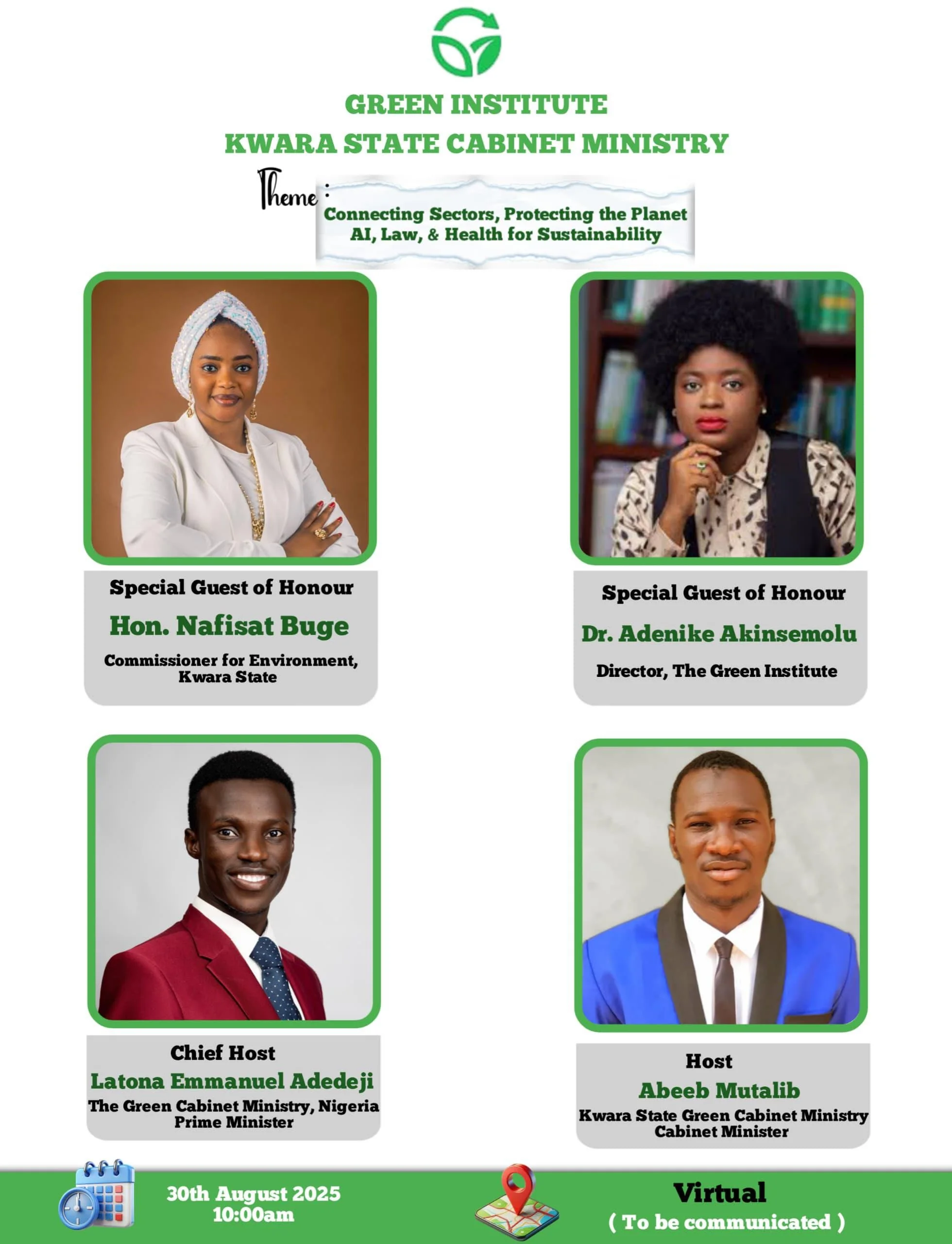
Theme: Connecting Sectors, Protecting the Planet: AI, Law, and Health for Sustainability
Date: Saturday, 30th August 2025
Time: 10:00 a.m. – 12:15 p.m.
Platform: Zoom
Host: Kwara State Green Cabinet Ministry under the auspices of The Green Institute
Introduction
On Saturday, 30th August 2025, the Kwara State Green Cabinet Ministry, under the auspices of The Green Institute, successfully hosted the Interdisciplinary Dialogue Webinar themed Connecting Sectors, Protecting the Planet: AI, Law, and Health for Sustainability. The session commenced promptly at 10:00 a.m. via Zoom and concluded at 12:15 p.m., engaging nearly two hundred participants from within and outside Nigeria.
Background and Rationale
The accelerating climate crisis continues to influence legal systems, public health, and technological development. Recognising this interconnectedness, this state-level initiative of The Green Institute convened the webinar to foster collaboration across sectors and to promote actionable, cross-disciplinary strategies.
By integrating insights from artificial intelligence, law, and public health, the event aligned with global sustainability objectives while positioning Kwara State as a pioneering hub for interdisciplinary environmental action.
Objectives
The key objectives of the webinar were to:
Explore the intersections of AI, law, and health in advancing environmental sustainability.
Encourage collaborative, cross-sectoral thinking in addressing climate-related challenges.
Inspire participants to develop and implement action-oriented solutions.
Present the Kwara State Green Cabinet Ministry as an inclusive platform for sustainable innovation.
Opening Session
The session opened with warm welcome remarks and goodwill messages. Dr Adenike Akinsemolu, Director of The Green Institute, delivered an inspiring keynote address emphasising the vital links between AI, law, and health in shaping a sustainable future. She urged attendees to adopt the Green Pledge as a practical framework for individual, community, and global action.
A goodwill message from the Ministry of Environment, Kwara State, was also delivered. Special recognition was extended to the Honourable Commissioner for Environment, Hon. Nafisat Musa Buge, for her unwavering support and commitment to collaborative environmental action.
Speaker Presentations
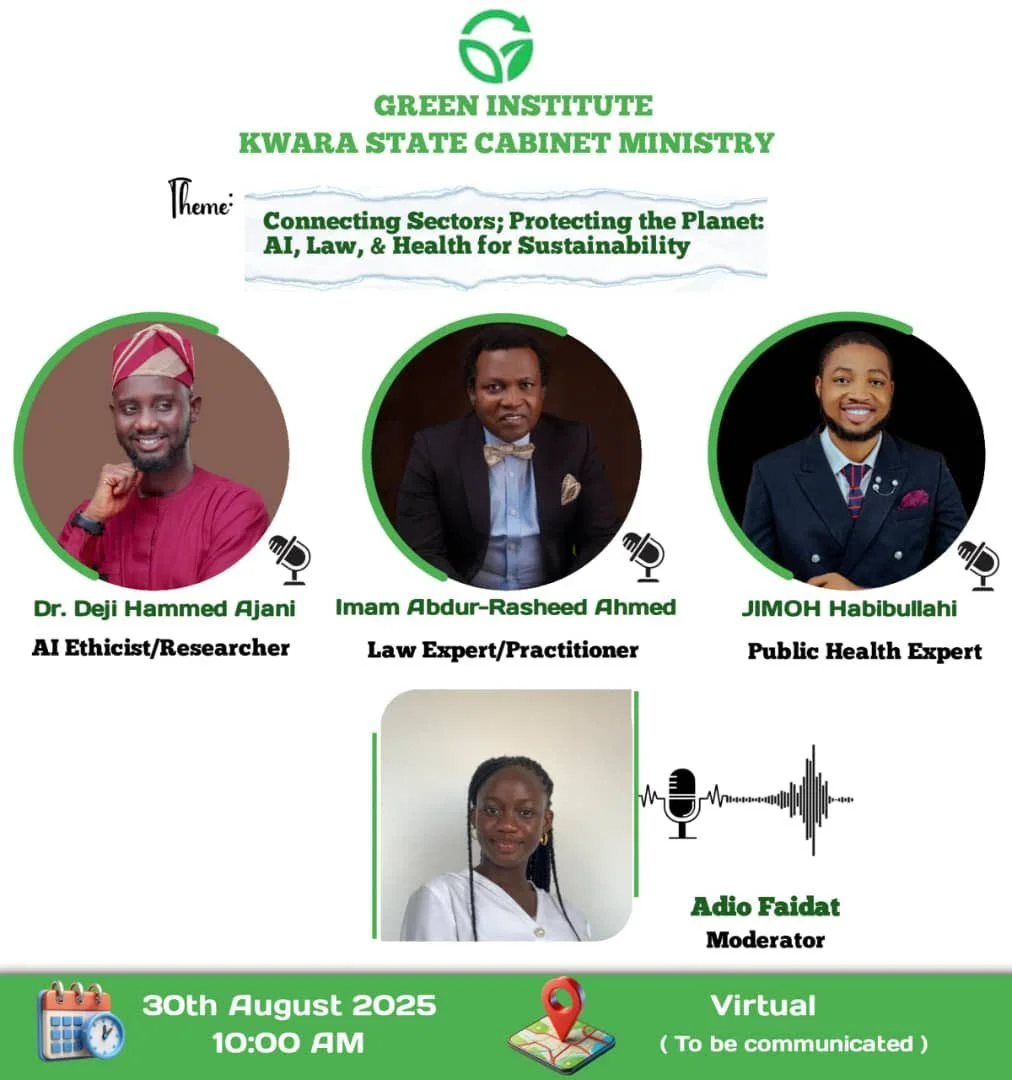
Dr ‘Deji Ajani discussed how AI, leveraging data, automation, and predictive modelling, can revolutionise environmental monitoring by detecting deforestation, energy inefficiency, and other ecological challenges. He emphasised AI’s potential to provide real-time insights for proactive intervention.
Barrister Imam Abdur-Rasheed Ahmed analysed Nigeria’s environmental legal frameworks, referencing key legislation such as the NESREA Act, Climate Change Act, FEPA, the Environmental Impact Assessment Act, and state-level laws including the Kwara State Environmental Protection Agency Law. He stressed the importance of institutional synergy in protecting public health and upholding constitutional rights.
Mr Jimoh Habibullahi highlighted environmental pollution as a silent global killer responsible for premature deaths and widespread illnesses. He advocated for a transition to renewable energy, stronger pollution control measures, improved access to clean water, and the promotion of sustainable agricultural practices.
Interactive Engagement
Participants had ample opportunity to engage with the speakers, pose questions, and share perspectives. Notably:
Priyashree Ghosal, a participant from India, highlighted the environmental challenges associated with Durga Puja festivals, such as the widespread use of single-use plastics and improper waste disposal, which significantly raise pollution levels during celebrations.
Isiyaku Abdullahi, from Northern Nigeria, emphasised that environmental degradation is often exacerbated by weak law enforcement and corporate non-compliance. He called for the strengthening of legal frameworks to move beyond policy documentation towards genuine implementation and improved public health outcomes.
Moderation and Coordination
The session was expertly moderated by Adio Faidat, a final-year law student and executive member of the Kwara State Green Cabinet Ministry. Behind-the-scenes coordination was efficiently handled by Abdullahi Tawfiq Salman and Abdulazeez Bin-Abdulazeez, whose dedication ensured the seamless execution of the event.
Certificates and Recognition
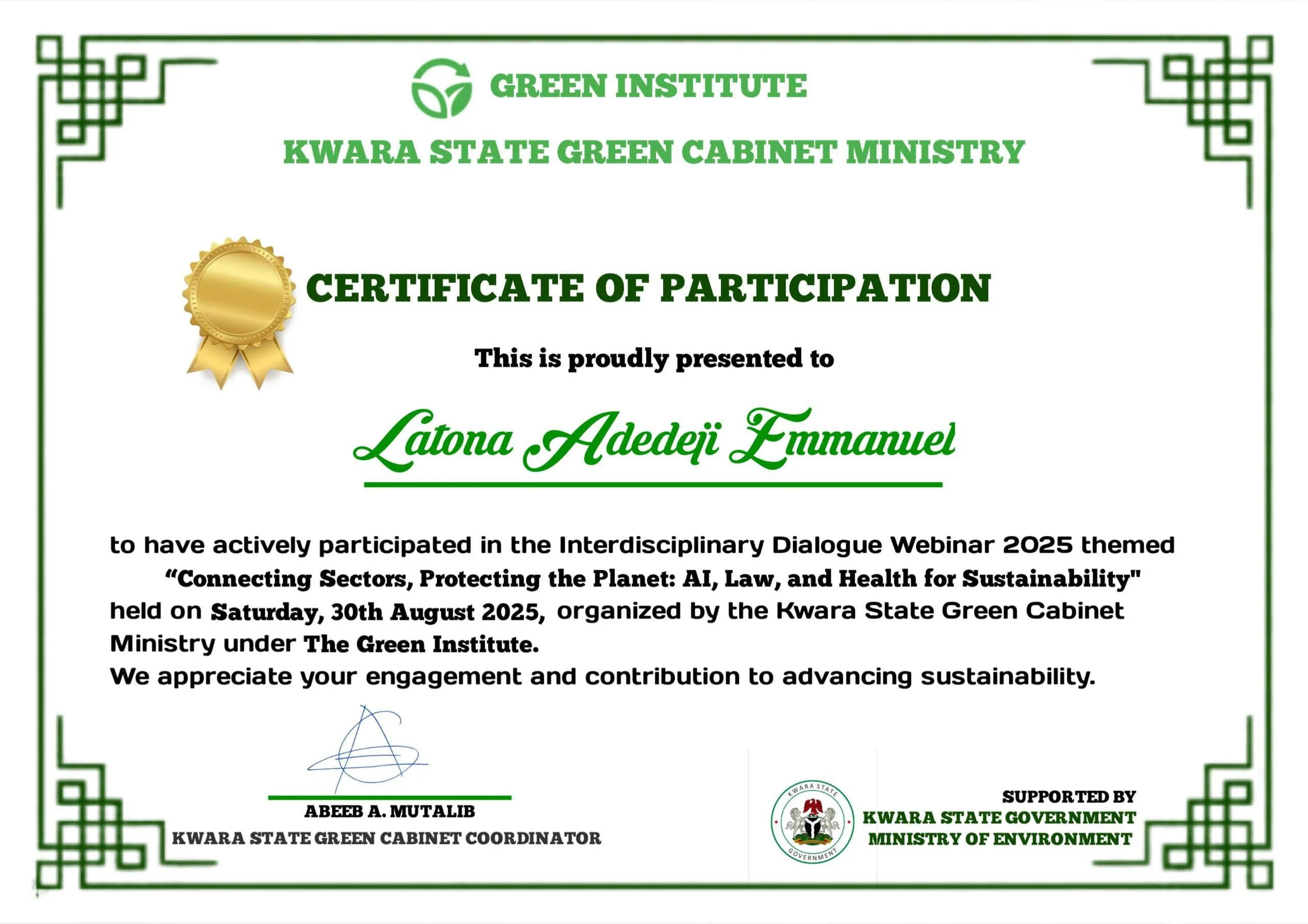
Certificates of Participation were issued to all attendees in recognition of their engagement. Special appreciation goes to Hon. Nafisat Musa Buge, Honourable Commissioner for Environment, Kwara State, for her continued support. Gratitude is also extended to Dr Adenike Akinsemolu, Director of The Green Institute, the distinguished speakers, and every member of the Kwara State Green Cabinet team whose collective efforts contributed to the success of the programme.
Closing and Key Takeaways
Abeeb Mutalib, Coordinator of the Kwara State Green Cabinet, delivered the vote of thanks. He encouraged participants to apply the knowledge gained by integrating sustainability practices into their professions, communities, and daily lives. The webinar officially closed at 12:15 p.m.
Conclusion
The Interdisciplinary Dialogue Webinar 2025 demonstrated that meaningful environmental progress can be achieved when technology, legal systems, and public health are addressed in harmony. By bringing together voices from multiple disciplines, The Green Institute and the Kwara State Green Cabinet Ministry continue to lead the way in inspiring actionable change towards a more sustainable future.