
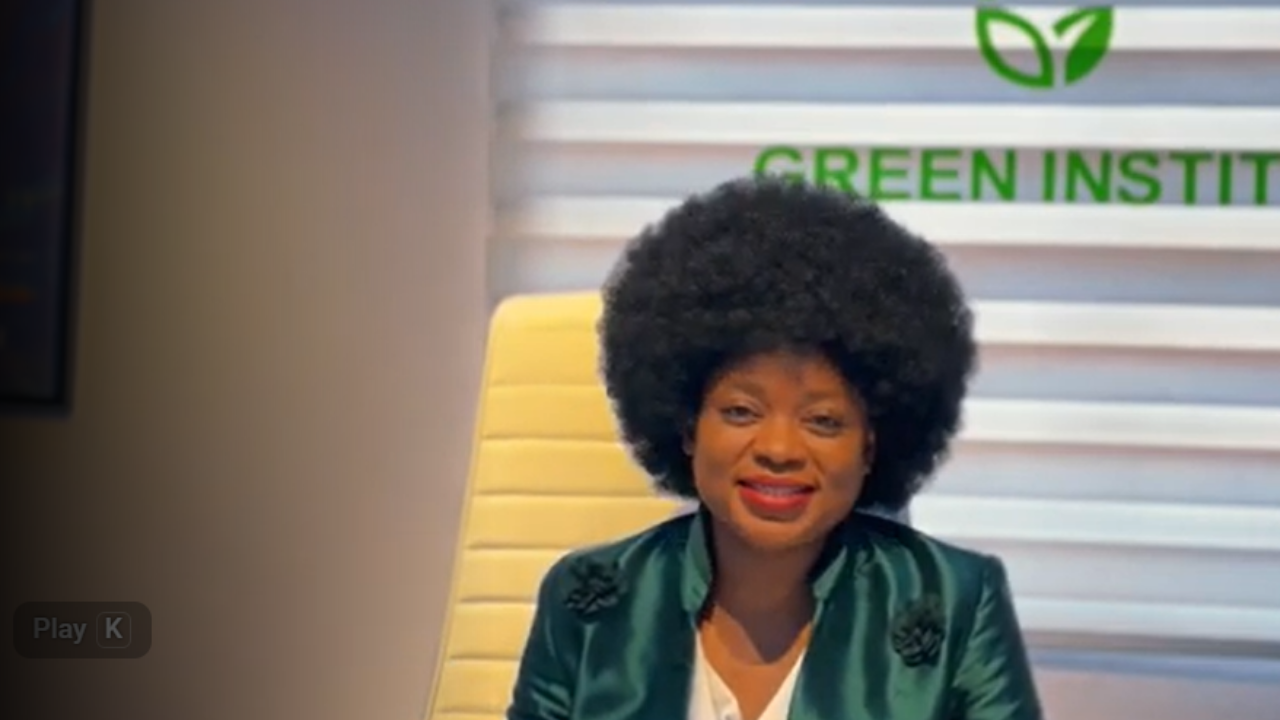
Our mission at The Green Institute remains clear: we are building the next generation of sustainability leaders through education, advocacy, and innovation.
Watch the Founder’s Message below as we reaffirm our purpose, our priorities for 2026, and why Africa must not only participate in global sustainability efforts — Africa must lead.
FULL TRANSCRIPT
Good day.
As we enter 2026, I want to be very clear about why The Green Institute exists, what we stand for, and where we are going.
The Green Institute was founded on a simple but urgent conviction:
that sustainability will not be achieved by policies alone, projects alone, or technology alone.
It will be achieved by leaders.
Leaders who understand systems.
Leaders who can connect science to policy.
Leaders who can translate ideas into action.
And leaders who are grounded in ethics, equity, and responsibility.
That is why our mission is clear and unchanged:
to build the next generation of sustainability leaders through education, advocacy, and innovation.
In 2026, the world faces overlapping challenges—climate instability, energy transitions, food insecurity, environmental degradation, and growing social inequalities.
These challenges are global, but their impacts are local.
And nowhere is this more evident than in Africa.
For too long, Africa has been framed as a participant in global sustainability conversations.
At The Green Institute, we reject that framing.
Africa must not only participate.
Africa must lead.
Leadership grounded in knowledge.
Leadership informed by lived realities.
Leadership that shapes global thinking, policy, and practice.
In 2026, The Green Institute is focused on institutional leadership.
This means three things.
First, education.
We are investing in rigorous, forward-looking education that prepares leaders to think critically, act responsibly, and operate across disciplines and sectors.
Our fellowships, courses, and academic programmes are not designed for certificates alone; they are designed for impact.
Second, advocacy.
We believe that advocacy must be intellectual, evidence-based, and policy-relevant.
In 2026, The Green Institute will continue to contribute to national, continental, and global conversations with clarity, credibility, and conviction.
And third, innovation.
Not innovation for visibility, but innovation for systems change.
Solutions that are locally grounded, scalable, and informed by research.
In 2026, every Green Institute programme, convening, publication, and partnership is united under one theme:
Building the Next Generation of Sustainability Leaders.
This is not a slogan.
It is a responsibility.
It means that every course must build capacity.
Every event must strengthen thinking.
Every partnership must add value.
And every output must contribute to long-term change.
As Founder and Global Director, my commitment is to ensure that The Green Institute continues to operate with integrity, intellectual rigour, and strategic focus.
We will not be distracted by trends.
We will not dilute our mission for short-term visibility.
And we will not compromise the credibility of this institution.
Instead, we will continue to build—deliberately, consistently, and collaboratively.
To our fellows, partners, speakers, and collaborators:
you are not participants in a programme;
you are part of an institution.
An institution committed to shaping ideas, developing leaders, and influencing systems for a sustainable future.
As we move through 2026 and beyond, let us be guided by this conviction:
That leadership is built, not assumed.
That sustainability requires depth, not noise.
And that Africa’s contribution to global sustainability must be intellectual, ethical, and transformative.
This is the work of The Green Institute.
This is our focus for 2026.
And this is our commitment to the future.
Thank you.
#OfficiallyGreen