Everyone will lose unless humanity makes ‘peace with the planet’, declares Guterres

Humanity is “waging a war on nature”, threatening biodiversity loss, climate disruption and escalating pollution, the UN chief said on Friday.

“We will all be losers if we don’t achieve peace with the planet”, Secretary-General António Guterres told a webinar ahead of the International Day for Biological Diversity, commemorated annually on 22 May. 

“We should all be advocates for nature”, he said. 

A dismal picture 

Nature sustains life and provides opportunities, services and solutions, he explained, noting that “a healthy planet is critical for achieving the Sustainable Development Goals (SDGs)”. 

Yet, biodiversity is declining at an “unprecedented and alarming rate”, and the pressures are intensifying, he warned. 

“We have failed to meet any of our internationally agreed biodiversity targets”, the UN chief said. 

He said one million species are at risk of extinction; ecosystems are disappearing “before our eyes”; deserts are spreading, and wetlands are being lost. 

Every year, 10 million hectares of forests are lost, oceans are overfished and “choking with plastic waste” as the carbon dioxide they absorb is acidifying the seas, bleaching and killing coral reefs, he added. 

And the total annual international public finance for nature is significantly less than the subsidies causing its degradation. 

“We are depleting resources faster than nature can replenish them”, the UN chief continued. 

Zoonic factor 

The pandemic has highlighted the intimate relationship between people and nature, he said, while changes in land use and encroachment on wild habitats are the primary paths for emerging infectious diseases, such as the deadly Ebola and COVID-19 viruses. 

“Three-quarters of new and emerging human infectious diseases are zoonotic”, jumping from animals to humans, and against this backdrop, the UN chief said that tackling the current COVID-19 crisis provides an opportunity to recover better. 

Biodiversity dividends 

In this landmark year for restoring balance with nature, tackling the climate emergency and getting ahead of the pollution crisis, the UN chief underscored, “our efforts to protect biodiversity will be key”. 

UN News.jpg

He said that solutions to the current crisis must expand opportunity, reduce stark inequalities and respect planetary boundaries, with “nature-positive investments and actions” to allow everyone to benefit from the “dividends of biological diversity”. 

Later this year, governments will meet for 15th Conference of Parties of the Convention on Biodiversity (COP-15) in Kunming, China, to finalize a new global framework for biodiversity to protect nature, restore ecosystems and reset humanity’s relationship with the

“It is essential that they succeed”, stressed the Secretary-General. “The rewards will be tremendous”. 

Movement for change 

There are many existing solutions to protect the planet’s genetic diversity on land and at sea, but they must be employed. 

“Everybody has a part to play. Sustainable lifestyle choices are the key”, said the UN chief, calling sustainable production and consumption “the answer”. 

Better policies that promote government, business and individual accountability are needed to give every person throughout the world the choice to live sustainably and be part of a movement for change. 

“Let us all be part of the solution”, he said. “Together, we can halt biodiversity loss and ecosystem degradation and build a future where we live in harmony with nature”. 

‘Demand better for nature’ 

In her Biodiversity Day message, Inger Andersen, Executive Director of the UN Environment Programme (UNEP), spelled out that the planet’s challenges are “so acute that we don’t have the luxury of waiting around for someone else to step up and take action”. 

She explained that UNEP supports countries in monitoring and managing their biodiversity “as best we can”; sounds the alarm on what science is saying regarding biodiversity loss and how to change course; and works with businesses and finance to help shift towards “nature-positive investments”. 

The agency also works with decision-makers to factor in assets provided by nature to limit destruction caused by economic activity and mobilizes the entire UN system to support biodiversity through each of their mandates. 

“When we demand better for nature, we get better outcomes for all people”, stated Ms. Andersen. 

Become the solution 

Elizabeth Maruma Mrema, Executive Secretary of the Convention on Biological Diversity (CBD), said that diversity of life on the planet is “declining more than ever before in human history”; plant and animal species face extinction; and “humans are overusing the Earth’s capacity by more than half”.  

Explaining that halting biodiversity loss would create the necessary conditions to achieve the SDGs, improve human health and address the climate emergency, she stressed: “Now is the time to change our relationship with nature”. 

The CBD chief underscored the importance of a COP-15 compact to protect crucial ecosystems, species and genetic diversity, saying that by acting for nature, “we can create a fairer, healthier and more sustainable world”.  

“Are you part of the solution to save biodiversity? If not, I invite you. Become part of the solution for nature”, she concluded.

Richest nations agree to end support for coal production overseas

Fiona Harvey

G7 countries reaffirm commitment to limit global heating to 1.5C after nearly two days of wrangling

Children play by the beach near a coal power plant in Java. Photograph: Kemal Jufri/Greenpeace

Children play by the beach near a coal power plant in Java. Photograph: Kemal Jufri/Greenpeace

The world’s richest nations have agreed to end their financial support for coal development overseas, in a major step towards phasing out the dirtiest fossil fuel.

After nearly two days of wrangling at a meeting of the G7 Environment and energy ministers, hosted virtually by the UK on Thursday and Friday, all reaffirmed their commitment to limiting global heating to 1.5C, and committed to phasing out coal and fully decarbonising their energy sectors in the 2030s.

Japan, one of the world’s biggest sources of finance for coal power, along with China, held out on agreeing to stop helping to build until the final stages of the two-day virtual meeting. Japan’s government raised concerns that if it halted the financing, China would step in and build coal-fired power plants overseas that were less efficient than Japanese designs.

The other G7 members – the UK, the US, the EU, France, Italy, Germany, and Canada – were all united in calling for an end to such financing. The rich countries that make up the G7, along with other major non-G7 economies such as China and South Korea, have played a major role in the past in financing fossil fuel development in poorer countries. Japan, China and South Korea in particular have offered to help build coal-fired power plants in cash-strapped developing countries.

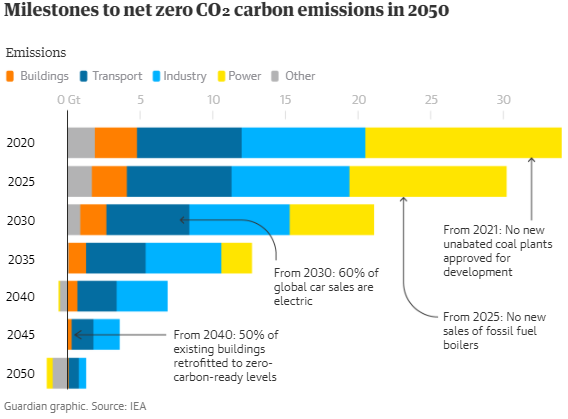
However, the International Energy Agency said earlier this week that all new developments of fossil fuels must end this year to give the world a good chance of keeping within the 1.5C limit. A recent increase in the use of coal, after last year’s lockdowns around the world, is largely responsible for what is forecast by the global energy watchdog to be the second biggest rise in emissions on record this year.

The IEA has set out milestones for a pathway to net zero CO₂ carbon emissions in 2050

The IEA has set out milestones for a pathway to net zero CO₂ carbon emissions in 2050

John Kerry, the US climate envoy, said the US was determined to bring forward policies consistent with keeping within a temperature rise of 1.5C above pre-industrial levels, including phasing out coal. Referring to the IEA advice, he said the US would phase out unabated coal-fired power, which means power stations without technology to capture and store carbon dioxide.

Kerry said: “I will strongly recommend to the president that this is a policy that we should pursue … But I guarantee that we will be completely consistent with 1.5C. 1.5C governs the choices we have to make in the next 10 years. Any decision has to be within that framework.”

He said the G7 decision to affirm a 1.5C temperature limit, which according to scientists will require a halving of greenhouse gas emissions this decade as well as reaching net zero emissions by 2050, marked the first time that the countries had made such a commitment and was a major step forward. The 2015 Paris agreement requires countries to hold temperature rises “well below” 2C above pre-industrial levels, with a 1.5C limit as an aspiration.

“[There was] a greater sense of urgency than I have felt in G7 countries as a unit,” he said.

Barbara Pompili, France’s environment minister, said: “I am delighted that an agreement could be found regarding a key aspect of our G7 communique: the absolute end of new direct government support for international coal power generation. It gives a very strong signal to the world that coal is an energy of the past and has no place in our future energy mix. It sets the stage for a radical transition towards clean energy.

“That was a difficult decision for Japan in particular, and I am very pleased that Japan was able to take this decisive step.”

South Korea, another major source of finance for coal-fired power generation overseas, has already agreed to end the practice. That leaves China as the biggest source of such finance in developing countries.

China will now be keenly watched ahead of Cop26, the vital UN climate talks to be hosted by the UK in Glasgow this November. The world’s biggest emitter has yet to produce a national plan for curbing greenhouse gas emissions by 2030, called a nationally determined contribution (NDC) and an essential part of any deal at Glasgow.

Amina Mohammed, deputy secretary-general of the UN, told the meeting: “We are running out of time to bend the emissions curve and cut emissions by 45% globally by 2030 and that’s from 2010 levels. This means all main emitters must deliver enhanced NDCs this year with concrete and credible targets that we can follow through to 2030. Important investments in the targets we set for 2030 will determine the outcome of credibility of the 2050 targets. And it means no new coal starting now, phasing out coal in OECD countries by 2030, and in the rest of the world by 2040.”

The G7 communique contains a caveat, the Guardian understands, at the behest of the Japanese government, that would allow financing for coal in “limited circumstances at the discretion of each country”. It is understood this will only be used in exceptional circumstances.

The draft text reads: “We commit to promoting the increased international flow of public and private capital toward Paris Agreement-aligned investments and away from high-carbon power generation to support the clean energy transition in developing countries. In this context, we will phase out new direct government support for carbon-intensive international fossil fuel energy, except in limited circumstances at the discretion of each country, in a manner that is consistent with an ambitious, clearly defined pathway towards climate neutrality in order to keep 1.5C within reach, in line with the long-term objectives of the Paris Agreement and best available science.

“Consistent with this overall approach and recognising that continued global investment in unabated coal generation is incompatible with keeping 1.5C within reach, we stress that international investments in unabated coal must stop now and commit to take concrete steps towards an absolute end to new direct government support for unabated international thermal coal power generation by the end of 2021, including through Official Development Assistance, export finance, investment, and financial and trade promotion support.”

Trillions of litres of water released into Murray-Darling fails to help threatened species, research finds

Graham Readfearn

A ‘just add water’ approach is unlikely to be successful, with better monitoring of species needed to target environmental watering

The Darling-Barka River. An Australian National University study suggests a major rethink is needed of the way water is released for the environment in the Murray-Darling Basin. Photograph: Jenny Evans/Getty Images

The Darling-Barka River. An Australian National University study suggests a major rethink is needed of the way water is released for the environment in the Murray-Darling Basin. Photograph: Jenny Evans/Getty Images

Trillions of litres of water released into the Murray-Darling Basin to benefit the environment has failed to increase the populations of threatened species, according to new research.

In a damning assessment of the monitoring of eight threatened species, the research from Australian National University scientists says the public reporting of the benefits of environmental watering was fragmentary and not backed by evidence.

A “major rethink” of the way water was released for the environment through the $13bn basin plan was now needed, the research said.

Since 2007, some 198,000 gigalitres of environmental water had been released into the Murray-Darling Basin – the equivalent of almost 400 Sydney Harbours of water.

Research at the university’s Fenner School of Environment and Society looked at eight species listed nationally as threatened: two frogs, two waterbirds and four fish.

After reviewing all available data on the location and number of the species, the analysis published in the journal Marine and Freshwater Research found “no overall beneficial effect in terms of population increase of threatened species from environmental watering under the Basin Plan”.

Prof Jamie Pittock, a co-author of the research, told Guardian Australia: “Our overall finding is that there is no evidence of any improvement after reallocating about 2,000 billion litres of water and spending those billions of dollars.”

He said they found there was no monitoring at all of the threatened species in one-quarter of all the places where water was released. Some environmental watering had undoubtedly benefited some species, but the evidence for this was scarce, the report said.

Albie Ryan, who led the research but has since moved into private industry as an environmental consultant, said poor monitoring of species had led to poorly targeted releases of water.

He said a top-down approach to conservation and monitoring had not worked. “What’s more effective is a bottom-up grassroots approach that’s led by the community and brings together people including Indigenous groups and catchment managers.”

The researchers wrote that a lack of assessments meant it was not possible to know if Australia was upholding obligations to three international environmental treaties – the Convention on Biological Diversity, the Convention on Migratory Species and the Ramsar Convention on Wetlands.

Two of the species – flathead galaxias and silver perch – are listed nationally as critically endangered, but a national recovery plan is not in place for either. Plans are only in place for the southern bell frog, trout cod and Murray hardyhead.

“A failure to monitor and detect translates into a failure to prioritise species in environmental watering plans,” the research said.

“The approach to conservation in the basin that is characterised by the expression ‘just add water’ is unlikely to be successful in the long term without more sophisticated and strategic management.”

The Murray-Darling Basin Authority has seen previous drafts of the research.

In a statement Vicki Woodburn, the authority’s executive director of basin strategy and knowledge, said the authority agreed monitoring “needs to be improved across the basin and that threatened species should be considered”.

The authority had received $7.5m from the Australian government to improve monitoring capability “as this is an area requiring funding boost” and a strategy was being developed.

She said: “We welcome this independent research and the contribution it makes to the public conversation. It also helps to inform our work.

“This paper makes some good points, however the Basin Plan and the Water Act are not solely responsible for monitoring and recovering threatened species populations – there is role for all governments, including through the Environment Protection and Biodiversity Conservation (EPBC Act) in this important work.”

Starting up a Sustainability Business? Here is what you need to know!

Leonardo Lima

In our current scenario, we need new ideas to reduce environmental impacts and create a prosperous world. International companies seek innovation and business models to improve the relationship with ecosystems and communities.

For this reason, sustainable entrepreneurship has been growing inside and outside companies, contributing to the solution of social and environmental problems, both locally and globally. Boosting entrepreneurship is an emergency and a strategy for governance and companies, for example; this makes the marketplace more productive through technological change, creates jobs, and adds value for members of the society. Sustainability entrepreneurship acts at the interface of politics, business, and civil society to mobilize new resources and aim at a structural change towards socially and environmentally sound economic activities. 

Currently, several people are trying to develop new ideas to solve some socio-environmental problems, in addition, there are many challenges that compel governments and companies to envision new ideas. As a result, new entrepreneurial methodologies are being implemented in several projects to accelerate business, but, unfortunately, the lack of opportunities and experiences during schools and undergraduate courses is a major barrier to the entrepreneur's mindset.

In order to help new entrepreneurs, 4D Sustainability Canvas created a simple and affordable solution to develop new sustainable business models. The company developed a methodology that supports the first steps for small and medium-sized companies, carrying out a journey.

The company follows these steps:

1. Map the impact

  • Value chain

  • Community

  • Governance

  • Planet

  • Employees

2. Associate the organization with the UN 2030 Agenda

3. Define the sustainability goals

  • Goal

  • Action

  • Related SDG

  • Target indicator

  • Owner

  • Reporting method

  • Business advantage

4. GET Results

The world is ‘standing on the precipice’ of multiple crises, former UN chief warns


Tania Bryer

  • Former U.N. Secretary-General Ban Ki-moon said the coming 10 years would be crucially important for global leaders to work on the U.N.’s Sustainable Development Goals.

  • These are 17 targets created by the New York-based organization which are a call for action on economic, social and environmental sustainability by the year 2030.

  • Narrowing it down, he said that the ongoing Covid-19 crisis had further highlighted the impact of a global water shortage.

Former UN Secretary General Ban Ki-Moon IThomas Trutschel | Photothek | Getty Images

Former UN Secretary General Ban Ki-Moon IThomas Trutschel | Photothek | Getty Images

Former U.N. Secretary-General Ban Ki-moon has spoken of the multiple disasters the world is currently facing, which have only been accentuated by the ongoing coronavirus pandemic. 

Ban, who led the U.N. from 2007-2016, called on global leaders to raise their ambition in order to avoid failures on a range of different issues, including climate change and the scarcity of water.

“There are still 2 billion people who lack safe drinking water, more than 1.5 billion people who do not have electricity and there are more than 60 million schoolchildren who do not go to school, even elementary school ... This is sad, this is really heartbreaking,” Ban told CNBC’s “Sustainable Future” in March, speaking around World Water Day.

“We are standing on the precipice of all these crises ... I hope that global leaders should have far-reaching global visions, that we are in this world together, we are all in this together, otherwise, we will all be a failure. Therefore, I’m really urging political leaders to do their best, lead by example,” he added. 

Ban said the coming 10 years would be crucially important for global leaders to work on the U.N.’s Sustainable Development Goals. These are 17 targets created by the New York-based organization which are a call for action on economic, social and environmental sustainability by the year 2030.

Narrowing it down, he said that the ongoing Covid-19 crisis had further highlighted the impact of a global water shortage.

“The pandemic of course has thrown a spotlight on this issue and it has also really demonstrated that water is a connecting thread linking the myriad of impacts of our crises, whether that’s around infectious diseases or food security, the last year has seen us experience all of them,” he said.

“When trillions of dollars are being spent for controlling the coronavirus, I think we need to see a bigger, bigger picture, investing wisely in water, that will really help our life. That’s one of the most important urgent items of (the) Sustainable Development Goals now,” he added.

Ban was speaking alongside the CEO of the Global Center for Adaptation, Patrick Verkooijen. Ban is also the chair of the GCA, which describes itself as a “solutions broker to accelerate, innovate and scale adaptation action for a climate-resilient world.”

Verkooijen told CNBC that the pandemic had been a “wake-up call.” “We are utterly unprepared for the next crisis, the climate emergency ... 90% of all natural disasters are water-related, more floods, more droughts, more storms, more fires. In the last two decades, these climate disasters have doubled. Half a million people lost their lives and over 2 trillion in economic losses,” he said.

“In 2017, three storms cost the United States economy $265 billion. Last year in 2020, one storm, over $55 billion in economic losses. I think (U.S. Special Presidential Envoy for Climate) John Kerry said it very well, we have now crossed the point that investing in prevention is much more effective than cleaning up afterwards. That’s why investing in water and climate adaptation is the way to go,” he added.

Ban, who led efforts for the signing of the Paris Agreement for Climate Change in 2015, said that action on addressing all these issues needed to be sped up.

“We have to really expedite and raise the ambition level particularly by political leaders ... People know that climate change is very important, very serious and needs urgent action,” told CNBC.

“But at the same time, we have to take care of all the food shortages and gender empowerment, water shortages, quality education, resilient cities.”

‘Catastrophic’: Sierra Leone sells rainforest for Chinese harbour

Seascape: the state of our oceans

Karen McVeigh and Kabba Kargbo in Freetown

Controversial deal with China would be ‘disastrous’ for fishing and protected rainforest, say opponents

The beach earmarked for development fringes the Western Area Peninsula national park, home to endangered species including pangolins. Photograph: Issouf Sanogo/AFP/Getty

The beach earmarked for development fringes the Western Area Peninsula national park, home to endangered species including pangolins. Photograph: Issouf Sanogo/AFP/Getty

A $55m (£39m) deal struck by the government of Sierra Leone with China to build an industrial fishing harbour on 100 hectares (250 acres) of beach and protected rainforest has been criticised as “a catastrophic human and ecological disaster” by conservationists, landowners and rights groups.

The gold and black sands of Black Johnson beach fringe the African nation’s Western Area Peninsula national park, home to endangered species including the duiker antelope and pangolins. The waters are rich in sardines, barracuda and grouper, caught by local fishermen who produce 70% of the fish for the domestic market.

After reports of a Chinese-backed fishmeal plant began circulating on social media, A statement that appeared to be from the Sierra Leonean fisheries ministry confirmed the deal, but denied the planned construction was a “fish mill”. The facility would be a harbour for tuna and “other bigger fishing” vessels exporting to international markets, it said. It would include a “waste-management component” to “recycle marine and other wastes into useful products”.

The government said the beach, one of many along the nation’s 250-mile (400km) coastline, was the “most suitable place” for construction, and revealed the finance ministry had set aside a compensation package of 13.76bn leone (£950,000) for affected landowners. But the statement leaves more questions than answers, say those objecting to the plan.

The planned development is on Whale Bay, known for its cetaceans and also a key fish-breeding area, say opponents of the scheme. Photograph: Issouf Sanogo/AFP/Getty

The planned development is on Whale Bay, known for its cetaceans and also a key fish-breeding area, say opponents of the scheme. Photograph: Issouf Sanogo/AFP/Getty

Two legal campaign groups, the Institute for Legal Research and Advocacy for Justice (ILRAJ) and Namati Sierra Leone, have written to the government, under the 2013 Right to Access Information Act, demanding to see the environmental and social-impact assessment studies, and the report showing that the beach was, as claimed, the most suitable place for construction “in terms of bathymetry, social safeguards (minimum resettlement costs) and environmental issues”. They are also seeking a copy of the grant agreement between China and Sierra Leone.

Basita Michael, a lawyer for the ILRAJ, said: “The press release was very vague. It left us wondering how did we arrive here and how come we are only hearing about this now. We have a right to know more.”

James Tonner, who owns land at Black Johnson with his mother, Jane Aspden Gbandewa, has written an open letter to the president, Julius Maada Bio, calling for him to intervene and stop the construction, which Tonner said would be “disastrous for the country and the planet”.

It would destroy pristine rainforest, plunder fish stocks and pollute fish breeding grounds and several ecosystems, Tonner said. The beach is on Whale Bay, so-named because whales and dolphins are seen there.

Tonner, who lives in London, has set up a crowdfunding page to fund a judicial review into the deal. The government could be acting unconstitutionally if it acquired the land compulsorily, he said, because the constitution requires any such move to be in the public interest. The compensation stated by the government was also unfair, he argued, claiming that the rate was about 30 times lower than the market value of the land.

“Under the constitution, the government can sequester land if it is in the public interest,” Tonner said. “Even if this just a deep-water harbour, it is not in the public interest because it’s not a suitable site. There are fish breeding sites in the lagoon. It will wipe out the local fish people live on.”

Tito Gbandewa, Tonner’s stepfather, is a former fisherman who runs an ecotourism business on the beach and owns about 1.2 hectares. He said: “If they do this here, the water will be dirty, there will be a lot of oil and noise, the trawlers will be all around.

“Our own fishermen won’t have a place to fish. Everything will be spoiled. Tourism will be finished.”

Dr Sama Banya, president emeritus of the Conservation Society of Sierra Leone, echoed Gbandewa’s comments, saying the proposed development would have a “disastrous” impact on tourism and “the very fish industry that it’s supposed to support”.

Tito Gbandewa: ‘If they do this here, the water will be dirty, there will be a lot of oil and noise, the trawlers will be all around.’

Tito Gbandewa: ‘If they do this here, the water will be dirty, there will be a lot of oil and noise, the trawlers will be all around.’

Emma Kowa Jalloh, Sierra Leone’s fisheries minister, insisted that the plan was for a harbour and not a fishmeal factory. She said: “I can categorically tell you there is no fish mill [sic] going in at Black Johnson. What we are doing is a fish harbour that will be built by the Chinese government. A fish mill is something where you go and catch all the baby fish and grind it into food to give to piggeries, and fish in aquaculture – and that is so not true.”

It would be built with a Chinese government “grant” and equity from Sierra Leone in the form of land, she said. Half of the land needed was government-owned, she said, including the seafront, up to 200 metres from the sea. The rest has been acquired through compulsory acquisition, she said.

“People are making this fuss about it,” the minister added. “I would just appeal to people: ‘be patient, we want to be developed, we want to grow, we want to be classified as an upcoming country. There must be development and somebody has to sacrifice.’

“I’m not saying everything is going to be 100% perfect but we will make sure that it is near-perfect.”

Air pollution linked to ‘huge’ rise in child asthma GP visits

Damian Carrington

Exclusive: consultations for asthma and other respiratory infections go up with increased dirty air, finds study

The study found that inhaler prescriptions also increased significantly as a result of higher air pollution. Photograph: Yui Mok/PA

The study found that inhaler prescriptions also increased significantly as a result of higher air pollution. Photograph: Yui Mok/PA

A “huge” increase in the number of visits to doctors by children with asthma problems occurs after a week of raised air pollution, according to a study. The number of inhaler prescriptions also increases significantly.

Dirty air is already known to increase hospital treatment for severe asthma attacks and other respiratory problems. But the new research is the first using clinical data to show increased illness among the much bigger number of people who seek treatment from their GP.

The researchers said children were the most severely affected by the raised air pollution, but there were increases in GP consultations and inhaler prescriptions for people of all ages. Overall, they said, the study demonstrates that air pollution, particularly from diesel vehicles, affects whole communities.

The researchers called for action to cut air pollution and said pollution warnings could be used to help those at risk to prepare for episodes of increased dirty air. The research was conducted in south London over five years and analysed more than 750,000 respiratory consultations at GPs and inhaler prescriptions.

The average level of particle pollution in Lambeth during the study period was 21 micrograms per cubic metre of air (µg/m3). The researchers found that when this pollution was raised by 9 µg/m3 for a week, the number of child consultations for asthma and respiratory infections went up by 7.5%. For nitrogen dioxide pollution, the average level was 51µg/m3, and a rise of 22µg/m3 was linked with consultations rising by 6%.

“These are huge increases,” said Mark Ashworth, at King’s College London, who led the research. “We’d expected much smaller associations. This is a very large shift of the dial and has never been shown before.”

Air pollution was found to have caused the death of nine-year-old Ella Kissi-Debrah. Photograph: Family Handout/PA

Air pollution was found to have caused the death of nine-year-old Ella Kissi-Debrah. Photograph: Family Handout/PA

Children are already among the most frequent visitors to GPs and respiratory problems are one of the most common reasons for consultations, he said, so these percentage rises mean a large number of extra visits.

Furthermore, Ashworth said: “We think these headline figures are a substantial underestimate.” This is because the GP data was only available from Monday to Friday and during surgery hours, so consultations at weekends or in the evening were not included in the data.

“We all have in our minds the case of Ella Kissi-Debrah,” Ashworth said. “If only we’d had this evidence then.” A landmark ruling by a coroner in December found that air pollution was a cause of death of the nine-year-old girlin south London in 2013.

“We now have confirmation that diesel-related air pollution is linked strongly to respiratory illness that is bad enough to see the GP,” Ashworth said. “That’s got to be a call to reduce diesel pollution.”

Rosamund Kissi-Debrah, Ella’s mother and clean air advocate for the World Health Organization (WHO), said: “I keep on saying daily how so many are affected like Ella. Diesel must be phased out as soon as possible – the health impacts are terrible. We can’t have a generation of children on inhalers. Health professionals must continue to speak up as their voice is critical.

The coroner’s April report on the prevention of future deaths said the UK’s legal limits for particulate pollution should be halved, to be in line with WHO guidelines. He also said better warnings on air pollution levels should be provided to the public and that medical staff should be trained to give patients more information on the dangers of dirty air.

Privacy safeguards mean that large datasets of clinical data from GPs are rare but the new study, published in the journal Environmental Health, used Lambeth DataNet, which provides anonymised information on 1.2 million patients.

Data on respiratory consultations and inhaler prescriptions from 2009–2013 were compared with fine-scale air pollution data to reveal the links. The researchers took account of other factors, including the weather and levels of deprivation.

Air pollution levels have reduced since the study period, but NO2 levels remain illegally high in many urban areas and particle pollution is frequently above WHO guidelines, though there is thought to be no safe limit.

“It is not just a few severely affected people who are going to be hit by particulates and NO2,” said Ashworth. “It’s a large proportion of people who are vulnerable. Therefore, anybody taking asthma inhalers is going to have a degree of vulnerability and needs to be prepared.”

At least 12 dead as tornadoes rip through two Chinese provinces

Reuters

"I've grown up in Wuhan and I've never seen anything like it," one resident of the city posted on China's Weibo app.

SHANGHAI — Two tornadoes ripped through China's central city of Wuhan and a town in the eastern province of Jiangsu, killing at least 12 people and injuring hundreds while destroying homes and property, the official Xinhua news agency said on Saturday.

Eight people were reported dead in Wuhan, in Hubei province, with 280 injured after Friday's tornado ripped through the district of Caidian at 8:39 p.m. local time, the agency said.

The tornado toppled 27 houses and damaged 130 more, as well as two tower cranes and row upon row of sheds at construction sites, it added.

"I've grown up in Wuhan and I've never seen anything like it," one resident of the city posted on China's Weibo app. "There's been so much extreme weather recently."

Another tornado struck the town of Shengze, in the Suzhou area of tornado-prone Jiangsu province, killing four people and injuring 149, Xinhua said.

Fire officials said the winds damaged electricity facilities and toppled several factory buildings.

Tornadoes often hit Jiangsu in the late spring and early summer.

China's commercial hub of Shanghai, around 62 miles from Suzhou, was also hit by powerful thunderstorms, prompting weather officials to declare an alert.

Download the NBC News app for breaking news and politics

More heavy storms were expected in Shanghai and other parts of the Yangtze river delta region later on Saturday, the state weather forecaster said.

China faces more extreme weather as a result of climate change, Jia Xiaolong, an official of the forecaster, told reporters in late April, adding that the risk of disasters such as heat waves and floods was expected to rise in the coming years.

Climate emissions shrinking the stratosphere, scientists reveal

Damian Carrington

Exclusive: Thinning indicates profound impact of humans and could affect satellites and GPS

The thickness of the stratosphere has contracted by 400 metres since the 1980s, the researchers found. Photograph: Alamy

The thickness of the stratosphere has contracted by 400 metres since the 1980s, the researchers found. Photograph: Alamy

Humanity’s enormous emissions of greenhouse gases are shrinking the stratosphere, a new study has revealed.

The thickness of the atmospheric layer has contracted by 400 metres since the 1980s, the researchers found, and will thin by about another kilometre by 2080 without major cuts in emissions. The changes have the potential to affect satellite operations, the GPS navigation system and radio communications.

The discovery is the latest to show the profound impact of humans on the planet. In April, scientists showed that the climate crisis had shifted the Earth’s axis as the massive melting of glaciers redistributes weight around the globe.

The stratosphere extends from about 20km to 60km above the Earth’s surface. Below is the troposphere, in which humans live, and here carbon dioxide heats and expands the air. This pushes up the lower boundary of the stratosphere. But, in addition, when CO2 enters the stratosphere it actually cools the air, causing it to contract.

The earth’s atmosphere consists of several layers, with the troposphere at the bottom. The measurements indicated here are approximate and can vary enormously according to time of year, or position in relation to the earth.

The earth’s atmosphere consists of several layers, with the troposphere at the bottom. The measurements indicated here are approximate and can vary enormously according to time of year, or position in relation to the earth.

The shrinking stratosphere is a stark signal of the climate emergency and the planetary-scale influence that humanity now exerts, according to Juan Añel, at the University of Vigo, Ourense in Spain and part of the research team. “It is shocking,” he said. “This proves we are messing with the atmosphere up to 60 kilometres.”

Scientists already knew the troposphere was growing in height as carbon emissions rose and had hypothesised that the stratosphere was shrinking. But the new study is the first to demonstrate this and shows it has been contracting around the globe since at least the 1980s, when satellite data was first gathered.

The ozone layer that absorbs UV rays from the sun is in the stratosphere and researchers had thought ozone losses in recent decades could be to blame for the shrinking. Less ozone means less heating in the stratosphere. But the new research shows it is the rise of CO2 that is behind the steady contraction of the stratosphere, not ozone levels, which started to rebound after the 1989 Montreal treaty banned CFCs.

The study, published in the journal Environmental Research Letters, reached its conclusions using the small set of satellite observations taken since the 1980s in combination with multiple climate models, which included the complex chemical interactions that occur in the atmosphere.

Sunset over the Indian Ocean. Above the darkened surface of Earth, a brilliant sequence of colours denotes several layers of the atmosphere. Deep oranges and yellows are visible in the troposphere that extends from Earth’s surface to 6-20km high. The pink to white region above the clouds appears to be the stratosphere; this atmospheric layer generally has little or no clouds and extends up to approximately 50km above Earth’s surface. Above the stratosphere blue layers mark the upper atmosphere as it gradually fades into the blackness of outer space. Photograph: NASA

Sunset over the Indian Ocean. Above the darkened surface of Earth, a brilliant sequence of colours denotes several layers of the atmosphere. Deep oranges and yellows are visible in the troposphere that extends from Earth’s surface to 6-20km high. The pink to white region above the clouds appears to be the stratosphere; this atmospheric layer generally has little or no clouds and extends up to approximately 50km above Earth’s surface. Above the stratosphere blue layers mark the upper atmosphere as it gradually fades into the blackness of outer space. Photograph: NASA

“It may affect satellite trajectories, orbital life-times, and retrievals […] the propagation of radio waves, and eventually the overall performance of the Global Positioning System and other space-based navigational systems,” the researchers said.

Prof Paul Williams, at the University of Reading in the UK, who was not involved in the new research, said: “This study finds the first observational evidence of stratosphere contraction and shows that the cause is in fact our greenhouse gas emissions rather than ozone.”

“Some scientists have started calling the upper atmosphere the ‘ignorosphere’ because it is so poorly studied,” he said. “This new paper will strengthen the case for better observations of this distant but critically important part of the atmosphere.”

“It is remarkable that we are still discovering new aspects of climate change after decades of research,” said Williams, whose own research has shown that the climate crisis could triple the amount of severe turbulence experienced by air travellers. “It makes me wonder what other changes our emissions are inflicting on the atmosphere that we haven’t discovered yet.”

The dominance of humanity activities on the planet has led scientists to recommend the declaration of a new geological epoch: the Anthropocene.

Among the suggested markers of the Anthropocene are the radioactive elements scattered by nuclear weapons tests in the 1950s and domestic chicken bones, thanks to the surge in poultry production after the second world war. Other scientists have suggested widespread plastic pollution as a marker of a plastic age, to follow the bronze and iron ages.

Study finds alarming levels of ‘forever chemicals’ in US mothers’ breast milk

Tom Perkins

Toxic chemicals known as PFAS found in all 50 samples tested at levels nearly 2,000 times what is considered safe in drinking water

‘The study shows that PFAS contamination of breast milk is likely universal in the US,,’ said Erika Schreder, the report’s co-author. Photograph: Compassionate Eye Foundation/David Oxberry/Getty Images

‘The study shows that PFAS contamination of breast milk is likely universal in the US,,’ said Erika Schreder, the report’s co-author. Photograph: Compassionate Eye Foundation/David Oxberry/Getty Images

A new study that checked American women’s breast milk for PFAS contamination detected the toxic chemical in all 50 samples tested, and at levels nearly 2,000 times higher than the level some public health advocates advise is safe for drinking water.

The findings “are cause for concern” and highlight a potential threat to newborns’ health, the study’s authors say.

“The study shows that PFAS contamination of breast milk is likely universal in the US, and that these harmful chemicals are contaminating what should be nature’s perfect food,” said Erika Schreder, a co-author and science director with Toxic Free Future, a Seattle-based non-profit that pushes industry to find alternatives to the chemicals.

PFAS, or per and polyfluoroalkyl substances, are a class of about 9,000 compounds that are used to make products like food packaging, clothing and carpeting water and stain resistant. They are called “forever chemicals” because they do not naturally break down and have been found to accumulate in humans.

They are linked to cancer, birth defects, liver disease, thyroid disease, plummeting sperm counts and a range of other serious health problems.

The peer-reviewed study, published on Thursday in the Environmental Science and Technology journal, found PFAS at levels in milk ranging from 50 parts per trillion (ppt) to more than 1,850ppt.

There are no standards for PFAS in breast milk, but the public health advocacy organization Environmental Working Group puts its advisory target for drinking water at 1ppt, and the federal Agency for Toxic Substances and Disease Registry, within the Department of Health and Human Services, recommends as little as 14ppt in children’s drinking water.

Though researchers are concerned by the findings, newborns are difficult to study so there has not been a thorough analysis of how PFAS affect them, said Sheela Sathyanarayana, a co-author of the study and pediatrician with the University of Washington.

But she added that studies of older children and adults have linked the chemicals to hormonal disruptions and suggests PFAS harm the immune system, which could be especially problematic for infants because breast milk bolsters their immune system.

Though the study checked a relatively small sample size, the contamination cut across socioeconomic and geographic groupings, which is “what makes the issue so difficult on an individual level”, Sathyanarayana said.

“What it speaks to is that the chemicals are so ubiquitous that we can’t really predict who will have the highest exposures,” she added.

The study also runs counter to a chemical industry claim that its newer generation of PFAS that are still in use do not accumulate in humans. It found more than 12 kinds of compounds in about half of the samples, and 16 compounds overall, including several that are currently in use.

Evidence also suggests that the problem is getting worse. The study is the first in the US since 2005 to check breast milk samples, and shows an increase in the newer generation of PFAS, while older compounds that were phased out by industry are still present, and some at high levels.

The study also analyzed breast milk data from around the world and found PFAS detection frequency is increasing.

Among steps that the authors recommend pregnant women and mothers take to protect themselves are avoiding greaseproof carryout food packaging, stain guards like ScotchGard, waterproof clothing that uses PFAS, and cooking products with Teflon or similar non-stick properties, though manufacturers often do not disclose the chemicals’ use.

Moreover, the compounds’ ubiquity makes them all but impossible to avoid, and Schreder said that the best solution is a virtual ban of the entire chemical class, including those that industry claims do not accumulate as much in humans.

“The study provides more evidence that the PFAS that companies are currently using and putting into products are behaving like the ones they phased out, and they’re also getting into breast milk and exposing children at a very vulnerable phase of development,” she said.

SUSTAINABLE FUTURE: 4 steps to take to achieve socially responsible investment goals, according to a consultant


Karen Gilchrist

  • With sustainable investments becoming an increasing part of the international agenda, pressure is piling on businesses to ensure they have a suitable strategy in place.

  • Benjamin McCarron, founder and managing director of Singapore-based consultancy Asia Research and Engagement, told CNBC there are four key principles companies can follow to make their ESG plan consistent.

  • The guidance comes as ESG investments have been rising, hitting a high of $2 trillion in Q1 2021.

With sustainable investments becoming an increasing part of the international agenda, pressure is piling on businesses to ensure they have a suitable strategy in place.

BlackRock — the world’s largest asset manager and a forerunner in sustainable investments — was last week accused of inconsistency in its ESG agenda. ESG stands for environmental, social and corporate governance, and refers to a set of standards that measure a company’s performance in areas like carbon emissions and social responsibility.

The investment firm was found to have links to an Indonesian palm oil company, which once again raised concerns around possible blind spots in the ESG investment process. But according to Singapore-based consultancy Asia Research and Engagement (ARE), there are several steps businesses can take to ensure their ESG strategy is considered and consistent.

It’s no good having a commitment for 2050 and expecting all of the change to happen in 2049.
— Benjamin McCarron FOUNDER AND MANAGING DIRECTOR, ASIA RESEARCH AND ENGAGEMENT

First, businesses must set out a strong intention to “manage whatever it is that needs to be managed,” Benjamin McCarron, founder and managing director of ARE told CNBC Tuesday. That could be internal policies or external investments.

Then, leaders should set in place a time-targeted plan to meet those goals.

“It’s no good having a commitment for 2050 and expecting all of the change to happen in 2049, so there needs to be a plan which is in place and which is progressive through time,” he said.

An Acehnese worker harvests palm oil fruits at a palm oil plantation area in Kuta Makmur, North Aceh Regency. SOPA Images | LightRocket | Getty Images

An Acehnese worker harvests palm oil fruits at a palm oil plantation area in Kuta Makmur, North Aceh Regency. SOPA Images | LightRocket | Getty Images

Next, they need to implement a transparent reporting system and have appropriate governance in place to ensure that reporting is adhered to.

Finally, businesses need to start now. “Don’t leave it too late,” said McCarron.

The advice comes as interest in ESG investments has been rising. In the first quarter of 2021, investments in sustainable funds hit a new high of nearly $2 trillion, marking the fourth quarter of gains, according to Morningstar.

However, investors should continue to exercise caution to ensure companies are acting in accordance with their claims. Institutional investors should engage in dialogue, exert their voting rights and implement shareholder proposals to make sure companies are meeting the set goals.

Meanwhile. it’s much easier for retail investors, said McCarron: “You can have whatever values you want. If you don’t want to own something, don’t own it.”

The Green Digest: Biden's land conservation program, Post-covid economy and other world issues

The Green Institute

How will the government use its dollars for Biden's land conservation program to promote local conservation?

President Joe Biden has a big challenge, to conserve 30% of the US land and water by 2030. Biden signed an executive order at the beginning of his term that addresses “facing the climate crisis”. With that, a report was created to explain which way the US can go in order to reach its goal. The report was titled as "Conserving and Restoring America the Beautiful", within their actions are creating more parks, increasing the habitats of animals, boost outdoor recreation and create incentives for fishers, farmers and forest owners to voluntarily conserve some of their land. Much has been discussed in this program as the report lacks many details on how the government will use its federal dollars and powers to promote local conservation. Although the importance of environmental preservation is clear, during the recent meeting of the House Committee on Natural resources, GOP lawmakers repeatedly described the plan as Biden's "radical 30 by 30 land grab initiative."

GOP lawmakers repeatedly described it as Biden’s “radical 30 by 30 land grab initiative.”

Circular Economy: The Future of Business Post COVID-19

Much has been discussed about the impacts of the new circular economy and its positive effects on the environment and the generation of economic opportunities, but what is the perspective for after COVID-19? The post-pandemic world is very uncertain, but top experts have concluded that adopting circular economy strategies might be one of the best ways to ensure business recovery. About 8.6% of the world economy is circular, says The 2020 Global Circularity Report. Great opportunities are in store for this market, as it is directly linked to consumption habits when it comes to recycling, reusing, and reusing waste and raw materials. The circular economy is able to generate employment opportunities, create new avenues of revenue, and fuel economic activity while reducing some pressure on natural resources. Faced with the impacts of covid, the circular economy appears as a solution for new lifestyles and businesses, with more social responsibility and concern for future generations.

SDG Media Zone at UN Youth Forum focuses on reimagining sustainable development as we approach a post-pandemic world

The discussion started in the SDG Media Zone at the 10th UN Youth Forum on advances in the objectives of sustainable development. Climate change and inequality were the most debated topics, and in the face of these issues, global youth perspectives on problems and possible global solutions in the post-pandemic were discussed. Young activists and local leaders expressed their opinions and showed what attitudes would be essential to continue pursuing the SDGs. The session was a special episode of the BBC World Service's 17-part series, called Project 17, where seventeen 17-year-olds in seventeen countries explore progress and setbacks towards achieving the Sustainable Development Goals.

Living Planet: Aflatoxins threaten food security for millions in East Africa

Global warming has been impacting life on land in several ways, and due to the rise in temperature on earth, a new type of mycotoxin called “aflatoxin” is affecting corn and peanut crops in East Africa, where thousands of people depend on these foods for survival. Several researchers in pathology and other areas have been studying over the years the serious situation that has been aggravated by the high temperature and several technologies can help to mitigate this impact, but that investment is needed.

ENVIRONMENT Renewables grew at fastest rate in two decades last year, IEA says in new report

Pippa Stevens

Peter Cade | Stone | Getty Images

Peter Cade | Stone | Getty Images

Renewable power generation grew at the fastest rate in two decades last year, and that growth is set to continue in the aftermath of the pandemic, according to a new report from the International Energy Agency.

IEA said policy decisions in China and the U.S., among other things, fueled the growth, counteracting the impact of supply chain disruptions from the coronavirus.

Renewable electricity added last year jumped 45% to 280 gigawatts (GW), marking the largest year-over-year increase since 1999.

The Paris-based agency envisions this rate of growth becoming the “new normal.” IEA sees 270 GW added in 2021, followed by 280 GW in 2022. These estimates are 25% higher than the agency’s prior forecasts established last November.

“Wind and solar power are giving us more reasons to be optimistic about our climate goals as they break record after record,” said Fatih Birol, IEA’s executive director. “Last year, the increase in renewable capacity accounted for 90% of the entire global power sector’s expansion.”

In its annual World Energy Outlook report released in November, IEA said solar is poised to become the new king of electricity as falling prices make solar cheaper than new coal and gas-fired plants.

IEA believes solar installations will continue to break records, and predicts more than 160 GW installed annually by 2022. The agency said that’s almost 50% above 2019′s pre-pandemic installations. Utility-scale projects are expected to propel the growth, rising from over 55% of annual additions to nearly 70% by 2022.

“Following the pandemic-induced slowdown of the first half of 2020, U.S. residential and commercial markets recovered fully and even grew in the latter part of the year,” the report said.

Global wind capacity additions jumped more than 90% in 2020 to hit 114 GW, although IEA envisions a slowdown in growth during both 2021 and 2022.

Renewable capacity growth in China is poised to stabilize below 2020′s record level thanks to production that was pulled forward, but any slowdown will be balanced by acceleration in other regions.

In the U.S., some developers pushed projects forward since the tax incentives were set to expire at the end of 2020. The credits were ultimately extended by former president Donald Trump in December, and President Joe Biden has outlined additional plans to extend them further.

“Declining costs, a recovering distributed PV sector and growing interest in corporate PPAs offer hope for more extensive solar PV expansion,” the report said.

Biden’s recently unveiled infrastructure package earmarks more than $600 billion for clean energy spending, including $100 billion for the power grid and $174 billion to spur the development and rollout of electric vehicles. The plan also calls for a 10-year extension of the tax credits.

The IEA’s forecast does not factor in the potential infrastructure bill or the administration’s recently announced emissions reduction target.

“If enacted, the bill would drive a much stronger acceleration in the deployment of renewables after 2022,” the report said.

THE GREEN ROOM (Episode 12): Uzoma Asagwara on How Self-Actualization promotes Sustainable Development

GREEN ROOM: LIVE WEBINAR TRANSCRIPT


Summary of the Discussion

This month’s episode started with a short introduction of our speaker, Uzoma Asagwara, and the introduction of the topic, how self-actualization promotes sustainable development. Uzoma spoke extensively on the journey of identifying their identity and embracing it. They further spoke on the inequalities and inequities in society and the need to address them in order to achieve the sustainable development goal.

DOWNLOAD full transcript

LISTEN TO PODCAST


ABOUT THE SPEAKER

Uzoma Asagwara is a Registered Psychiatric Nurse, former member of the Canadian National basketball team and recently made history as the first Black, Queer, Gender Non-Conforming person elected to the Manitoba Legislative Assembly and across Canada.

Uzoma Asagwara is a Registered Psychiatric Nurse, former member of the Canadian National basketball team and recently made history as the first Black, Queer, Gender Non-Conforming person elected to the Manitoba Legislative Assembly and across Canada.

Read full bio

ABOUT THE MODERATOR

Dr. Jason J. McSparren is an educator, researcher, and administrator with a PhD. in Global Governance and Human Security from Massachusetts Boston.He is also a Pre-Doctoral Fellow (2017-18) for the West African Research Association (WARA).

read full bio


Favourite Quote

When we ensure that there are no barriers in the way of anybody accessing the services that they need, when we take care of those in our communities who are most vulnerable, it benefits, absolutely, everybody.
— Uzoma Asagwara

REGISTER FOR THE NEXT GREEN ROOM

At least 1m people facing starvation as Madagascar’s drought worsens

Kaamil Ahmed and Rivonala Razafison

People eating termites and clay as UN says acute malnutrition has almost doubled this year in south

This youth travelled for more than an hour to find water for his family of 10 after recent light rain but found the well was dry. Photograph: Ainga Razafy/MSF

This youth travelled for more than an hour to find water for his family of 10 after recent light rain but found the well was dry. Photograph: Ainga Razafy/MSF

Madagascar’s worst drought in 40 years has left more than a million people facing a year of desperate food shortages.

The south of the island will produce less than half its usual harvest in the coming months because of low rains, prolonging a hunger crisis already affecting half the Grand Sud area’s population, the UN estimates.

The south saw 50% of its usual rains during the October planting season, in a fourth year of drought.

Julie Reversé, emergency coordinator in Madagascar for Médecins Sans Frontières, said: “Without rain, they will not be able to return to the fields and feed their families. And some do not hesitate to say that it is death that awaits them if the situation does not change, and the rain does not fall.”

According to the Famine Early Warning System Network, most poor families have to rely on foraging for wild foods and leaves that are difficult to eat and can be dangerous for children and pregnant women. Aid agencies have reported people eating termites and mixing clay with tamarind.

Reversé said violent sandstorms (known as tiomena) in December made the situation worse by covering farming land and food such as the cactus fruit, which is often relied on during the “lean” season.

“Most of the people living in the southern part of Madagascar rely essentially on their harvest for food and income. Because of the drought and the lack of rain, people cannot cultivate what they usually eat or sell at the market,” said Reversé.

Jean-Louis Tovosoa, 52, a father of 15 who lives on the outskirts of Ambovombe, in Androy, the southernmost region of Madagascar, said life had become very difficult. “This year, we have nothing to eat. We rely on God’s providence for our survival. We are also asking the government to assist us. Otherwise, we will die,” he said.

“Over the five last years, tiomenas have become more and more frequent. They have been affecting a wide range of territory. There were no rains over the three last years. Because of the persistent drought, violent winds have swept away the good soil for cultivation. They have killed the cactus plants, which are vital for us in the time of famine. They have also destroyed crops and killed animals such as zebus [cattle], sheep and goats.”

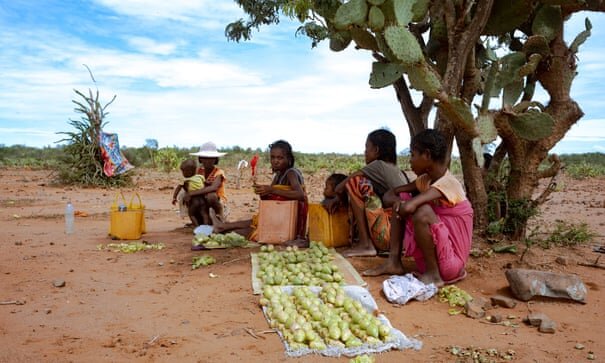
Prickly pears are one of the last foods available in this arid environment. These women walked for a day to collect fruit for their stall. Photograph: Ainga Razafy/MSF

Prickly pears are one of the last foods available in this arid environment. These women walked for a day to collect fruit for their stall. Photograph: Ainga Razafy/MSF

The UN World Food Programme says acute malnutrition in children under five has almost doubled over the past four months in most districts in the south. Ambovombe has the highest rates.

On Friday the Integrated Food Security Phase Classification (IPC), a multi-agency body that monitors global food security, issued an alert of a “sustained deterioration in food insecurity in the Grand South of Madagascar from April to December 2021”.

It said: “Over 1.1 million people are in high acute food insecurity due to insufficient rainfall, rising food prices and sandstorms. The lean season is expected to begin earlier than usual for the current consumption year, as households will deplete their low food stocks due to minimal production.”

Voriandro Tiandrainy, 42, a father of four from the district of Toliara II, on the western coast, said the drought had left many farmers unable to grow rice. “We enjoyed a wet climate before. Over recent years, it has become more and more dry. Farmers have had to abandon rice cultivation,” he said. Many people are now eating just one meal a day.

“Parents are also unable to pay school fees for their children. Moreover, a new disease has affected our zebus. We have never known this disease; it has killed 10 to 20% of the livestock.”

In response to the crisis, MSF began running a mobile clinic in late March and has so far treated more than 800 children for malnutrition, a third of whom were in a severe condition.

Reversé said MSF staff are also noticing other illnesses in the areas they work in, including bilharzia (a waterborne disease caused by parasitic flatworms), diarrhoea, malaria and respiratory infections. They said the illnesses were caused by malnutrition, as well as a lack of clean water.

According to the UN’s food agency, the number of people suffering from hunger has risen by about 85% on last year because of the accumulative effects of years of drought and people having to sell livestock and belongings to buy food.

People in the south are still sending family members to the cities to look for work but with little success because the Covid-19 pandemic has shut down small businesses and ended the seasonal work created by the tourism industry that had provided crucial income.

‘The next decade will be all about heat’: can Athens head off climate crisis?


Helena Smith

Smog settles over central Athens. Photograph: Eye Ubiquitous/Alamy

Smog settles over central Athens. Photograph: Eye Ubiquitous/Alamy

Like every Athens mayor, Kostas Bakoyannis is acutely aware of the illustrious heritage of one of the world’s oldest cities. After all, he says, it is busts of Pericles and his mistress Aspasia that adorn the entrance of the neoclassical town hall. From the windows of his cavernous office, he can glimpse the Parthenon through the jumble of concrete buildings and antennas.

But Bakoyannis prefers to talk about the present, not least his plans for fountains, parks, and trees – antidotes to the afflictions of more modern times.

“When you’re the mayor of Athens you are not in dialogue with history,” he says. “You’re in dialogue with the problems, needs, aspirations and hopes of present-day Athenians and anyone who might visit Athens even for a day.”

With that mission, Bakoyannis has his work cut out for him. Decades of reckless urban planning are catching up with the city. Pollution, densely packed neighbourhoods, and traffic congestion – byproducts of an uncontrolled building spree that began in the 1950s – are still evident today.

In conditions often likened to a pressure cooker, temperatures can surpass 40C (104F) in the summer. “Our models show annual mean temperatures across the Mediterranean increasing by up to 2C over the next 30 years,” says Christos Zerefos, a professor of atmospheric physics. “In the summer the air temperature will rise by more than 3C. Ecosystems will suffer.”

Bakoyannis, the scion of a political dynasty, was elected to the post in 2019. He knows time is of the essence.

A pocket park in Athens. Photograph: Vassilis Triandafyllou/Reuters

A pocket park in Athens. Photograph: Vassilis Triandafyllou/Reuters

“What we are facing is not a climate crisis but clearly a climate emergency,” he says. “If we’re to do our job well we have to adhere to the principles of resilience and sustainability.”

A municipal employee works at a pocket park in Athens, Greece. Photograph: Louiza Vradi/Reuters

A municipal employee works at a pocket park in Athens, Greece. Photograph: Louiza Vradi/Reuters

With the help of state and private sector support, EU structural funds and municipal levies, the budget allocated to green space has quadrupled. Every year €10m is earmarked for nature conservation, according to Bakoyannis, whose candidacy was backed by the centre-right New Democracy party now in government and led by his uncle, the prime minister, Kyriakos Mitsotakis.

Public-private partnerships, until recently a rarity in Greece, will help finance a huge “double regeneration” project that involves a football stadium in the heart of Athens being turned into an urban park, and a green overhaul for the industrial wasteland in the poorer western suburbs where the arena will be moved to.

Progress has been made in reducing car lanes to reclaim public space for pedestrians and cyclists, rejuvenating the hills of Athens, fixing fountains in public squares and creating pocket parks.

All the projects have one goal: to offset the challenges Europe’s warmest city is likely to confront as a result of rising temperatures.

“The next decade is going to be all about heat,” says Lenio Myrivili, co-chair of the Washington-based Extreme Heat Resilience Alliance, who advises Bakoyannis. “How we manage it and prepare for it is going to be vital.”

A former Athens vice-mayor herself, Myrivili is in no doubt of what lies in store if action isn’t taken.The Greek capital has been singled out in studies on the risks posed by climate change. An analysis of 571 European cities by Newcastle University in 2018 predicted it would experience the worst increases in severe drought and heatwaves by 2050. In a similar study, the ratings agency Moody’s also ranked the Greek capital highest in terms of exposure to rising temperatures. With heatwaves likely to become more frequent and extreme, it forecast that Greece’s credit strength would also become “sensitive to climate change …. [particularly] if heatwaves were to depress tourist activity”.

Prior to the pandemic Athens had become increasingly popular as a tourist destination, attracting over six million visitors in 2019.

“It’s imperative that we shield the city through heat mitigation,” says Myrivili. “The best way to do this is by introducing nature, biodiversity and ecosystems into urban areas. We’ll also need to more cleverly manage our water resources and ultimately bring the rivers of Attica, so scandalously cemented over, back to life.”

Athens was the first city to sign up to Prince Charles’ Terra Carta, (Earth Charter), described as a roadmap to a green post-pandemic recovery, when the British royal visited the capital for celebrations marking the 200th anniversary of the war of independence last month.

After a “lost decade” as a result of the nation’s prolonged economic crisis, Bakoyannis says he is determined not to lose more time because of the coronavirus crisis.

Exploiting the quietude of lockdown, municipal teams have focused on revamping forgotten parks and hills.

In Omonia square, the central plaza also within view of the Acropolis, analysis has shown temperatures dropping by up to four degrees since a multi-jet fountain was installed last year.

Not all the public works have gone down well. The mayor’s eagerness for “liberating” public space has its critics. Bakoyannis, who has also vowed to tackle vehicle emissions by reducing traffic in the city centre, was forced to hand back a traffic lane on a major avenue amid opposition over the move.

Children play in a pocket park in Kolonos in Athens. Photograph: Xinhua/REX/Shutterstock6

Children play in a pocket park in Kolonos in Athens. Photograph: Xinhua/REX/Shutterstock6

“Like most Athenians I’d love the city centre to be pedestrianised,” says Kostas Hadzopoulos out walking his yorkshire terrier around the freshly-planted pocket park in Pangrati, among the most congested districts in central Athens. “But a lot of these moves seem slapdash and ill-thought-out. That said, this was a rubbish dump before, and now it’s a breath of fresh air.”

Bakoyannis is sanguine in the face of criticism that has also been made by his political opponents.

“Change is never easy,” he says. “At the end of the day improving the quality of life is not ideological… We’re all in this fight together.”

UN raises serious human rights concerns over Australia’s India travel ban

Daniel Hurst

‘Nobody’s going to be jailed … at this time,’ deputy PM Michael McCormack says

The UN has questioned whether Australia’s India travel ban is consistent with the country’s human rights obligations. Photograph: Matt Jelonek/Getty Images

The UN has questioned whether Australia’s India travel ban is consistent with the country’s human rights obligations. Photograph: Matt Jelonek/Getty Images

UN human rights officials have raised “serious concerns” about the Morrison government’s ban on Australians returning from India, and the severe penalties attached to breaches.

The office of the UN high commissioner for human rights has questioned whether the controversial temporary measure – which can attract maximum penalties of five years’ imprisonment or $66,600 – is consistent with Australia’s human rights obligations.

“We have serious concerns about whether the Biosecurity Determination – and the severe penalties which can be imposed for its breach – meets Australia’s human rights obligations,” a spokesperson for the office, Rupert Colville, said early on Wednesday.

“In particular, article 12 of the International Covenant on Civil and Political Rights (ICCPR), which is binding on Australia, provides that no one shall be arbitrarily deprived of the right to enter his own country.”

In response to a request for comment from Guardian Australia, Colville said the UN human rights committee “has emphasised the narrow authority to refuse nationals’ return, and considers that there are few, if any, circumstances in which deprivation of the right to enter one’s own country could be reasonable.

“In assessing the issue of arbitrary deprivation, key factors to be taken into account are its necessity to achieve a legitimate end and its proportionality, including whether it is the least intrusive approach to accomplish its public health objectives.

“We note that the measure is scheduled to be reconsidered on 15 May.”

The determination – criminalising the return to Australia of anyone who has been in India in the past 14 days – was put in place by the health minister, Greg Hunt, late last Friday night, using existing biosecurity laws, but has triggered a backlash.

Amid mounting pressure over its hardline approach, including from within Coalition ranks, the immigration minister, Alex Hawke, is scheduled to meet community leaders on Wednesday to discuss the ban that is blocking 9,000 people, including 650 who are considered vulnerable, from returning to Australia.

Scott Morrison and senior ministers have said they are acting in the interests of keeping Australians safe and have played down the prospect that the harsh penalties would actually be imposed.

The deputy prime minister, Michael McCormack, said the prime minister had “made it quite clear yesterday that nobody’s going to be jailed”.

“Obviously, there needs to be a hardline taken as far as the overall act being in place, but nobody’s going to be jailed ... at this time,” McCormack told ABC News Breakfast on Wednesday. “The prime minister made it clear.

“We have taken this pause. We have made it in the national interests. We have done it, based on the best possible medical advice. It’s until May 15. We review it constantly, as you’d expect us to do.”

The Labor leader, Anthony Albanese, described the government’s handling of the issue as “a shambles”, asking: “Why do you make an announcement in the middle of the night about threats of five years’ jail and considerable fines and then days later say that we won’t implement the law?”

In April the UN human rights committee requested that Australia promptly allow the return of two vaccinated citizens from the US, as the body prepared to consider their complaints about the impact of Australia’s strict caps on international arrivals.

Assisted by the leading human rights lawyer Geoffrey Robertson QC, the citizens argue that the implementation of those caps clashes with the ICCPR.

Campaigners have previously described the situation as “dire” for a lot of Australians who were unable to return home, and say there is a sense of “losing hope”.

Revealed: 2,000 refugee deaths linked to illegal EU pushbacks

Lorenzo Tondo

A Guardian analysis finds EU countries used brutal tactics to stop nearly 40,000 asylum seekers crossing borders

Migrant rescue patrol in the Aegean Sea by the Turkish coastguard. A case has been filed against the Greek state that claims patrol boats towed migrants back to Turkish waters and abandoned them. Photograph: Erdem Şahin/EPA

Migrant rescue patrol in the Aegean Sea by the Turkish coastguard. A case has been filed against the Greek state that claims patrol boats towed migrants back to Turkish waters and abandoned them. Photograph: Erdem Şahin/EPA

EU member states have used illegal operations to push back at least 40,000 asylum seekers from Europe’s borders during the pandemic, linked to the death of more than 2,000 people, the Guardian can reveal.

In one of the biggest mass expulsions in decades, European countries, supported by EU’s border agency Frontex, systematically pushed back refugees, including children fleeing from wars, in their thousands, using illegal tactics ranging from assault to brutality during detention or transportation.

The Guardian’s analysis is based on reports released by UN agencies, combined with a database of incidents collected by non-governmental organisations. According to charities, with the onset of Covid-19, the regularity and brutality of pushback practices has grown.

The findings come as the EU’s anti-fraud watchdog, Olaf, has launched an investigation into Frontex over allegations of harassment, misconduct and unlawful operations aimed at stopping asylum seekers from reaching EU shores.

According to the International Organization for Migration, in 2020 almost 100,000 immigrants arrived in Europe by sea and by land compared with nearly 130,000 in 2019 and 190,000 in 2017.

Since January 2020, despite the drop in numbers, Italy, Malta, Greece, Croatia and Spain have accelerated their hardline migration agenda. Since the introduction of partial or complete border closures to halt the outbreak of coronavirus, these countries have paid non-EU states and enlisted private vessels to intercept boats in distress at sea and push back passengers into detention centres. There have been repeated reports of people being beaten, robbed, stripped naked at frontiers or left at sea.

In 2020 Croatia, whose police patrol the EU’s longest external border, have intensified systemic violence and pushbacks of migrants to Bosnia. The Danish Refugee Council (DRC) recorded nearly 18,000 migrants pushed back by Croatia since the start of the pandemic. Over the last year and a half, the Guardian has collected testimonies of migrants who have allegedly been whipped, robbed, sexually abused and stripped naked by members of the Croatian police. Some migrants said they were spray-painted with red crosses on their heads by officers who said the treatment was the “cure against coronavirus”.

According to an annual report released on Tuesday, the Border Violence Monitoring Network (BVMN), a coalition of 13 NGOs documenting illegal pushbacks in the western Balkans, abuse and disproportionate force was present in nearly 90% of testimonies in 2020 collected from Croatia, a 10% increase on 2019.

In April, the Guardian revealed how a woman from Afghanistan was allegedly sexually abused and held at knifepoint by a Croatian border police officer during a search of migrants on the border with Bosnia.

“Despite the European Commission’s engagement with Croatian authorities in recent months, we have seen virtually no progress, neither on investigations of the actual reports, nor on the development of independent border monitoring mechanisms,” said Nicola Bay, DRC country director for Bosnia. “Every single pushback represents a violation of international and EU law – whether it involves violence or not.”

Since January 2020, Greece has pushed back about 6,230 asylum seekers from its shores, according to data from BVMN. The report stated that in 89% of the pushbacks, “BVMN has observed the disproportionate and excessive use of force. This alarming number shows that the use of force in an abusive, and therefore illicit, way has become a normality […]

“Extremely cruel examples of police violence documented in 2020 included prolonged excessive beatings (often on naked bodies), water immersion, the physical abuse of women and children, the use of metal rods to inflict injury.”

In testimonies, people described how their hands were tied to the bars of cells and helmets put on their heads before beatings to avoid visible bruising.

A lawsuit filed against the Greek state in April at the European court of human rights accused Athens of abandoning dozens of migrants in life rafts at sea, after some had been beaten. The case claims that Greek patrol boats towed migrants back to Turkish waters and abandoned them at sea without food, water, lifejackets or any means to call for help.

BVMN said: “Whether it be using the Covid-19 pandemic and the national lockdown to serve as a cover for pushbacks, fashioning open-air prisons, or preventing boats from entering Greek waters by firing warning shots toward boats, the evidence indicates the persistent refusal to uphold democratic values, human rights and international and European law.”

According to UNHCR data, since the start of the pandemic, Libyan authorities – with Italian support since 2017, when Rome ceded responsibility for overseeing Mediterranean rescue operations to Libya – intercepted and pushed back to Tripoli about 15,500 asylum seekers. The controversial strategy has caused the forced return of thousands to Libyan detention centres where, according to first hand reports, they face torture. Hundreds have drowned when neither Libya nor Italy intervened.

SOS Méditerranée operates the Ocean Viking, one of the few remaining NGO rescue boats in the Mediterranean. Photograph: Flavio Gasperini/SOS Mediterranee

SOS Méditerranée operates the Ocean Viking, one of the few remaining NGO rescue boats in the Mediterranean. Photograph: Flavio Gasperini/SOS Mediterranee

“In 2020 this practice continued, with an increasingly important role being played by Frontex planes, sighting boats at sea and communicating their position to the Libyan coastguard,” said Matteo de Bellis, migration researcher at Amnesty International. “So, while Italy at some point even used the pandemic as an excuse to declare that its ports were not safe for the disembarkation of people rescued at sea, it had no problem with the Libyan coastguard returning people to Tripoli. Even when this was under shelling or when hundreds were forcibly disappeared immediately after disembarkation.”

In April, Italy and Libya were accused of deliberately ignoring a mayday call from a migrant boat in distress in Libyan waters, as waves reached six metres. A few hours later, an NGO rescue boat discovered dozens of bodies floating in the waves. That day 130 migrants were lost at sea.

In April, in a joint investigation with the Italian Rai News and the newspaper Domani, the Guardian saw documents from Italian prosecutors detailing conversations between two commanders of the Libyan coastguard and an Italian coastguard officer in Rome. The transcripts appeared to expose the non-responsive behaviour of the Libyan officers and their struggling to answer the distress calls which resulted in hundreds of deaths. At least five NGO boats remain blocked in Italian ports as authorities claim administrative reasons for holding them.

Malta, which declared its ports closed early last year, citing the pandemic, has continued to push back hundreds of migrants using two strategies: enlisting private vessels to intercept asylum seekers and force them back to Libya or turning them away with directions to Italy.

“Between 2014 and 2017, Malta was able to count on Italy to take responsibility for coordinating rescues and allowing disembarkations,” said De Bellis. “But when Italy and the EU withdrew their ships from the central Mediterranean, to leave it in Libya’s hands, they left Malta more exposed. In response, from early 2020 the Maltese government used tactics to avoid assisting refugees and migrants in danger at sea, including arranging unlawful pushbacks to Libya by private fishing boats, diverting boats rather than rescuing them, illegally detaining hundreds of people on ill-equipped ferries off Malta’s waters, and signing a new agreement with Libya to prevent people from reaching Malta.”

Last May, a series of voice messages obtained by the Guardian confirmed the Maltese government’s strategy to use private vessels, acting at the behest of its armed forces, to intercept crossings and return refugees to Libyan detention centres.

In February 2020, the European court of human rights was accused of “completely ignoring the reality” after it ruled Spain did not violate the prohibition of collective expulsion, as asylum applications could be made at the official border crossing point. Relying on this judgment, Spain’s constitutional court upheld “border rejections” provided certain safeguards apply.

Last week, the bodies of 24 migrants from sub-Saharan Africa were found by Spain’s maritime rescue. They are believed to have died of thirst and hunger while attempting to reach the Canary Islands. In 2020, according to the UNHCR, 788 migrants died trying to reach Spain.

The Guardian has approached Frontex for comment. Previously the agency has said it will be “cooperating fully” with Olaf.

Increased cancer risk for petroleum industry workers and people living near plants: New UN study

UN NEWS

Фото ООН I An oil platform in the Caspian Sea. Petroleum plants that process oil products can prove an increased cancer risk to those working there, or living nearby, a new IARC study shows.

Фото ООН I An oil platform in the Caspian Sea. Petroleum plants that process oil products can prove an increased cancer risk to those working there, or living nearby, a new IARC study shows.

The findings add to increasing evidence of the health consequences of air pollution from petroleum extraction and refining.

Types of cancer risk

The review identified an increased risk of mesothelioma, skin melanoma, multiple myeloma, and cancers of the prostate and urinary bladder, and conversely, decreased risk of cancers of the oesophagus, stomach, colon, rectum, and pancreas.

Offshore petroleum work was associated with an increased risk of lung cancer and leukaemia.

Living close to petroleum facilities was also associated with an increased risk of childhood leukaemia.

Scientists in the Environment and Lifestyle Epidemiology Branch of the agency carried out 41 cohort studies, 14 case–control studies, and two cross-sectional studies to compile their review.

Their findings have been published in the International Journal of Environmental Research and Public Health.

More research needed

The authors point out that further studies on the effect of exposure to petroleum and its closest derivatives (e.g. benzene) are needed in order to identify how they modify cancer risk.

In particular, there is a need for targeted studies in under-researched areas of high petroleum production with presumably higher exposures.

The scientists argue that the best way forward may be an international consortium to guide new studies in Africa, the Middle East, and Asia, in order to harmonize how studies are carried out and how exposure is assessed.

Rich nations’ climate targets will mean global heating of 2.4C – study

Fiona Harvey

Rise is a 0.2C improvement on previous forecast but still substantially above goal of Paris climate agreement

A power plant and traffic in New York. The figures give an idea both of the importance of the contribution by the US – the world’s second biggest emitter – and other rich nations in setting fresh emissions targets. Photograph: Justin Lane/EPA

A power plant and traffic in New York. The figures give an idea both of the importance of the contribution by the US – the world’s second biggest emitter – and other rich nations in setting fresh emissions targets. Photograph: Justin Lane/EPA

New climate targets announced by the US and other rich nations in recent weeks have put the world on track for global heating of about 2.4C by – the end of the century, research has found.

That is a 0.2C improvement on the previous forecast of 2.6C, but still substantially above the Paris goal of holding temperature rises to no more than 2C above pre-industrial levels, with an aspiration to limit heating to 1.5C.

Analysts have said the goals will still be within reach if key countries step up with better plans and if all countries bring forward new policies to meet their commitments.

The forecasts from the Climate Action Tracker are necessarily uncertain, but the figures give an idea both of the importance of the contribution by the US – the world’s second biggest emitter – and other rich nations in setting fresh emissions targets, and of how much more remains to be done to meet the Paris goals.

Tougher targets from China, the world’s biggest greenhouse gas emitter, and other countries will be needed to keep the Paris goals within reach, the analysis found.

While countries responsible for nearly three-quarters of global emissions have set or are considering goals to reduce carbon to net zero, Climate Action Tracker found that for most countries, policies are lagging well behind targets.

Many countries’ policies do not yet match their pledges. The analysis found that based on current policies, the world would be expected to warm by 2.9C.

Bill Hare, the chief executive of Climate Analytics, one of the two organisations behind the tracker, said: “It is clear the Paris agreement is driving change, spurring governments to adopt stronger targets, but there is still some way to go, especially given that most governments don’t yet have policies in place to meet their pledges. Governments must urgently step up their action.”

At the White House summit, the US pledged to halve its emissions by 2030, compared with 2005 levels. Canada also submitted a tougher emissions target and Japan, South Africa and Argentina promised to increase their ambition. China, the world’s biggest emitter, restated a promise on curbing future coal use.

Ahead of the Cop26 UN climate talks to be held in Glasgow this November, countries are expected to come up with fresh plans to cut their carbon between now and 2030.

This decade is regarded as crucial for climate action, because if emissions continue to rise for the next 10 years, as they have in previous decades, there will be little chance of holding temperature rises within the Paris limits, which represent the threshold of safety beyond which climate breakdown is likely to become catastrophic and irreversible.

The Intergovernmental Panel on Climate Change has found that emissions should be roughly halved in the next 10 years, to avoid temperature rises above 1.5C.

China is the biggest emitter yet to produce a national plan for the next 10 years, called a nationally determined contribution (NDC). India, South Korea, New Zealand, Turkey and Saudi Arabia are also among the scores of countries still to submit plans.

Countries responsible for about half of global emissions have submitted NDCs so far, but many are under pressure to toughen them as some are regarded as too weak, including Australia, Russia, Mexico and Brazil.

Niklas Höhne of NewClimate Institute, also a partner in the Climate Action Tracker, said governments were still moving too slowly and needed to emulate the swift response to Covid-19, by treating the climate as a crisis. “Only if all governments flip into emergency mode and propose and implement more short-term action [can] global emissions still be halved in the next 10 years,” he said.

This week, countries will meet again for the Petersberg dialogue, a climate meeting held by the German government at which some EU countries may come forward with strengthened offers of climate finance to the developing world. Climate finance is regarded as essential to put poor countries on track to reduce greenhouse gas emissions, and to cope with the impacts of climate breakdown, but so far offers from rich countries have fallen short of what experts say is needed.