

THE GREEN INSTITUTE
Can human beings ever act without expecting something in return? And what does selflessness have to do with the way we treat one another—and the planet?
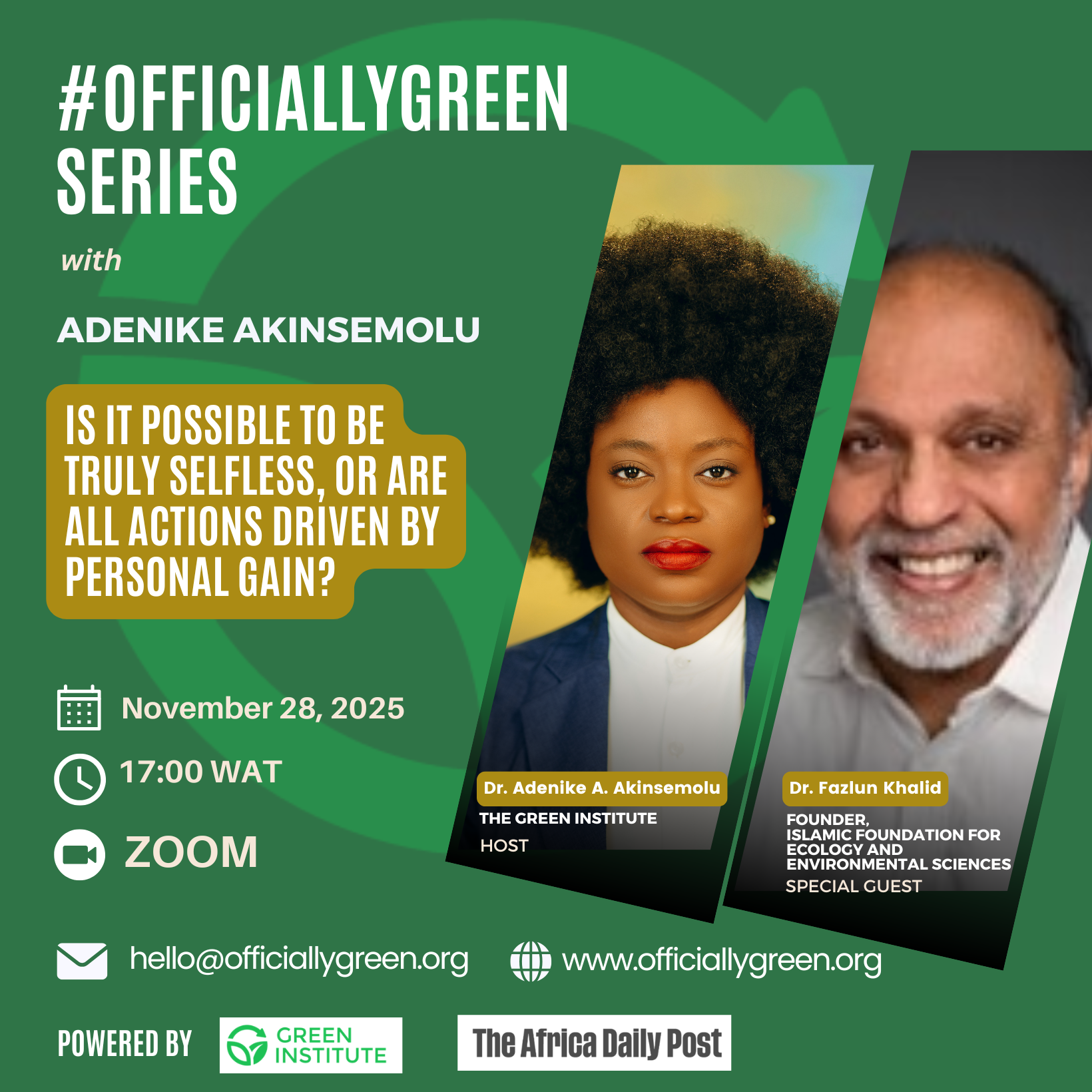
These questions shaped the 28 November 2025 edition of the Officially Green Series, hosted by Dr. Adenike A. Akinsemolu of The Green Institute. The session, titled “Is It Possible to Be Truly Selfless, or Are All Actions Driven by Personal Gain?”, featured Dr. Fazlun Khalid, founder of the Islamic Foundation for Ecology and Environmental Sciences (IFEES) and a leading voice in Islamic environmental thought.
The conversation moved beyond the philosophical question of whether pure selflessness exists. It explored ego, intention, consumerism, spirituality, community and environmental responsibility, asking what it truly means to live for something beyond ourselves.
Can We Ever Be Truly Selfless?
Dr. Khalid began with a simple reality: we all have an ego. Human beings naturally experience satisfaction, recognition or fulfilment from their actions, including acts of generosity.
But this does not necessarily make those actions selfish.
For Dr. Khalid, the more important issue is intention. Why do we give? Why do we serve? Why do we choose to help another person?
An individual may experience happiness after doing something good, but that feeling does not automatically cancel the value of the act. Compassion, generosity and altruism can, in fact, help reshape the ego and direct it towards service.
Selflessness, therefore, may not require completely eliminating the self. Instead, it involves developing the discipline to look beyond it.
Our Relationship With Nature Is Part of the Question
The conversation soon expanded from human relationships to our relationship with the natural world.
Drawing from Islamic environmental ethics, Dr. Khalid described creation as something humanity is deeply connected to rather than separate from. He spoke about the Qur'anic concept of mizan, or balance, and the responsibility of human beings to respect the balance within creation.
For him, one of the roots of today's environmental crisis is our growing disconnection from nature. Consumerism and modern ideas of development have encouraged people to see the natural world primarily in terms of what can be extracted, owned or consumed.
He also highlighted Al-Mizan: A Covenant for the Earth, an environmental document drawing on Islamic teachings and developed to strengthen ecological responsibility within faith communities and beyond.
The message was clear: caring for the Earth cannot be separated from how we understand our responsibilities to others.
“We Are Made to Want Today What Did Not Exist Yesterday”
One of the most memorable observations of the session came during the discussion on consumer culture.
“We are made to want today what did not exist yesterday.”
Dr. Khalid reflected on a society in which success is increasingly associated with acquiring more—a better job, a larger home, the latest phone or another new possession.
Technology itself, he stressed, is not necessarily the problem. The challenge is how it is used and how easily constant advertising, competition and consumption can shape our desires.
This is particularly important for younger generations. Dr. Khalid spoke about the traditional idea of “transmission”—children learning values by observing parents, elders and the wider community. Sharing, caring, good behaviour and responsibility towards the Earth were not simply taught in formal lessons; they were demonstrated through everyday life.
As screens take on a greater role in shaping attitudes and aspirations, he argued for rebuilding strong family and community relationships and using technology more deliberately for education, care and positive social development.
From Taking to Giving
The conversation also explored spiritual traditions of self-restraint and discipline. Dr. Khalid discussed futuwwah, which includes teachings around good manners, service, respect for others and responsibility towards the environment.
These principles bring the question of selflessness into everyday life.
What do we choose to buy? How much do we really need? How do we use our resources? Are our decisions guided entirely by personal advancement, or do we consider their impact on other people and the Earth?
Selflessness becomes less of an abstract ideal and more of a practice—one expressed through generosity, restraint, service and conscious choices.
Think of the Other
Perhaps the simplest lesson of the webinar came when Dr. Khalid reflected on living a more giving life:
“Think of the other.”
In those few words lies a challenge to the culture of endless consumption and individual gain.
Thinking of the other means recognising that our lives are connected—to family, community, future generations and the natural world. It does not mean that we cease to have personal needs or ambitions. Rather, it asks us to make room for something beyond ourselves.
The session offered no simplistic answer to whether absolute selflessness exists. Instead, it left participants with a more practical question: How can we become more intentional about giving, caring and contributing?
Perhaps creating a greener and more humane world begins there—not with eliminating the self, but with learning to think beyond it.
The Officially Green Series is powered by The Green Institute and creates space for conversations exploring the ideas, values and actions shaping a greener and more humane world.