
Ashraf Rehman
GREEN FELLOW
As part of our commitment to amplifying impactful research and policy conversations, The Green Institute is pleased to feature this insightful article by our fellow, Ashraf Rehman. He is a Green Fellow with interests in energy policy, sustainability, and development transitions.
In this piece, Ashraf explores the complex pathway of transitioning from coal dependence to cleaner energy systems in a developing economy like India. The article highlights the delicate balance between economic growth, energy security, and environmental sustainability, an issue that resonates strongly across the Global South.
By examining the challenges of infrastructure, employment, and policy frameworks, this work contributes meaningfully to ongoing discussions on achieving a just and inclusive energy transition.
Originally published by Asian Confluence
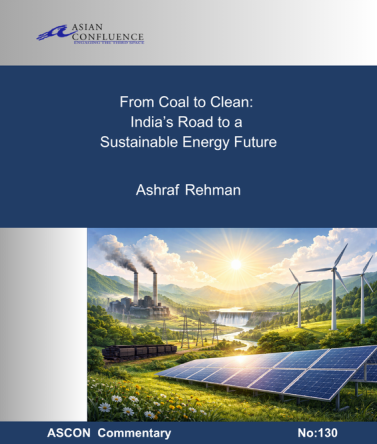
India aims to reach net zero carbon emission by 2070 and generate 50 percent of its power from non-fossil fuels sources by 2030. These goals look impressive, but there are significant challenges in India’s energy transition. However, if managed well, India could become a global leader in clean energy.
Energy transition is not a recent phenomenon. In the past, civilizations have experienced various energy transitions. The transition from wood to coal during the Industrial Revolution represents one such energy transition, then the progression from coal to oil and gas in the 20th century.
The world is undergoing yet another energy transition, fuelled by worries about climate change, the need for energy security, and in the pursuit of cleaner, more sustainable energy alternatives. This transition is intricate, involving changes across technological, economic, social, and political realms.
In the 2015 Paris Agreement, countries around the world acknowledged the need to limit the increase in global temperatures to well below 2°C, and preferably to 1.5°C above pre-industrial levels. To achieve the goal of reduced global warming, substantial cuts in greenhouse gas emissions, including CO2, will be necessary within a defined timeframe.
By balancing the quantity of greenhouse gases emitted with the amount removed from the atmosphere, it will significantly aid in mitigating the harmful emissions that lead to global warming. The Glasgow Climate Pact established at the COP26 conference in 2021 agreed to achieve net zero emissions by 2050, vital for maintaining temperature increase to 1.5°C, and all participating countries committed to strive for this target.
The energy transition is designed to accomplish multiple objectives. It intends to decrease greenhouse gas emissions to lessen the effects of climate change and aims to stimulate economic growth and create jobs through the innovation and implementation of new, clean energy technologies.
Although energy transition is a worldwide trend, its speed and characteristics differ across countries, influenced by factors such as resource availability, economic circumstances, and policy priorities. Additionally, energy transition is a key element for enhancing energy security.
Relying on fossil fuels, particularly those imported from other countries, make nations vulnerable to fluctuating prices and supply interruptions. By diversifying their energy sources and boosting the share of homegrown renewable energy, countries can improve their energy stability. The renewable energy industry is among the fastest-growing sectors globally, providing numerous job opportunities in manufacturing, installation, and maintenance.
India’s energy transition is grid around three key pillars. First, India’s electricity consumption is one of the prime reasons for the emission of carbon. Therefore, as part of decarbonisation efforts, the country aims to increase its renewable energy capacity with a special focus on solar energy.
Second, the industrial sector is a major emitter of carbon in India. Rapid growth in the industrial sector has increased the use of fossil fuels to generate energy and consumption of electricity for industrial use in various sectors. Hence, industrial decarbonisation is another area that requires attention.
Third, it is also necessary to create an environment for the transition of transportation from high carbon emission to solar/electric vehicles. Schemes such as Sustainable Alternative Towards Affordable Transportation (SATAT) aims to increase the use of biofuels with a target of achieving 20 percent ethanol blending petrol by 2030.
India’s energy transition goals are achievable, but not without challenges. Reports suggest that India would require around USD 10 trillion dollars by 2070 to achieve its energy transition goals. This huge demand for funding makes financing an important constraint for energy transition in India. In addition, lack of coordination or collaboration among key stakeholders, government, public and various organizations, creates poor communication to achieve a holistic goal for energy transition.
Furthermore, technological development and advancement is necessary, such as green hydrogen and carbon capacity utilization storage (CCUS) for decarbonising heavy industries. However, lack of proper infrastructure, policy formation and financial limitations are some challenges to technological advancement for energy transition.
India’s energy transition presents a delicate balancing act between sustaining rapid economic growth and ensuring environmental responsibility. The country’s developmental needs—rising energy demand, industrial expansion, and improving living standards cannot be compromised. At the same time, the urgency of addressing climate change, in line with global commitments such as the Paris Agreement and the Glasgow Climate Pact, necessitates a decisive shift toward cleaner energy systems.
Despite significant challenges ranging from financial constraints and technological gaps to institutional coordination and heavy reliance on coal—India has demonstrated strong intent through ambitious targets and policy initiatives. Efforts in renewable energy expansion, green hydrogen development, and cleaner transportation signal a structural transformation already underway.
India’s success will depend on its ability to integrate policy coherence, attract sustained investment, foster innovation, and ensure inclusive participation across sectors. A pragmatic, phased transition rather than an abrupt shift will be essential to safeguard energy security while reducing emissions. If managed effectively, India’s energy transition can become a pathway to sustainability and a driver of long-term economic resilience and global leadership in clean energy.
Editor’s Note: The issues discussed in this article are highly relevant to energy transition efforts in Nigeria and across Africa, where similar challenges of balancing energy access, economic growth, and sustainability persist.
The Green Institute remains committed to amplifying research and ideas that advance sustainable development and climate policy discourse.