Why globalization will survive the coronavirus crisis

Why globalization will survive the coronavirus crisis, according to economist Jeffrey Sachs

Economist and bestselling author Jeffrey Sachs says a geopolitical cold war with China would be a “dreadful mistake.” He explains how globalization will persist as societies and workplaces move online, and urges policymakers to come together to tackle issues like climate change. Sachs says the U.S. economy won’t have a “v-shaped” recovery because of the country’s failure to contain the pandemic.

proo.JPG
Watch video

MON, AUG 10 20208:40 AM EDT

Letter from economists: to rebuild our world, we must end the carbon economy

Jeffrey Sachs, Joseph Stiglitz, Mariana Mazzucato, Clair Brown, Indivar Dutta-Gupta, Robert Reich, Gabriel Zucman and others

The carbon economy amplifies racial, social and economic inequities, creating a system that is fundamentally incompatible with a stable future

‘If we fail to act now, the present moment may merely be a preview of what is to come.’ Photograph: Bebeto Matthews/AP

‘If we fail to act now, the present moment may merely be a preview of what is to come.’ Photograph: Bebeto Matthews/AP

From deep-rooted racism to the Covid-19 pandemic, from extreme inequality to ecological collapse, our world is facing dire and deeply interconnected emergencies. But as much as the present moment painfully underscores the weaknesses of our economic system, it also gives us the rare opportunity to reimagine it. As we seek to rebuild our world, we can and must end the carbon economy.

Even as climate breakdown looms around the corner, the pressure to return to the old carbon-based economy is real – and all the more dangerous, given the fundamental instability of an economy rooted in injustice. Sources of large-scale human suffering, such as crop failures, water shortages, rising tides, wildfires, severe weather, forced migration and pandemics, go hand-in-hand with a warming world. For example, exposure to airborne pollution heightens the risk of complications from diseases like Covid-19, and deforestation and rising temperatures make the emergence of future infectious diseases more likely. When these consequences manifest, it is no accident that they are disproportionately felt by communities of color, low-income communities, the most vulnerable nations and peoples, and other historically marginalized groups.

It is Black people in America, for instance, who bear some of the highest rates of exposure to polluted air. The carbon economy amplifies and begets racial, social and economic inequities, creating a system that is fundamentally incompatible with a stable future. If we fail to act now, the present moment may merely be a preview of what is to come, as we are forced into ever-more-painful situations and tradeoffs. It is naive, moreover, to imagine that we can simply nudge the fossil fuel industry – an industry that has lied about climate change for decades, actively opposed serious climate solutions and continues to plan for a fossil fuel-dependent future – into good behavior.

Instead, we should recognize that the present moment creates an opportunity to bring about a better future for ourselves and our children. By taking on the carbon economy, we can begin charting a pathway towards economic recovery while building a fairer, more sustainable world in the process.

Governments must actively phase out the fossil fuel industry. Bailouts and subsidies to big oil, gas and coal companies only further delay the essential energy transition, distorting markets while locking us into a future we cannot afford. Instead, a coordinated phaseout of exploration for and extraction of carbon resources allows governments to redeploy funds towards green technology, infrastructure, social programs and good jobs, spurring an economic transition that benefits people and the planet.

Institutions of financial power must end their fossil fuel investments and funding. When our largest banks, most influential investors and most prestigious universities place bets on the success of the fossil fuel industry, they provide it with the economic and social capital necessary to maintain the dangerous status quo. Instead, these institutions should divest from fossil fuel companies and end financing of their continued operations while reinvesting those resources in a just and stable future.

People must build political power to advocate for a fairer economic system. If we attempt an economic rebuilding whose guiding principle is a return to “business as usual” we will simply substitute one crisis for another. Instead, we must recognize that when crises strike, the disaster amplifies along society’s fault lines, and that when we don’t prepare for disasters, the costs of inaction fall most heavily on the most vulnerable. A green recovery can and must uplift those who need it most, at home and around the world, creating a more resilient and regenerative society in the process.

By achieving a large-scale economic transformation that dismantles the carbon economy and brings about a greener world, we have an opportunity to begin the process of economic recovery while working to undo the injustices at the heart of our modern system. As the undersigned experts in economics, we call on our policymakers to recognize the role that meaningful climate action has to play in rebuilding our world – to recognize that a healthy economy and society require a healthy planet.

This letter has been signed by more than 100 economists. See the full list of signatories here

Record melt: Greenland lost 586 billion tons of ice in 2019

Greenland lost a record amount of ice during an extra warm 2019, with the melt massive enough to cover California in more than four feet (1.25 meters) of water, a new study said.

After two years when summer ice melt had been minimal, last summer shattered all records with 586 billion tons (532 billion metric tons) of ice melting, according to satellite measurements reported in a study Thursday. That's more than 140 trillion gallons (532 trillion liters) of water.

That’s far more than the yearly average loss of 259 billion tons (235 billion metric tons) since 2003 and easily surpasses the old record of 511 billion tons (464 billion metric tons) in 2012, said a study in Communications Earth & Environment. The study showed that in the 20th century, there were many years when Greenland gained ice.

“Not only is the Greenland ice sheet melting, but it’s melting at a faster and faster pace,” said study lead author Ingo Sasgen, a geoscientist at the Alfred Wegener Institute in Germany.

Last year’s Greenland melt added 0.06 inches (1.5 millimeters) to global sea level rise. That sounds like a tiny amount but “in our world it’s huge, that’s astounding,” said study co-author Alex Gardner, a NASA ice scientist. Add in more water from melting in other ice sheets and glaciers, along with an ocean that expands as it warms — and that translates into slowly rising sea levels, coastal flooding and other problems, he said.

While general ice melt records in Greenland go back to 1948, scientists since 2003 have had precise records on how much ice melts because NASA satellites measure the gravity of the ice sheets. That's the equivalent of putting the ice on a scale and weighing it as water flows off, Gardner said.

As massive as the melt was last year, the two years before were only on average about 108 billion tons (98 billion metric tons). That shows that there’s a second factor called Greenland blocking, that either super-charges that or dampens climate-related melting, Gardner said.

In the summer, there are generally two factors in Greenland's weather, Gardner said. Last year, Greenland blocking — a high pressure over Canada that changes the northern jet stream — caused warm southern air to come up from the United States and Canada and flow into Greenland, forcing more melting.

In 2017 and 2018 without Greenland blocking, cooler Arctic air flowed from open ocean into Greenland, making summer milder, he said.

This year, Greenland’s summer melt has been not as severe, closer to normal for recent times, said Ruth Mottram, an ice scientist at the Danish Meteorological Institute, who wasn’t part of Sasgen’s research.

Mottram and several other outside scientists said Sasgen's calculations make sense. In her own study this month in the International Journal of Climatology, she found similar results and also calculated that Greenland coastal regions have warmed on average 3 degrees (1.7 degrees Celsius) in the summer since 1991.

“The fact that 2019 set an all-time record is very concerning,” said New York University ice scientist David Holland, who wasn’t part of either study

A Continent on the Brink

Alistair Bunkall,

Defence and Security correspondent

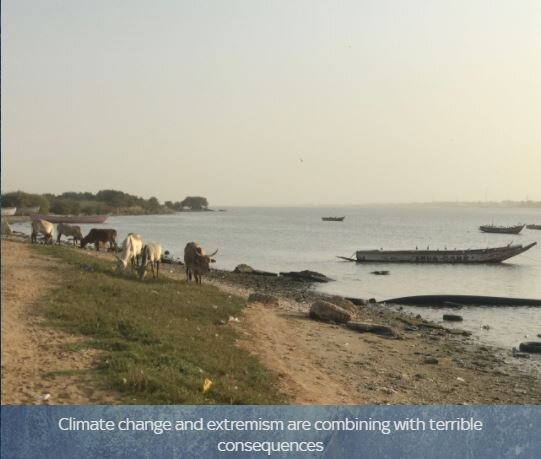
There is nowhere in Africa where the waters are rising as fast as Saint-Louis.

The colourful city on Senegal's northern border with Mauritania was once celebrated as the Venice of Africa, but the sea that surrounds it is now closing in so fast that ten metres are lost to the incoming tide each year.

photo-28-02-2020-08-35-25-2560x1920.jpeg

Along the crumbled seawall, houses teeter at impossible angles, completely uninhabitable.

They will fall into the sea any day and then the frontline will move inland another few metres.

The waves of the southern Atlantic are drowning the old French colonial capital and taking lives with them.

More than 100 million people live along the west African coast - four million of those have been displaced, forced to live in temporary camps away from the shoreline.

You can draw a viable line of extremism from coast to coast across the African continent and connect it to climate change.

Capture.JPG

"When droughts come and wipe out herds of cattle, that leaves people susceptible to be swayed to follow extremists who come into their communities and then pretend they can provide for them," Mohamed Chambas, the UN special representative for the Sahel, told Sky News.

"We know that is false, they cannot. They lead them to death and destruction. But this [climate change] is certainly one of the triggers, important factors to conflict in the Sahel."

boko.JPG

Most of those countries in the Sahel region find themselves in the grip of vicious conflict as militants battle weak governments.

France has more than 5,000 troops fighting insurgents in Mali, a former colony.

They are backed up by a tiny British contingent that transport troops and equipment around in Chinook helicopters, but it's not enough.

The UN peacekeeping force in Mali is struggling to keep control. It is regularly attacked by militants and is often described as the UN's "most dangerous mission".

The death toll in the country is rising rapidly, more than 4,000 were killed in 2019.

A few hundred British soldiers were set to join the UN mission in Mali this summer, but the deployment has been delayed because of coronavirus.

They will deploy by the end of this year, all being well.

Few think it will be "peace-keeping" in the traditional sense – it could prove to be the riskiest British operation in many years.

Across the Sahel, there are small numbers of British, American and other European forces training West African militaries - but it is a slow process against an evolving enemy.

We witnessed a large multi-national exercise and saw how Nigerian, Cameroonian and Moroccan forces are learning counter-terrorism drills from their Western allies.

They are fighting an enemy that is moving freely across borders in spaces that few can still live in. 

It is a war against extremism and the elements, and the truth is, they're not winning it.

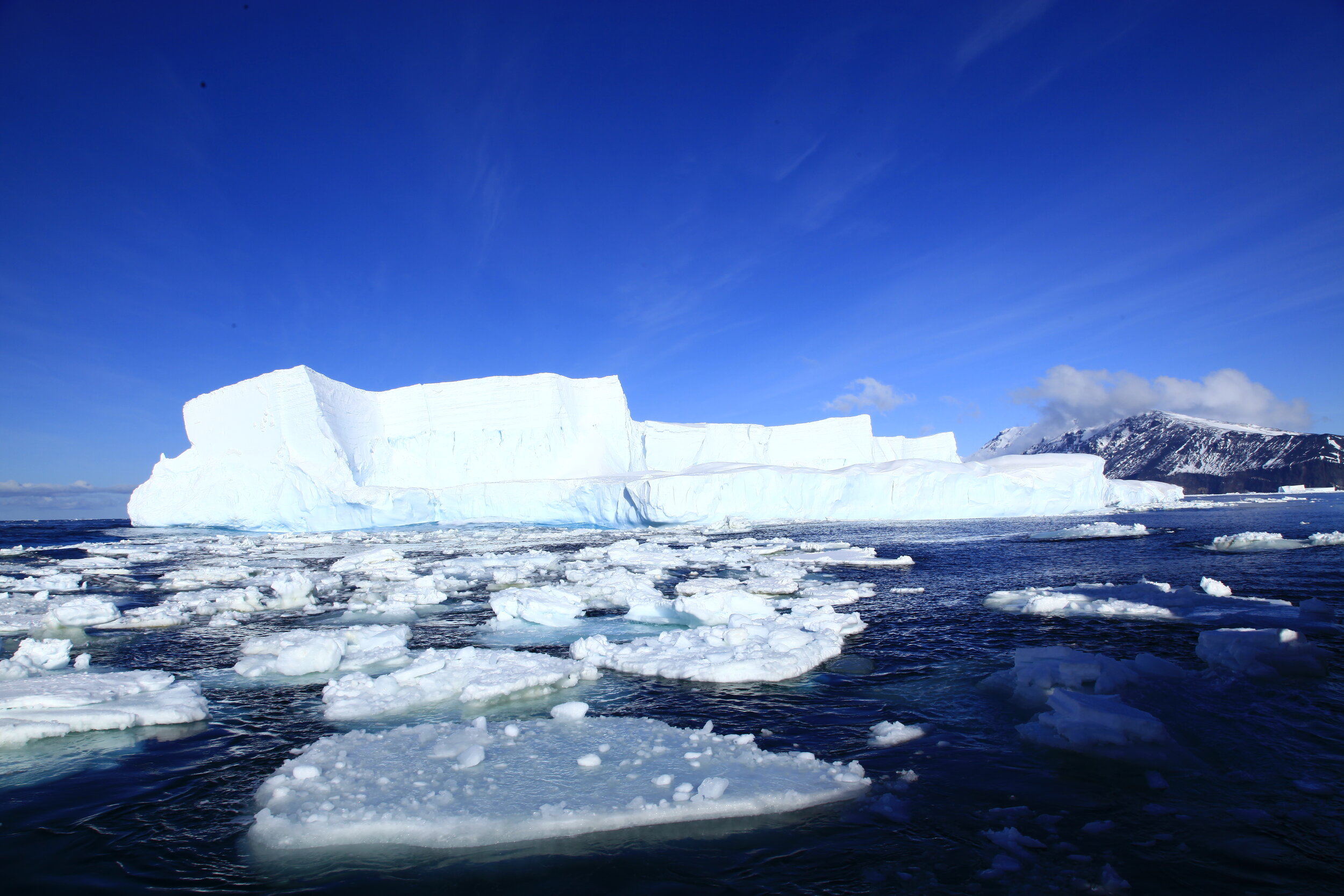
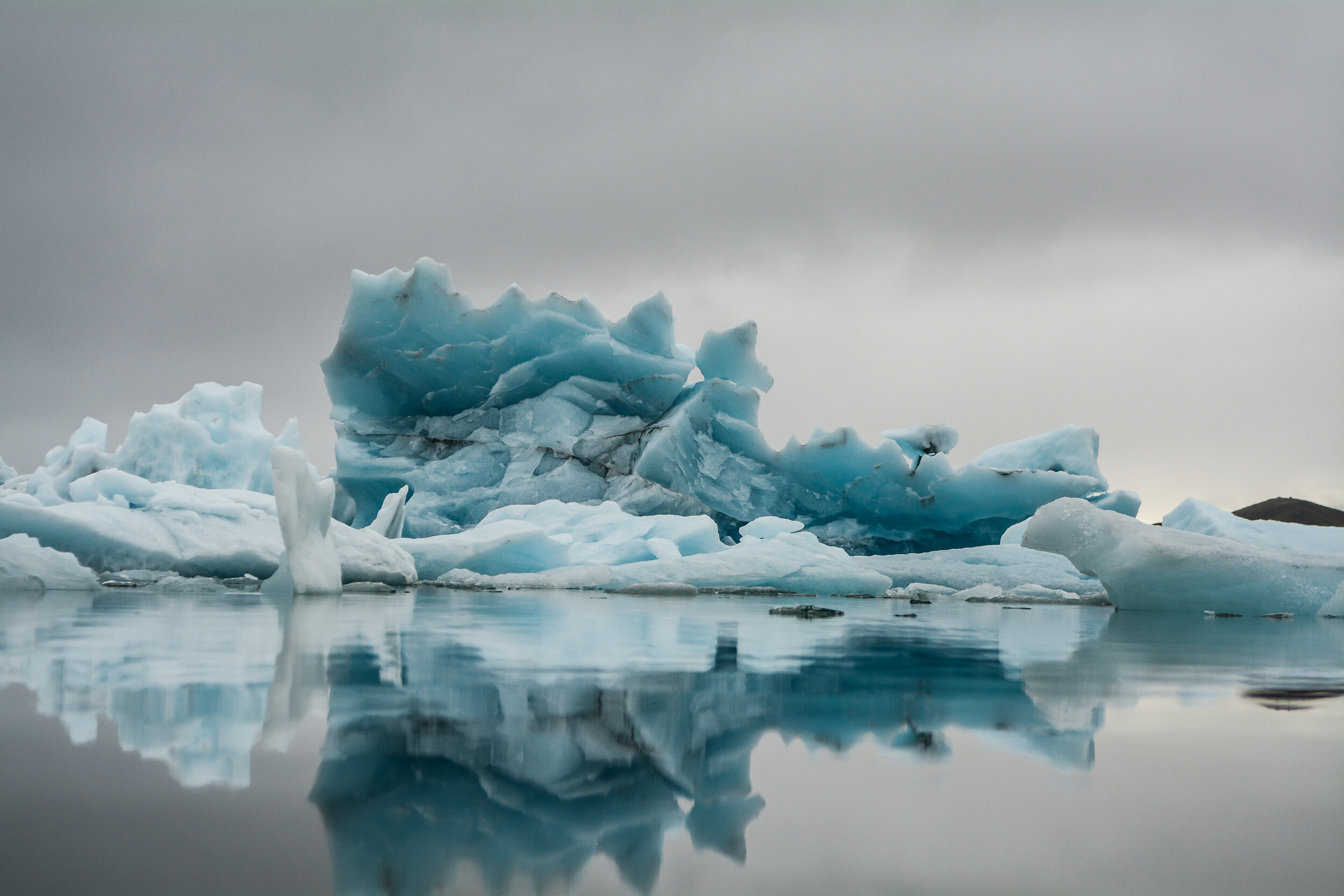
Warming Greenland ice sheet passes point of no return

Laura Arenschield

Even if the climate cools, study finds, glaciers will continue to shrink

Nearly 40 years of satellite data from Greenland shows that glaciers on the island have shrunk so much that even if global warming were to stop today, the ice sheet would continue shrinking.

"We've been looking at these remote sensing observations to study how ice discharge and accumulation have varied," said Michalea King, lead author of the study and a researcher at The Ohio State University's Byrd Polar and Climate Research Center. "And what we've found is that the ice that's discharging into the ocean is far surpassing the snow that's accumulating on the surface of the ice sheet."

King and other researchers analyzed monthly satellite data from more than 200 large glaciers draining into the ocean around Greenland. Their observations show how much ice breaks off into icebergs or melts from the glaciers into the ocean. They also show the amount of snowfall each year -- the way these glaciers get replenished.

The researchers found that, throughout the 1980s and 90s, snow gained through accumulation and ice melted or calved from glaciers were mostly in balance, keeping the ice sheet intact. Through those decades, the researchers found, the ice sheets generally lost about 450 gigatons (about 450 billion tons) of ice each year from flowing outlet glaciers, which was replaced with snowfall.

"We are measuring the pulse of the ice sheet -- how much ice glaciers drain at the edges of the ice sheet -- which increases in the summer. And what we see is that it was relatively steady until a big increase in ice discharging to the ocean during a short five- to six-year period," King said.

The researchers' analysis found that the baseline of that pulse -- the amount of ice being lost each year -- started increasing steadily around 2000, so that the glaciers were losing about 500 gigatons each year. Snowfall did not increase at the same time, and over the last decade, the rate of ice loss from glaciers has stayed about the same -- meaning the ice sheet has been losing ice more rapidly than it's being replenished.

"Glaciers have been sensitive to seasonal melt for as long as we've been able to observe it, with spikes in ice discharge in the summer," she said. "But starting in 2000, you start superimposing that seasonal melt on a higher baseline -- so you're going to get even more losses."

Before 2000, the ice sheet would have about the same chance to gain or lose mass each year. In the current climate, the ice sheet will gain mass in only one out of every 100 years.

King said that large glaciers across Greenland have retreated about 3 kilometers on average since 1985 -- "that's a lot of distance," she said. The glaciers have shrunk back enough that many of them are sitting in deeper water, meaning more ice is in contact with water. Warm ocean water melts glacier ice, and also makes it difficult for the glaciers to grow back to their previous positions.

That means that even if humans were somehow miraculously able to stop climate change in its tracks, ice lost from glaciers draining ice to the ocean would likely still exceed ice gained from snow accumulation, and the ice sheet would continue to shrink for some time.

"Glacier retreat has knocked the dynamics of the whole ice sheet into a constant state of loss," said Ian Howat, a co-author on the paper, professor of earth sciences and distinguished university scholar at Ohio State. "Even if the climate were to stay the same or even get a little colder, the ice sheet would still be losing mass."

Shrinking glaciers in Greenland are a problem for the entire planet. The ice that melts or breaks off from Greenland's ice sheets ends up in the Atlantic Ocean -- and, eventually, all of the world's oceans. Ice from Greenland is a leading contributor to sea level rise -- last year, enough ice melted or broke off from the Greenland ice sheet to cause the oceans to rise by 2.2 millimeters in just two months.

The new findings are bleak, but King said there are silver linings.

"It's always a positive thing to learn more about glacier environments, because we can only improve our predictions for how rapidly things will change in the future," she said. "And that can only help us with adaptation and mitigation strategies. The more we know, the better we can prepare."

THE GREEN ROOM (Episode 4): Niyi Osundare on "What the Earth Said"

GREEN ROOM: LIVE WEBINAR TRANSCRIPT


Summary of the Discussion

There were peculiar beliefs trailing our African heritage that forbids certain human interference with nature. We were told stories of forbidden forests, trees that must not be cut down, animals exempted from poaching, and rivers esteemed as sacred. Our ancestors' farmlands would compulsorily be left fallow at some particular time of the year as tradition demands. Due to the dearth of scientific reasoning, we never asked why but followed these instructions to the letter. So far, so good, our adherence paid off as we barely recorded cataclysmic natural disasters.

For satisfactory answers and an in-depth analysis into this mysterious fact, find out more by downloading the audio, video or transcript of the webinar.


LISTEN TO PODCAST

Audio Block
Double-click here to upload or link to a .mp3. Learn more

ABOUT THE SPEAKER

 Professor Niyi Osundare is a prolific poet, dramatist and literary critic. He gained degrees at the University of Ibadan (BA), the University of Leeds (MA) and York University, Canada (PhD, 1979)

Professor Niyi Osundare is a prolific poet, dramatist and literary critic. He gained degrees at the University of Ibadan (BA), the University of Leeds (MA) and York University, Canada (PhD, 1979)

Read full bio

ABOUT THE MODERATOR

Dr. Jason J. McSparren is an educator, researcher, and administrator with a PhD. in Global Governance and Human Security from Massachusetts Boston.He is also a Pre-Doctoral Fellow (2017-18) for the West African Research Association (WARA).

Tosin Gbogi is an assistant professor of English at Marquette University, specializing in popular cultures, Africana literatures, and critical race and ethnic studies.

read full bio

Q & A

Tosin Gbogi: I think we will start the conversation now and I would like to open the conversation with a question on place and childhood and by this. I mean that you know you of course grew up in Ikere Ekiti, and we find this in your poetry. I remember that I traveled through that place. I think 2016 sometimes down 16, I was looking for the for the Rocks which one is Olosunta

Prof. Osundare: They saw you (laughs)

 Tosin Gbogi: very good one. In the eyes of the earth for example one finds references to Oke Ubo, Abusoro, to Oke Eniju to Oke to Ogbese Odo and to Oke Roku. We also see like just said I will hear Olosunta we see and hear Oranle and we hear Eshidale.  Now my question then is this how did the Ikere of your childhood or the Nigeria of your childhood shape the way we think about the earth and the writing that you do, they are eco- poetic activism.

Prof Osundare: I also say that the happiest years of my life where the years I was born 1947 and 1966 when Nigeria experienced her first coup d’état. Particularly 1960- 1966 Understood conveniently on our necks at this time. There were problems but we know better somehow there was most sanity and then after that things began to really fall apart. I have seen a little bit of the world and I can compare coaches and I will say that an African culture is extremely strong and Yoruba is part of it. There is a depth to Yoruba culture and language and relationships between other cultures and other languages in the country and on the continent and now our planet. For example every citizen had its own organization through all of the different activities. The kind of songs that went with dancing. My father was a farmer I grew up on the farm another. We'll call it Ara oko. I just want to put it that way a very proud Ara oko indeed and then the region was respecting indigenous religion one of the problems. One of the causes of a crisis in Africa today I think is the Takeover of our indigenous selves by Islam and Christianity Yoruba Culture, Yoruba cosmology are really rooted in the this plus That kind of plastic that has access to it happened that when this religion came. Oh, no. Oh, it's a weak now that has caused a lot of problem.  All the artworks because in Africa culture and religion. The artists have to do is leave him each of the Orisa were thrown out because they were called Idols as our Idols a Catholic practice. Those idols were civilized. Respect for the forest disappeared as I saw him one of the invitations to this program. There were secret forests in those days the imbrue God intends for the furnace has its own some time researching now the forest what actually made the trees had its own identity. So I grew up with all the songs Egungun Festival, Osanyin Festival, and Osun of course. All this things contributed to the way I saw the world. I have never encountered anything more poetic than those. So when you talk about poetry you'd only go out is surrounded by it naming ceremony, Marriage ceremony, Ekun Iyawo there were all there Okay? Yeah. Yeah. Take another look at Wole Soyinka’s Works another look at Chinua Achebe’s works. A lot of what we do without the culture and of course without diminishing the impact of what has come from abroad in doing this and that not this instead of that.  “Me loluwa wi” as the Yoruba say the sky is wide enough for a thousand birds to fly without clashing unless some are unnecessarily greedy.  I think I'm stronger because I have added Western ways of doing things and so on to my own Yoruba ways of doing them.  Now I have to substitute what’s coming from our side they reached the Poetry of it. It is in our backyard which is bedroom. It's in the kitchen. It's in the song we sing to welcome the new moon, is the song when we see a beautiful flower.

Tosin Gbogi: Thank you very much for that response, In your recent work you moved towards a new kind of the color value called differential Aesthetics and I was thinking because in that paper you were talking about art and politics and how Western understanding of Aesthetics would you know mean that you know, you don't combine both, you know, I kind of think that you also find It is selected poems in 2002 selected poems. So I was so this kind of material that you put in your poetry, some critics consider this essentialism. How do you balance the how do you respond to that?

Prof. Osundare: Thank you Very much, yes differential Aesthetics Yeah This is an idea, It's not just theory it is a principle that rules my Enterprise even my creative Consciousness, differential. A Chinese poet writes differently from an American poet, An Indian poet writes differently from an Australian we are all writing poetry but from different cultural and social and political background. Yes German Harwich (name), also said let the thousand flowers bloom, but what I say with many of the so-called critics and theories especially in the western part of the world is let my flower bloom and takes over the whole earth. You should concur one little Village in France, some little village in America. I would say well now I have a little that covers all literature written everywhere every time in the world. That is ignorance it is first cousin of stupidity no critics African writers are always had for this problem with the critics especially Western critics.  Socrates Aristotle, Plato those of course a great writers, those are a Great Fairy. Those are great thinkers. I'm happy that I know them. I know their Works. There are correspondences. I mean look at the ancient Hebrew culture and ancient Yoruba cultural, there are similarities because we are just human beings so problems arise when you compose your own theoretical and aesthetic judgment or what coming from other places.

Just one example, And I stand to be corrected Yoruba doesn't have and doesn't rely on any rhyming pattern which must come terminally in the poem a ABAB CD then it is not poem. Who told you that. What about what I called system rhythm mechanism. Yoruba is music, Igbo is music, Edo, Urhobo. Music is Africa. Go to the Congo they are doing music and poetry which birth appreciated those forms of music different types of different aesthetically and emotionally from this so I'm saying that yes let a thousand flowers bloom. Write enough poetry but have enough intelligence, have enough humility to know that not everybody in the world should create a poem or so do this sculpture or should do the painting that will match your own expectations and your own prejudices. Yes, differential aesthetics. In Yoruba you don’t say “Mo fe ka ewi but you say Mo fe kewi” I want to chant poetry, I want to sing poetry, I want to perform poetry. This is very important aspect call system rhythmicality.  The music in it, how do we rarely handle it?

Tosin Gbogi: Thank you very much for that wonderful. I would like to bring in Dr. Chigbo Anyaduba who is an assistant professor in the University of Winnipeg.

Dr. Anyaduba: Thank you very much Tosin and thank you Professor.

Prof. Osundare: You're welcome.

Dr. Anyaduba: I particularly want to thank you for the incredible work you have been doing especially for the art.  Some of your poems that I have been privileged to read have inspired me a lot so quickly regarding the subject of poetry and environment. I thought that one of the things your poems have done for me is to connect me much more to the world that I live in especially to the so-called natural environment or natural world. And even when some of these poems maybe morning humans that Devastation of the environment or cautioning against urination of the Earth or prophesying Doom against violence to the natural world. I see you manage to feel that sense of being included with awareness. So I need to go Consciousness, you know about environment.  And I found it very fascinating the way yourself classified your work today into four movements, you know from paying homage to the Earth to morning the violence. Don't read the Earth and then to kind of the S retaliation or the consequences as you put it of human violence on the earth and then to admonition, you know, I'm still expecting the last poem. The first question concerns the General matter about writing and And we know that the people responsible especially for the destruction of the earth are not  usually the ones who suffer the consequences at least the immediate consequences at the moment, right the Niger Delta in Nigeria to distill it has specifically the victims of the despoliation going on. They are the ones who have suffered from Earth's retaliation, right? So my question is Why does Earth not discriminates in its retaliation why do victims of the kinds of capitalist destruction of the environment still by represented as victims when he retaliates, you know your Katrina poems as an example in this regard, right? And my second question is a more General one, in all the years that you've been writing I think over 40-50 years. Now you'd be in writing all these cautionary walks, you know cautioning against environmental pollution in Nigeria. And in other parts of the world at the same time, the more you seem to write the more intensified the human violence against the world has Been I remember the you know, the roots have become worse and we harvest more corpses from Nigerian Roots more trees have been murdered and Iroko trees of my childhood that were the wonder of my childhood before it disappeared now, I grew up in Anambra states, right? So in all these years you still continue to write and lament these outcomes. How could your lines your poems still carry, beautiful Melodies and metaphors that Inspire fancy and some form of musical pleasure in the face of this continuous destruction than witness right? What kept you going in all these years? What did you think changed or give you an inkling of a difference, To make you unwavering in your continued advocacy for and environmental justice.

Prof. Osundare: Thank you very much doctor Anyaduba.  I really appreciate it. It is a pity we are pressed for time the questions you have asked and also your comments could inspire a whole book and I really appreciate this. Why does Earth not to discriminate in its wrought?  Yes. Because nature is ruled by its own logic is like the question I ask all the  time when I see the wickedness that is being visited on people all over the world and the kind of really astonishing sufferings that we go through occasionally you ask how can God allow this to happen to his/her children.

That question we ask all the time but at the same time People say “Orun n yabo kii se wahala enikan” that is when the sky Is going to fall that is not the responsibility of only one person. In fact haven't finished the irony terrible irony about this is those who desolate the Earth those who plunder the Earth are In the position because of the wealth they have acquired, the loot they have scooped. They are in a position to protect themselves against the ravages and the consequences. So this are the illogicalities are facing. It is usually the homeless and the poor people who suffer, I must tell you that I have no answer to that because Katrina nearly killed my wife and me here everything we had on, you know was destroyed and also created two most terrible sinners in the world, you know, so what we should be doing is asking questions. Why should a few people do this and put the rest of us in Jeopardy? It is important for us to talk. It is important for us to work. That's what that 16 years old Swedish girl is asking us to do, no, we're not going to allow you to do this to us. Finally. Remember one or two statement is about we are just been doing this for so long and remember and one of my discussions with Chinua Achebe about three years before he died. We talked about this too. You know, I was teaching the novelist as teacher in our hopes and impediment and I asked Prof. and he laughed and he said we have been doing this for so long. What are we going to do? We cannot stop and there it “Ti ina o ba tan laso eje ki n tan leekanna” that is as long as there are lice in the hems of your garment there must be blood stains on your fingernails with the we have those fingernails, So we have to keep at it. Resilience this is it, In fact, one of the poems I was going to read this because I was pressed for time is titled stubborn hope and I have stolen that phrase from Dennis Brutus the great anti apartheid South African poet. I think one of his collections stubborn hope yes, our hope has to be stubborn. There is no giving up because we didn't inherit to this Earth from our ancestors; we borrow it from our children.

Dr. Anyaduba: Thank you very much.

DOWNLOAD FULL TRANSCRIPT

Favourite Quote

Tomorrow bids us tread softly, wisely, justly, lest we trample the eye of the Earth
— Professor Niyi Osundare
When the sky says I am going to fall, that is not the responsibility of only one person
— Professor Niyi Osundare

Top Comments

"Always enlightening to hear Prof. Osundare ". - Ipadeola Tdae

Glad to join from Niyi Osundare International Poetry Festival @NOIPOFEST Team— NOIPOFEST

"Epic session tonight. An honour to put a live-face to the legend Niyi Osundare and also happy to see again the Icon Tosin Gbogi (Happy Birthday Sir).”- Olufunke Olabode


FURTHER READING

Niyi Osundare. The Eye of the Earth (1986, winner of a Commonwealth Poetry Prize and the poetry prize of the Association of Nigerian Authors).

Niyi Osundare. 2011. City Without People: The Katrina Poems. 

REGISTER FOR THE NEXT GREEN ROOM

Osundare makes case for why every writer should be “climate change warrior”

Prof. Niyi Osundare

Prof. Niyi Osundare

Niyi Osundare, renowned poet and professor has urged writers to commit their crafts towards fight against climate change.

He spoke on August 7, 2020 at a webinar event organized by The Green Institute, a climate change advocacy organization, founded by Dr. Adenike Akinsemolu.

Tagged, “What the Earth Said”: A Reading and Conversation with Niyi Osundare, the event had in attendance scholars and students of literature as well as environmental advocates. It was hosted by Tosin Gbogi, an assistant professor of English and Africana Studies, Marquette University.

Some of the major highlights of the programme featured poetry performance by the celebrated poet from some his published works followed by discussions around their themes.

The performance centred around four theme-parts: the first on paying homage to the earth (extracted from The Eyes of the Earth and Days); the second part focused on mourning the violence done to the earth (extracted from Isle edited with Professor Slovich ); the third part (extracted from his Sequel to The Eyes of the Earth) reflected on the consequences of human actions on the earth; the fourth and final part (also extracted from his Sequel to The Eyes of the Earth) was an admonition to every human inhabiting the planet to be conscious of how their actions affect the state of our earth.

Osundare also read poems in honour of climate change activists he referred to as “earth warriors.”

One of those he specifically mentioned was Ken Saro Wiwa, writer and environmental activist, killed in 1995 by the Nigerian government over his strong protestation at the degradation of the Niger Delta region of the country caused by the activities of the multinational oil companies.

Another earth warrior he honoured was Gretta Thunberg, whose address on climate change at the United Nations inspired his poem, “How Dare You.”

Osundare furthered urged writers and artists to not shy away from partnering responsible and genuine politicians and policymakers in the fight against climate change.

London sees hottest stretch since 1960s

PA MEDIA

PA MEDIA

Central London has seen the longest stretch of high temperatures in almost six decades, as more thunderstorms are forecast across the UK.

The Met Office said temperatures surpassed 34 degree Celsius in the city for the sixth day in a row - the first time that has happened since at least 1961.

An amber storm warning is in place for much of England and Wales, including Liverpool, Bristol, Oxford and Cardiff.

Flooding, damage to buildings, travel disruption and power cuts are expected.

A yellow storm warning - meaning there is a small chance of flooding and travel disruption - has been issued elsewhere in England and Wales, as well as in parts of Scotland, for Wednesday night.

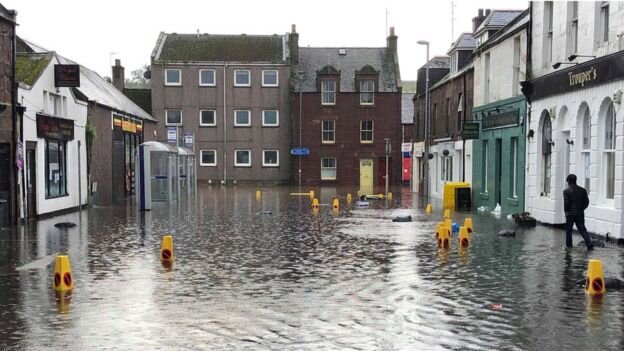
Stonehaven in Aberdeenshire saw flooding overnight. PA MEDIA

Stonehaven in Aberdeenshire saw flooding overnight. PA MEDIA

  • Major incident after thunderstorms bring flooding

  • South west England full to capacity, say police

  • More homes without water as heatwave continues

The yellow warning applies to parts of England and Wales until Monday night next week.

The Met Office also warned of potential damage to buildings from lightning strikes or strong winds, and 30 to 40mm of rain falling in less than an hour in some places.

It comes after torrential rain and lightning lashed large parts of Scotland on Tuesday night.

Sunbathers took to Southsea beach on Tuesday. PA MEDIA

Sunbathers took to Southsea beach on Tuesday. PA MEDIA

Three people have died after a passenger train derailed near Stonehaven in Aberdeenshire. It is thought the train hit a landslide after heavy rain and thunderstorms.

A major incident was also declared in Fife.

The Scottish Fire and Rescue Service said it received more than 1,000 emergency calls overnight due to the severe weather.

Ten properties in Lancashire were also affected by flooding following overnight storms, according to the Environment Agency.

However, hot weather has persisted elsewhere in the UK.

Devon and Cornwall Police warned the south west of England is "full to capacity", leading to "unprecedented demand" for 999 services.

The force said it saw an increase in anti-social behaviour and public order offences on Saturday and Sunday.

Assistant Chief Constable Jim Colwell said the weekend's events, spurred on by the hot weather, had forced officers to attend a "plethora of different incidents".

In Sussex, more homeowners had water supplies cut off or restricted on Wednesday. At least 300 householders had already been without tap water since Friday.

Steve Andrews, head of central operations for South East Water, said more than 150 million litres of extra water were being pumped into the network as the UK heatwave continues.

We Need To Work Together To Save This Planet – Prof. Osundare

Oyewumi Agunbiade

 Web News Radio Nigeria Ibadan

Prof. Niyi Osundare

Prof. Niyi Osundare

The renowned African poet, Professor Niyi Osundare, has called for a synergy among artistes, activists and policy makers in the battle against eco-degradation, an act that is presently contributing to global warming, earthquakes, hurricanes, water and air pollution, wildlife extinction, and many ailments such as asthma.

Professor Osundare made the call at virtual forum organized by the Green Institute.

The poet who lamented the alarming rate of desert encroachment, poisoned seas, and the extinction of species said the reckless use and abuse of the environment gave him much concern, hence his preservative advocacies through art.

He condemned world politicians who said climate change is not real, describing such leaders as dangerous to humanity. 

Professor Osundare noted that the restraint at addressing climate change globally cannot be dissociated from those who do not believe in it.

He urged the Salvation Army of the Earth as championed by the late Nigerian writer and environmental activist, Ken Saro-Wiwa never to relent in their advocacies as the calls are gradually being heeded in the face of overwhelming repercussions of environmental degradation.

Professor Osundare therefore called for a synergy among writers, activists, and policy makers to address the ravaging trend of climate change noting that writers’ and artists’ observation and advocacy can only translate to action when policy makers reason with them. 

"Why every writer should be a climate warrior”-Niyi Osundare on Poetry and the Environment

Niyi Osundare, renowned poet and professor has called upon writers to partner with politicians and policymakers in the fight against climate change.

Prof. Niyi Osundare

Prof. Niyi Osundare

The remark was made in a webinar event organized by The Green Institute, a climate change advocacy organization founded by Dr. Adenike Akinsemolu. 

The event held on the 7th of July, 2020 tagged “What the Earth Said”: A Reading and Conversation with Niyi Osundare was hosted by Tosin Gbogi, an associate professor of English and Africana Studies, Marquette University.

Click here to watch the full webinar on Youtube

In his introductory remark, Gbogi observed that “as a result of Covid-19, we are reminded that although humans are on this planet, we are not the planet”. As such, there’s no better time than now to discuss the  pertinent issue of the representation of the effects of human actions on the environment in literature in general and poetry in particular. And Niyi Osundare’s poetry was the lens through which the relationship between poetry and the environment was discussed.

Born in 1947, Prof. Niyi Osundare is the author of eighteen books of poetry, two books of selected poems, four plays, a book of essays, several monographs, academic papers, and feature articles on literature, culture, language, and politics. According to Gbogi, “His ecopoetics center both the human and non-human dimensions of our earth especially in ways that show their independence and intertwined state”. 

On why he began writing on the environment, Osundare said, he was inspired in the 1980s to write on the environment as a result of the destruction of the rainforest environment of his youth. 

The webinar was characterized by Osundare’s poetry performances of some of his selected poems which was followed by a question and answer session. The poems read ran on a four-part theme: the first part centered on paying homage to the earth (extracted from The Eyes of the Earth and Days); the second part focused on mourning the violence done to the earth (extracted from Isle edited with Professor Slovich ); the third part (extracted from his Sequel to The Eyes of the Earth) reflected on the consequences of human actions on the earth; the fourth and final part (also extracted from his Sequel to The Eyes of the Earth) was an admonition to every human inhabiting the planet to be conscious of how their actions affect the state of our earth. Furthermore, in that section, he celebrated climate change advocates whom he referred to as "Earth Warriors".

In the poems read, Osundare reflected on the intersection between poetry and the environment. His poems captured the devastation and the plunder done to the earth by scientists and policymakers. 

Essentially, Osundare captures in vivid language how the world has transformed from a beautiful haven to a mechanical village as a result of advancement in science and technology. He lambasted the climate destruction orchestrated in the name of scientific discovery, adding that “If you use the earth as science, then you won’t have the kind of ecocide that we are having now”.

Osundare bemoaned the effect of climate change on Nigeria in particular and the world at large.

In the Nigerian context, Osundare read poems concerning the oil spillage in the Niger Delta caused by multinational companies and that has become a nightmare for the people living in the South-South region of Nigeria. The poem he read was in honor of Ken Saro Wiwa, a revolutionary and a climate change agent (one of the Earth Warriors) from the Niger Delta who was hanged in 1995 by the Nigerian Military Ruler for his activism. Besides Ken Saro Wiwa, he also read another poem titled “How Dare You” inspired by a climate change address delivered to the United Nations by another Earth Warrior, Gretta Thomberg, a Swedish teenager. Hence for Osundare, the Earth Warriors aren't only in Nigeria but all over the world.

A peculiar feature of the poems read by Osundare is that they had a globalist outlook. What this means is that while he was lamenting the destruction of the rainforest in his native hometown in Ikere Ekiti, he was also by extension mourning the destruction of other rainforests in the world such as the Amazon forests.

For those who are skeptical about the concerns of climate change activists and for those who think it’s just a hoax, Osundare cited the case of Lake Chad, noting that the fact it’s drying up is a significant instance of a change in our planet.

The crux of the event was when the renowned professor read his last poem titled “Our Earth will not Die”, extracted from his famous collection, The Eye of the Earth. The poem contained a message of hope and the reverberating tune in which the Poet rendered the repeated line, “our earth will not die” foregrounded an optimistic tone on the part of the poet. The poet believes that as long as we remain committed to keeping the earth safe for ourselves, our children would also benefit from it and their future would be safe as he told the audience that, “we didn’t inherit this earth from our ancestors, we borrowed it from our children”.

A crucial point of the conversation we can’t but mention was when he discussed his notion of differential aesthetics. He explained that he developed the term in response to Western critics fond of imposing one theoretical and aesthetic judgment on works from other people from a different culture and downplaying their aesthetic appeal because it doesn’t fit into their rules of fine aesthetics.

The event which had in attendance scholars and students of poetry also attracted the attention of numerous environmental advocates.

Dropped emissions during COVID-19 lockdown will do 'nothing' for climate change

Chelsea Gohd 

Coroclimate.JPG

While greenhouse gas emissions plummeted as the world locked down in response to the coronavirus pandemic, such dips will do "nothing" to slow climate change unless society moves away from fossil fuels, researchers have found. 

On March 11, 2020, the World Health Organization declared the novel coronavirus disease, COVID-19, a pandemic, which it remains today. To slow the spread of the virus, countries around the world began implementing lockdown measures that limited travel and closed down factories and businesses. In turn, Earth-orbiting satellites saw a dramatic decrease in greenhouse gas emissions. 

However, according to an international study led by the University of Leeds, unless large-scale, structural interventions — like a significant switch away from fossil fuels — are implemented, these changes will not affect Earth's climate. In fact, the researchers found, even if lockdown measures continue in some fashion around the world until the end of 2021, more than a year and half total, global temperatures will only be roughly 0.018 degrees Fahrenheit (0.01 degrees Celsius) lower than expected by 2030.

"Lockdown showed that we can change and change fast, but it also showed the limits of behavior change," Piers Forster, study co-author and director of the Priestley International Center for Climate at Britain's University of Leeds, told AFP.

"Without underlying structural change we won't make it," he said, referring to climate goals. 

Climate work to do

Scientists have identified a temperature rise to "well below" 3.6 degrees F (2 degrees C) above levels before the Industrial Revolution as a major climate target. Some countries are striving to keep temperature rise smaller, below 2.7 degrees F (1.5 degrees C). However, according to these researchers, this goal will be difficult to reach. 

"If I'm brutally honest, the world is unlikely to decarbonize at the rates required for 1.5 C, but getting anywhere close will make our children's future better," Forster said.

To see exactly how lockdown has affected emissions and climate in the long term, the researchers used open-source data to calculate exactly how the emission levels of 10 different greenhouse gases and air pollutants changed between February and June 2020 in over 120 countries. During those four months, the scientists found that production of pollutants including carbon dioxide and nitrogen oxides dropped by between 10% and 30%, a significant decrease. 

However, the researchers found that the temporary emissions drop alone wouldn't have a significant impact on climate because these lockdown efforts are temporary, as opposed to larger, long-term structural changes. 

"The fall in emissions we experienced during COVID-19 is temporary and therefore it will do nothing to slow down climate change," co-author Corinne Le Quere from the University of East Anglia said in the same statement. 

In addition to measuring the effects of this temporary lockdown, the researchers also modeled how climate would be impacted if, after this lockdown period, larger changes like reduced use of fossil fuels were implemented around the world. The team highlighted that significant, government-led changes to reduce fossil fuel use would have a lasting, positive effect on climate. 

The scientists found that if invested 1.2% of gross domestic product in low-carbon technology post-lockdown, they could cut their emissions in half by 2030 compared with if countries continued to rely on fossil fuels as they do post-lockdown. 

"The government responses could be a turning point if they focus on a green recovery, helping to avoid severe impacts from climate change," Le Quere said. 

ECO-DEGRADATION: Stakeholders Must Act Fast To Save Humanity-Prof Osundare

OYE AGUNBIADE
positivefm news

osundare-header-1.jpg

A Renowned African poet, Professor Niyi Osundare, has called for a synergy among artistes, activists and policy makers in the battle against eco-degradation, an act that is presently contributing to global warming, earthquakes, hurricanes, water and air pollution, wildlife extinction, and many ailments such as asthma.

Osundare who is the author of the popular collections “The Eye of the Earth” and “City without People” made the call at an online forum that was organized by the Green Institute, Ondo. Tagged “What the Earth Said: A Reading and Conversation with Niyi Osundare,” the event was moderated by Dr. Tosin Gbogi who is an Assistant Professor of English and Africana Studies at Marquette University.

Introducing the reading and conversation, Gbogi noted that the event could not have been more timely given the strange times we now live in.

In the poetry reading and conversation that followed, Prof. Osundare who lamented the alarming rate of desert encroachment, poisoned seas, and the extinction of species said the reckless use and abuse of the environment gave him much concern, hence his preservative advocacies through art.

The poet also condemned world leaders who say climate change is not real, describing such leaders as dangerous to humanity.

He noted that the restraint at addressing climate change globally could not be dissociated from those who do not believe in it.

Speaking on the poem “Ours to Plough not to Plunder,” Osundare also indicted local farmers and individuals, observing that bush burning and untoward farming activities on the part of the farmers contribute to environmental pollution and global warming.

Recalling his background at Ikere Ekiti, Professor Osundare noted that the plundered earth once had its harmonic rhythm and prophylactic appeals which African ancestors enjoyed, hence the need for a collective front to return the earth to its beauty.

While commending those he described as the Salvation Army of the Earth in Nigeria, the poet remembered and hailed the significant interventions and contributions of late Ken Saro-Wiwa, the late Nigerian writer and environmental activist.

Osundare urged the Salvation Army of the Earth never to relent in their advocacies as the calls are gradually being heeded in the face of overwhelming repercussions of environmental degradation as seen in president Macron of France’s recent move over the wild fire in the amazon.

While responding to a question by Dr. Chigbo Anyaduba that perpetrators of degradation hardly suffer from the havoc as seen in the Niger Delta, Osundare, himself a survivor of Hurricane Katrina, enjoined the victims to insist on ending such act, noting that a silent mouth equals a resigned destiny.

The Don called on every writer to become a climate warrior advocating the preservation of the earth. “The world won’t change except we change it,” he said.

He also called for a synergy among writers, activists, and policy makers to address the ravaging trend of climate change noting that writers’/artists’ observation and advocacy can only translate to action when policy makers reason with them.

The convener of the Green Room and the director of the Green Institute, Dr. Adenike Akinsemolu, in a remark to the poet enjoined the people to be change agents in the preservation of their respective environment by being careful in relating to nature rather than waiting for government and policy makers.

The event which was streamed live across different social media platforms such as Facebook, Twitter, and YouTube had over one thousand participants some of who include Dr. Chigbo Arthur Anyaduba, Tolulope Odebunmi, and Gabriel Bamgbose.

Other participants include Prof. Adeleke Adeeko, James Murua, Molara Wood, Tade Ipadeola, Niran Okewole, Deji Toye, Olanike Olaleru, Oluwafunke Ogunya, Dr. James Yékú, Dr. Nathan Surh-Sytsma, Dr. Adeiza Isiaka Lasisi, Tosin Orimolade, Adeola Falayi, John Olumodi, and Mr. Tunde Laniyan, among others.

Participants cut across Nigeria, France, USA, Canada, Kenya, Uganda, and South Africa.

Niyi Osundare on Ecopoetry and Environmental Sustainability.

Poet and writer Níyì Ọ̀ṣúndáre recently stopped by The Green Room to share some poetry and personal thoughts on the current circumstances bedeviling humanity.

See below.

The event, “What the Earth Said: A Reading and Conversation with Níyì Ọ̀ṣúndáre,” was put together by the Green Institute and moderated by Tósìn Gbogí, an Assistant Professor of English and Africana Studies at Marquette University. Directed by Dr. Adéníkẹ Akínṣemólú, the Institute runs a monthly online forum called the Green Room, now in its third edition, through which it fosters discussions about the dying state of the earth and what needs to be done to stem this. 

Ọ̀ṣúndáre is a foremost African poet whose work has been widely acknowledged for its environmental concerns and motifs. He uses the earth as an organizing principle in his poetry—a principle which allows him to pay attention to, and even question the binary understanding of, the human and non-human dimensions of our world. Ọ̀ṣúndáre’s conversation at this event revolved around this principle, which allowed him to speak about subjects as varied as childhood memories in Ìkẹ́rẹ́-Èkìtì, Hurricane Katrina, the Amazon burning, and the perils of a city like Lagos that continues to borrow the sea as its land. 

The live event was widely attended and shared on Facebook, Twitter, and Instagram. The poems were read in both English and Yorùbá.

Pacific states face instability, hunger and slow road to Covid recovery

Dame Meg Taylor

Wicked Walu Island on the resort-studded Coral Coast of Fiji. Tourism to Fiji has fallen 99% because of Covid restrictions. Photograph: Torsten Blackwood/AFP via Getty

Wicked Walu Island on the resort-studded Coral Coast of Fiji. Tourism to Fiji has fallen 99% because of Covid restrictions. Photograph: Torsten Blackwood/AFP via Getty

While the worst of the Covid-19 pandemic has so far spared the Pacific, its economies are in free-fall, the region’s chief diplomat warns

Beyond the health and economic crises of Covid-19, the global pandemic has the potential to cause political instability and undermine state security across the Pacific, the region’s chief diplomat has warned.

Dame Meg Taylor, secretary general of the Pacific Islands Forum, said the region’s economies were struggling with the virus-induced shocks, and a prolonged crisis could worsen existing problems of hunger, poor healthcare, and state fragility.

“Covid-19 has exposed and exacerbated systemic and structural imbalances in our systems and societies, underlining the urgency for decisive policy action,” Taylor said.

“If I look at this from what’s happening within communities and different countries, I think some countries are getting harder hit than others, and I think where we’ve seen unemployment, we’ve seen people really struggle,” she said ahead of a virtual meeting of forum economic ministers on Tuesday.

“We’re seeing in places like Nadi low employment and lots of young mothers and carers with children who do not have sufficient resources to be able to feed themselves.”

Extreme poverty in the region could increase by more than 40%, the Australian thinktank Devpolicy found.

Taylor said the region was threatened by health, economic and the ongoing climate crises, all of which require decisive action from governments. And while Pacific countries have largely avoided the health disaster, a severe virus-related economic fallout threatens the economic, political and social fabric of the region.

In response to questions about Covid-19’s impact on political stability and state fragility, Taylor said: “Do I want to go further and predict that there’s going to be unrest? I would hope that there wouldn’t be. But I think … there may be disruptions. People are afraid of what is happening.”

Government revenues across the Pacific have been devastated by precipitous drops in tourism, and the shutdown of export and import industries. Most Pacific countries are forecasting economic contractions in 2020, with recovery not expected until 2021 or longer.

Among the hardest-hit are tourism-reliant countries such as the Cook Islands, Fiji and Vanuatu because of border closures and lockdowns, described as “catastrophic”.

Tourism makes up 40% of Fiji’s GDP. The International Monetary Fund recorded a 99% drop in tourist arrivals to the country in May 2020 compared with the same month last year.

Fiji’s economy is forecast to decline by 21.7% this year, the most of any Pacific nation.

Tourism recovery will largely depend on tourists from Australia and New Zealand, but with the worsening Covid-19 situation in Victoria, Australia’s borders may stay shut for some time.

New Zealand’s prime minister, Jacinda Ardern, has also confirmed that a trans-Tasman bubble with Australia is likely to be delayed for “several months”.

However, she announced on Monday there would be quarantine-free travel to the Cook Islands “this year”. She said NZ officials would head to the Cook Islands, and vice versa, “within the next 10 days” to verify travel procedures and clear a path.

Remittances, a lifeline for many Pacific households, are also expected to decline by 13%, according to the World Bank. This represents a huge downturn for Samoa, Tonga and the Marshall islands, where money sent back by overseas workers account for 40% of average household income.

Given the dire economic situation, there are growing concerns that Pacific governments may use the virus to justify accumulating unsustainable debt.

Fiji has announced a FJ$2bn (A$1.31bn) stimulus package, largely financed by loans, in response to the virus, pushing its debt to GDP ratio to 83.4%.

Similar scenes are being played out across the region, where governments lack the fiscal space or cash reserves to mount a serious response to long-term crises.

“[Virus-related economic fallout] is significantly constraining revenues, and national budgets and will require immediate and consistent financial support in the short- to medium-term to overcome the ensuing fiscal challenges,” Taylor said.

There has been some respite with US$210m in financial assistance by a range of donors, according to the Griffith University’s Covid-19 Pacific aid tracker.

This is separate from assistance Pacific have nations secured individually, including the ADB’s US$200m concessional loan to Fiji, and the establishment of the Pacific Resilience Facility, a regional climate fund, and the Pacific Humanitarian Pathway, which has allowed crucial foreign aid and medical equipment to be flown in during the pandemic.

In some of the first movement around the region, 170 ni-Vanuatu workers will arrive in Australia’s Northern Territory in coming weeks to pick mangoes.

Drivers who keep their windows down are exposed to 80 percent more air pollution

University of Surrey

Car users from the world's least affluent cities are exposed to a disproportionate amount of in-car air pollution because they rely heavily on opening their windows for ventilation, finds a first of its kind study from the University of Surrey.

According to the World Health Organisation (WHO), air pollution kills an estimated seven million people worldwide every year and nine out of 10 people breathe air with high levels of pollutants.

In a study published by the Science of the Total Environmentjournal, a global team of researchers led by Surrey's Global Centre for Clean Air Research (GCARE) investigated air pollution exposure levels for commuters in 10 different global cities -- Dhaka (Bangladesh), Chennai (India), Guangzhou (China), Medellín (Colombia), São Paulo (Brazil), Cairo (Egypt), Sulaymaniyah (Iraq), Addis Ababa (Ethiopia), Blantyre (Malawi), and Dar-es-Salaam (Tanzania).

The research team investigated PM2.5 and PM10 exposure levels inside vehicles during peak hours in the morning and evening, as well as off-peak hours in the middle of the day. The scientists measured how exposure levels changed when drivers used recirculation systems, fans and simply opened the windows.

The study discovered that drivers in some of the world's poorest cities experienced higher levels of in-car pollution.

Irrespective of the city and car model used, a windows-open setting showed the highest exposure, followed by fan-on and recirculation. Pollutionexposure for windows-open during off-peak hours was 91 percent and 40 percent less than morning and evening peak hours, respectively. The study also found that the windows-open setting exposed car passengers to hotspots of air pollution for up to a third of the total travel length.

The study found that commuters who turn on the recirculation are exposed to around 80 percent less harmful particles than those who open their car windows. Car cabin filters were more effective in removing pollution than fine particles, suggesting that if new cars had more efficient filters, it could reduce the overall exposure of car commuters.

Professor Prashant Kumar, Director of GCARE at the University of Surrey, said: "To be blunt, we need as many cars as possible off the road, or more green vehicles to reduce air pollution exposure. This is yet a distant dream in many ODA countries. Air-conditioned cars are unattainable for many poor and vulnerable commuters across the world, but our data is clear and coherent for all 10 participating cities.

"We must now work with our global partners to make sure they have the information needed to put in place programmes, policies and strategies to protect the most vulnerable in our communities and find realistic solutions to these serious problems."

Rising temperatures will cause more deaths than all infectious diseases – study

Poorer, hotter parts of the world will struggle to adapt to unbearable conditions, research finds

guardians.jpg

The growing but largely unrecognized death toll from rising global temperatures will come close to eclipsing the current number of deaths from all the infectious diseases combined if planet-heating emissions aren’t constrained, a major new study has found.

Rising temperatures are set to cause particular devastation in poorer, hotter parts of the world that will struggle to adapt to unbearable conditions that will kill increasing numbers of people, the research has found.

The economic loss from the climate crisis, as well as the cost of adaption, will be felt around the world, including in wealthy countries.

In a high-emissions scenario where little is done to curb planet-heating gases, global mortality rates will be raised by 73 deaths per 100,000 people by the end of the century. This nearly matches the current death toll from all infectious diseases, including tuberculosis, HIV/Aids, malaria, dengue and yellow fever.

The research used an enormous global dataset of death and temperature records to see how they are related, gathering not only direct causes such as heat stroke but also less obvious links such as a surge in heart attacks during a heatwave.

“A lot of older people die due to indirect heat affects,” said Amir Jina, an environmental economist at the University of Chicago and a co-author of the study, published by the National Bureau of Economic Research. “It’s eerily similar to Covid – vulnerable people are those who have pre-existing or underlying conditions. If you have a heart problem and are hammered for days by the heat, you are going to be pushed towards collapse.”

Poorer societies that occupy the hottest areas of the world are set to suffer worst. As already baking temperatures climb further this century, countries such as Ghana, Bangladesh, Pakistan and Sudan face an additional 200 or more deaths per 100,000 people. Colder, richer countries such as Norway and Canada, meanwhile, will see a drop in deaths as fewer and fewer people perish due to extreme cold.

“You see the really bad impacts at the tropics,” said Jina. “There’s not one single worldwide condition, there’s a lot of different changes with poorer people much more affected with limited ability to adapt. The richer countries, even if they have increases in mortality, can pay more to adapt to it. It’s really the people who have done the least to cause climate change who are suffering from it.”

Huge heatwaves have roiled the US, Europe, Australia, India, the Arctic and elsewhere in recent years, while 2020 is set to be hottest or second hottest on record, in line with the longer-term trend of rising temperatures. The deaths resulting from this heat are sometimes plain enough to generate attention, such as the that 1,500 people who died in France from the hot temperatures during summer last year.

Within richer countries, places already used to the heat will have an adaptation head start on areas only now starting to experience scorching conditions. “A really hot day in Seattle is more damaging than a really hot day in Houston because air conditioning and other measures are less widespread there,” said Bob Kopp, a co-author and climate scientist at Rutgers University.

“It’s not going to be free for Seattle to get the resilience Houston has. Obviously in poorer countries the situation is much worse. Climate change is a public health issue and and equality issue.”

The economic cost of these deaths is set to be severe, costing the world 3.2% of global economic output by the end of the century if emissions aren’t tamed. Each ton of planet-warming carbon dioxide emitted will cost $36.60 in damage in this high-emissions world, the researchers calculated.

This worst-case scenario would involve emissions continue to grow without restraint, causing the average global temperature increase to surpass 3C by 2100. The world has heated up by about 1C, on average, since the dawn of mass industrialization, an increase scientists say is already fueling increasingly severe heatwaves, wildfires, storms and floods.

A more moderate path, where emissions are rapidly cut, will see temperature-related deaths less than a third of the more severe scenario, the researchers found. The economic costs will be significantly lower, too.

“It’s plausible that we could have the worst case scenario and that would involve drastic measures such as lots of people migrating,” said Jina. “Much like when Covid overwhelms a healthcare system, it’s hard to tell what will happen when climate change will put systems under pressure like that. We need to understand the risk and invest to mitigate that risk, before we really start to notice the impacts.”

COVID-19 provides rare opportunities for studying natural and human systems

Stanford University

Like the legendary falling apple that hit Isaac Newton and led to his groundbreaking insight on the nature of gravity, COVID-19 could provide unintended glimpses into how complex Earth systems operate, according to a new Stanford-led paper. The perspective, published July 29 in Nature Reviews Earth & Environment, hypothesizes outcomes of unprecedented changes in human activity wrought by worldwide sheltering orders, and outlines research priorities for understanding their short and long-term implications. Getting it right could revolutionize how we think about issues as broad as greenhouse gas emissions, regional air quality, and the global economy's connection to poverty, food security and deforestation, according to the researchers. It could also help ensure an economically, socially and environmentally sustainable recovery from the coronavirus pandemic while helping prevent future crises.

"Without distracting from the most important priority -- which is clearly the health and well-being of people and communities -- the current easing of the human footprint is providing a unique window into the impacts of humans on the environment, including a number of questions that are critical for effective public policy," said lead author Noah Diffenbaugh, the Kara J Foundation Professor at Stanford's School of Earth, Energy & Environmental Sciences.

For example, the question of how much electrifying the vehicle fleet will improve air quality has until now relied heavily on theoretical arguments and computer models. The scale of recent emissions reductions, however, provides an opportunity to use atmospheric observations to check just how accurate those models are in simulating the impact of pollution-reduction interventions such as electric vehicle incentives.

Predicting pandemic outcomes

The researchers note that although many of the initial impacts of COVID sheltering, such as clear skies resulting from reduced pollutant emissions, could be perceived as beneficial to the environment, the longer-term impacts -- particularly related to the economic recession -- are less clear. To understand the impacts across both short and long timescales, they propose focusing on cascading effects along two pathways: (1) energy, emissions, climate and air quality; and (2) poverty, globalization, food and biodiversity.

Given the complex interactions along these pathways, the researchers emphasize the need for techniques that can bring together multiple lines of evidence to reveal causes and effects. This includes bolstering and expanding coordinated efforts to study the impacts of the pandemic, including safe deployment of environmental sensors that can track changing conditions, computer models that simulate Earth's response to the sheltering measures and solutions-oriented research trials that lend insight into human behavior and decision making. The authors also call for a coordinated data repository where many different kinds of data can be made openly available to the public in a uniform format.

"Almost overnight, people across the world had to change the way they live, the way they work -- with many facing loss of income -- commute, buy food, educate their children and other energy-consuming behaviors," said Inês Azevedo, an associate professor of energy resources engineering in Stanford's School of Earth, Energy & Environmental Sciences. "It's critical for us to better understand how future societal disruptions and catastrophes could affect interactions among energy systems and other systems that serve society."

Understanding the human response

A key factor in understanding how the pandemic's effects play out is its influence on human behavior and decision making.

"Human behavior contributes to, but is also affected by, changes in the Earth system, and COVID-19 is creating new challenges for ensuring people and corporations act to protect the planet," said co-author Margaret Levi, the Sara Miller McCune Director of Stanford's Center for Advanced Study in the Behavioral Sciences and a professor of political science. "While government was not a central focus in this paper, it clarifies the roles that laws, regulations and investments play in the safety of the food supply and food workers, emissions controls and many other aspects of the health of the Earth and its inhabitants."

Some of the pandemic's most lasting impacts on climate and air quality could occur via insights it provides into the calculation of policy parameters that measure the value that individuals and society place on different environmental trade-offs. The COVID-19 crisis is making these tradeoffs more explicit, the researchers point out. This is because governments, communities and individuals are making historic decisions reflecting underlying preferences for current and future consumption, as well as the tradeoff between different types of economic activity and individual and collective risk.

These decisions can help quantify the parameters that are routinely used in environmental policymaking (such as the cost of human lives lost to air pollution or of climate change associated with carbon dioxide emissions). As those updated parameters are incorporated into actual policy decisions, they will have lasting effects on the regulations that impact the long-term trajectory of climate and air quality.

Studying policy interventions designed to prevent socio-environmental damage -- such as the role of poverty in driving deforestation -- could also help vulnerable people weather poverty shocks from COVID-19 by providing a deeper understanding of how and where poverty and environmental degradation are most tightly linked. The researchers propose using the kinds of solution-oriented research trials that were awarded this year's Nobel Prize in Economics to study whether interventions such as payments for protection of natural resources are effective in staving off deforestation, over-fishing and other environmental damages.

"COVID-19 poses some of the biggest challenges we have faced in the last century," said paper co-author Chris Field, the Perry L. McCarty Director of the Stanford Woods Institute for the Environment and Melvin and Joan Lane Professor for Interdisciplinary Environmental Studies. "With every challenge, there are opportunities for learning, and this paper provides a map for expanding the set of opportunities."

Combating a pandemic is 500 times more expensive than preventing one, research suggests

Boston University: Jeremy Schwab

Investing in wildlife monitoring and deforestation could prevent costly pandemics, scientists find

According to new research, the failure to protect tropical rain forests has cost trillions of dollars stemming from the coronavirus pandemic, which has wreaked economic havoc and caused historic levels of unemployment in the United States and around the world.

For decades, scientists and environmental activists have been trying to draw the world's attention to the many harms caused by the rapid destruction of tropical forests. One of these harms is the emergence of new diseases that are transmitted between wild animals and humans, either through direct contact or through contact with livestock that is then eaten by humans. The SARS-CoV-2 virus -- which has so far infected more than 15 million people worldwide -- appears to have been transmitted from bats to humans in China.

"Much of this traces back to our indifference about what has been occurring at the edges of tropical forests," says Les Kaufman, a Boston University professor of biology.

He recently brought together 18 experts from Princeton University, Duke University, Conservation International, and other institutions, to better understand the economic costs of reducing transmission of viruses like the novel coronavirus. Looking at existing research, they made a startling realization.

They discovered that significantly reducing transmission of new diseases from tropical forests would cost, globally, between $22.2 and $30.7 billion each year. In stark contrast, they found that the COVID-19 pandemic will likely end up costing between $8.1 and $15.8 trillion globally -- roughly 500 times as costly as what it would take to invest in proposed preventive measures. To estimate the total financial cost of COVID-19, researchers included both the lost gross domestic product and the economic and workforce cost of hundreds of thousands of deaths worldwide. They published their findings in a policy brief in Science.

The researchers say disease transmission from wild animals to humans occurs frequently near the edges of tropical forests, where human incursions increase the likelihood of contact with animals. These incursions take the form of logging, cattle ranching, and other livestock businesses, and the exotic animal trade, among others. Tropical forests are often cut down in a patchwork or checkerboard pattern, increasing the amount of land that lies at the edges of the forest and thus increasing the risk for disease transmission between species that would normally live in different ecosystems.

To reduce disease transmission, Kaufman and his collaborators propose expanding wildlife trade monitoring programs, investing in efforts to end the wild meat trade in China, investing in policies to reduce deforestation by 40 percent, and fighting the transmission of disease from wild animals to livestock.

In China alone, wildlife farming (a government-monitored effort to sustainably hunt wild animals without overhunting them) is an approximately $20 billion industry, employing 15 million people, say Kaufman and his peers. In many China communities, the purchase of wildlife and bushmeat -- meat from wildlife species -- is a status symbol.

The researchers also propose to increase funding for creating an open source library of the unique genetic signatures of known viruses, which could help quickly pinpoint the source of emerging diseases and catch them more quickly, before they can spread.

Every year, two new viruses are estimated to transfer from animals to humans, the researchers say. Historically, these have included HIV, MERS, SARS-CoV-1, H1N1, and most recently, the SARS-CoV-2 virus that causes COVID-19. Kaufman and his colleagues hope that their report will spur governments around the world, including the US government, to help fund these preventive measures.

There are some signs of hope, they say, including the February announcement by the Standing Committee of the National People's Congress that wildlife consumption for food or related trade would be banned in China.

"The pandemic gives an incentive to do something addressing concerns that are immediate and threatening to individuals, and that's what moves people," says Kaufman. "There are many people who might object to the United States fronting money, but it's in our own best interest. Nothing seems more prudent than to give ourselves time to deal with this pandemic before the next one comes."

No Street Or Highway Named After Saro-Wiwa But The Criminals Who Killed Him Are Living Well —SaharaReporters Publisher, Sowore

The human rights activist said environmental protection agencies in Nigeria were working for the violators of the environment.

SaharaReporters Publisher, Omoyele Sowore, has wondered why the late environmentalist, Ken-Saro-Wiwa, was yet to be immortalised.

Sowore while speaking on the latest episode of The Green Room tagged ‘Environmental activism and its role towards achieving sustainable development: Lessons from Ken Saro-Wiwa, said the country owes history a duty to investigate who and who were responsible for killing Saro-Wiwa and disclosed the conspiracies behind the oil company site or the multinationals. 


Sahara-Reporters-Founder-Omoyele-Sowore-1.jpg

The human rights activist said environmental protection agencies in Nigeria were working for the violators of the environment.

He said, “So the Nigerian Army, police could easily be brought or hired to go and to enter an helicopter hired by Shell to go and shoot the villagers. Infact, Shell has its own police at a point and they call them Shell Police and they don't even hide it, they pay them special salaries, they are the ones who buy weapons for them and arm them, so when you have that, is like double tragedy for you, because now you don't have any independent agency of government that is evenly willing to corrobate and fight on the side of people who are fighting for the dignity of the environment.

“To accept the legacy of Ken Saro-Wiwa, first the country owes history a duty to investigate who and who were responsible for killing Ken Saro-Wiwa and what were the conspiracies behind the oil company site or the multinationals. You know, there are paper trails, who were the persons who carried out the handling? To let you know that they're not interested, the judge, Ibrahim Auta who sentenced him to death unjustly eventually became the Chief Judge of the Federal High court of Nigeria, the prosecutor who helped prosecute Ken Saro-Wiwa eventually became the President of the Nigeria Bar Association. 

“These are recent history, one of the judge advocates who was on the panel that killed him is currently the Director-General of customs in Nigeria, Hameed Ibrahim Ali.  So all of them had social promotions, they are still in the system. So if this happens in any sane country, those guys are supposed to be in jail or answering to some kind of sanction for what they did or be made to at least explain how they all ended up in the scheme or someone driving all of that process. But what did we do in Nigeria? Everybody who participated in the crime, they're doing very well except Ken Saro-Wiwa and his family. And you probably heard that his body has never been really found because they said they poured acid on him (I can't confirm that) after he was gone.

“Three of his kids have died since this thing started, you know his son who came to work with the Nigerian Government at that time died I think two years ago. One of his son died of COVID this year. His 13-year-old boy died when he started the activism and so Ken Saro-Wiwa lost pretty much everything but the Nigeria state didn't lose anything, the people who killed him didn't lose anything, they are doing well in the system. So that's what is wrong. His legacy is also declinable for Ogoni land even though the United Nation has come and said the Ogoni land needs total clean up. Till today, they have not. In fact, they are saying that three days ago that they re-awarded the contract again for the cleanup of Ogoni Land.

“You know, the army, the police, the press system is still going after the little activism that is left in Ogoni land. They are still there actively hunting down activists in the area. So, what legacy are we talking about? The only legacy he left is in the minds of people around the world who appreciate what he did not the Nigerian Government that I know of. There's still no Ken Saro-Wiwa University or Ken Saro-Wiwa Highway or Ken Saro-Wiwa streets in Abuja, all the street in Abuja are named after the criminals who looted Nigeria, Babaginda, Obasanjo, Buhari, Dongoyaro, all these criminals they are the ones who have barracks, theaters and all kinds of public buildings named after them as we speak.

“So Nigeria must reached that point as well that the Black Lives Matter has ignited all over the world, the slave masters and their status are being toppled. The status of the oppressors and the destroyers and the robbers who put Nigeria in the condition it is today, but nothing like that is happening yet. So it feels like we have to start the fight all over again.”

Speaking further, Sowore said any Sustainable Development Goals office or any office that is created in Nigeria to further such policies are just another way of wasting money.

He said, “For those of us who know about this SDGs, international policies for local development or international development, we just laugh when we hear that there is an office of the SDG in Nigeria. Any SDG office or any office that is created in Nigeria to further this International policies are just another way of wasting money.

“If you hear about SDG now, next time you'll hear about the UN they will be in New York annual jamboree and they would bring some 500 people with computers. So I don't really pay too much attention to when I hear this high ferreting buzzword, SDGs, millennium development, all kinds of buzz words that are used to confuse people here because we don't pay attention to them, we don't believe in them and we just create offices so that we tick all the boxes at the UN and oh, yeah, we have an SDG office, that's our SDG officer and they repeat the same thing everywhere they go to. But on the ground here, we have nothing to show that we're meeting any of the conditionality for the SDGs that the UN had to put in place.

“So because they come with performance indices and measures, so we just can't find that we are meeting any of those here. So but when it comes to the flamboyance of presence at the SDGs conferences, I'll tell you that Nigerians are doing a very good job for they wear the nicest suit, headgear and probably talk the longest, but on the ground here, there's nothing to show for it.”

The Green Digest: SDGs, COVID-19, Environment, and Circular Economy

The key issues addressed in this daily digest include COVID-19, circular economy, environment, renewable energy, sustainable development and SDGs.


Sustainable Development Goals (SDGs)*

As the deadline for achieving the SDGs draws to a close, Europe has been given a boost ahead in its trajectory towards achieving the sustainable development goals. Although specific gaps, such as gender equality (SDG 5), have widened, the region has nonetheless made progress in Peace, Justice, and Strong Institutions (SDG 16).

Environment*

Richard Grove, the co-founder of the center for world environmental history, dies at 64. His book Green Imperialism was the first to give an account of environmentalism, “tracing the beginnings of modern green thinking to European experiences in the island ecologies and tropical environments of Asia and Africa during colonial expansion.

Sustainable Development*

In the wake of the Great Reset Initiative, reconsideration about improving geospatial skills to accelerate the achievement of the SDGs has been adopted. Prior to this development, there has been little understanding of the imperative of geography as a crucial factor in underpinning the SDGs. Thankfully, Walker Kosmidou-Bradley, a geographer on the Afghanistan team in the World Bank’s Poverty and Equity Global Practice, has made it his mission to map every road across the country to ramp up sustainable development initiatives.

Economy*

In an interview with Andrea Huisman, Tjisse Stelpstra regional minister of the Province of Drenthe, aims to reinforce his stance with the New Circular Economy Action Plan (NCEAP) adopted on March 11, 2020. This plan sets out to tackle Europe’s 2.5billion tonnes of annual waste (Eurostat) from economic activities. He will be making his proposition during the plenary session of the European Committee of the Regions slated for 12-14 October 2020. The circular economy, according to Huisman, “is a key pillar of the European Green Deal, the EU’s growth strategy to reach climate-neutrality by 2050.”

COVID-19*

The unraveling of the COVID-19 pandemic has continuously led to discoveries. Currently, a new study released by the Center for Disease Control and Prevention (CDC) has shown that the coronavirus infections are two to thirteen times higher than reported, according to the New York Times. This report stems from the recognition that people with positive antibodies are asymptomatic and spread the disease unwittingly, as researches carried out in Minneapolis, Utah, New York, and seven other states in the United States have validated.

Renewable Energy*

Renewable energy has leveraged on the lockdown crises to seize a sizable amount of market share from fossil fuels in power generation. According to Reuters, renewables accounted for 44 percent of power generation in the European Union in the second quarter, compared against 37.2 percent in the same period a year earlier. Amidst the Trump Administration skepticism on the reality of climate change, New York Governor Andrew Cuomo is not relenting in his fight against climate change. His prominent strategy is the massive deployment of renewable energy, as seen in his proposal for 4GW renewable energy revitalization. The energy project is distributed across a 2.5GW offshore wind energy and 1.5GW land-based renewable energy, which takes the state closer to its objective of operating 9GW of offshore wind energy by 2035.